Ezra 3-4 Summary
Ezra 3-4 explained: In this commentary, the returned exiles are rebuilding the altar and Temple foundation, only to face fierce political opposition, intimidation, and severe discouragement. But there is a deeper meaning to their struggles, revealing how Christ fulfills the physical Temple and equips Christians to recognize modern enemy tactics, overcome delays, and stand firm in their faith journey.
Who are the primary leaders of the first return to Jerusalem in Ezra?
Zerubbabel and Joshua led the first return to Jerusalem. In Ezra 3-4, we are exploring that first return, which Ezra documented but was not a part of.
Zerubbabel, the Leader
Zerubbabel is the grandson of the last king of Judah, Jehoiachin. So if God is going to make anyone a king, Zerubbabel's descendants qualify for the position according to the Davidic Covenant. Zerubbabel, the leader by birth, is accompanied by Joshua, a priest.
Joshua, the High Priest
Joshua is the son of Jozadak. His ancestry is traced by Ezra in 1 Chronicles 6. His lineage is important because the high priest must be a descendant of Aaron. Joshua meets the criteria and will be the 24th high priest.
The point is, the Israelites have everything they need to start again. The seed promised from the Davidic Covenant and a high priest to lead back to the Mosaic Covenant.
Scene 1: The Rebuild Begins with the Altar
Ezra 3:1-6
1 When the seventh month came and the Israelites had settled in their towns, the people assembled together as one in Jerusalem. 2 Then Joshua son of Jozadak and his fellow priests and Zerubbabel son of Shealtiel and his associates began to build the altar of the God of Israel to sacrifice burnt offerings on it, in accordance with what is written in the Law of Moses the man of God. 3 Despite their fear of the peoples around them, they built the altar on its foundation and sacrificed burnt offerings on it to the Lord, both the morning and evening sacrifices. 4 Then in accordance with what is written, they celebrated the Festival of Tabernacles with the required number of burnt offerings prescribed for each day. 5 After that, they presented the regular burnt offerings, the New Moon sacrifices and the sacrifices for all the appointed sacred festivals of the Lord, as well as those brought as freewill offerings to the Lord. 6 On the first day of the seventh month they began to offer burnt offerings to the Lord, though the foundation of the Lord’s temple had not yet been laid.
Why do the Israelites rebuild the altar before the Temple foundation?
The altar is rebuilt even before the Temple because building the altar is crucial to the Israelites' relationship with God. The practice of building an altar began with the Israelites' forefathers.
- Noah' s first act upon landing the ark was to build an altar and offer sacrifices (Genesis 8).
- Abraham built an altar when he arrived in the land and was told by God it would be given to his descendants (Genesis 12).
- Jacob did the same in Genesis 33. These altars were for worship and thanksgiving.
- Moses, who wrote the Book of the Law, gave us the purpose of sacrifice. He also built the bronze altar for the Tabernacle.
- Solomon supersized that altar for the Temple.
And here we are, hundreds of years later, Zerubbabel and Joshua are laying the groundwork to renew Israel's covenant with God by building the altar first.
Why is the altar so important?
Atonement. Sacrifices on the altar are the only way sins can be forgiven or atoned for. And sin is what stands between them and a relationship with God. See this chart, based on Leviticus, with details about all the sacrifices.
Paul explains this best in the book of Hebrews:
Hebrews 9:22 22 In fact, the law requires that nearly everything be cleansed with blood, and without the shedding of blood there is no forgiveness.
For us, the old Law of cleansing sin with blood has been replaced with a new covenant.
Hebrews 9:11-15 11 But when Christ came as high priest of the good things that are now already here, he went through the greater and more perfect tabernacle that is not made with human hands, that is to say, is not a part of this creation. 12 He did not enter by means of the blood of goats and calves; but he entered the Most Holy Place once for all by his own blood, thus obtaining eternal redemption. 13 The blood of goats and bulls and the ashes of a heifer sprinkled on those who are ceremonially unclean sanctify them so that they are outwardly clean. 14 How much more, then, will the blood of Christ, who through the eternal Spirit offered himself unblemished to God, cleanse our consciences from acts that lead to death, so that we may serve the living God!
15 For this reason Christ is the mediator of a new covenant, that those who are called may receive the promised eternal inheritance—now that he has died as a ransom to set them free from the sins committed under the first covenant.
What three things do the exiles need for their relationship with God?
For their relationship with God, the exiles need:
- An altar for the forgiveness of sins.
- A high priest from the line of Aaron to perform the sacrifices.
- That promised seed of a king, the future Messiah, from the line of David.
For our relationship with God, these are all rolled into one man. We get the significantly superior, two-for-one: Jesus Christ. He is the king and high priest with a superpower because He is also the Son of God. He’s the only one who, with a single act, atoned for all sin. He is the only sacrifice we need.
The Exiles Remember
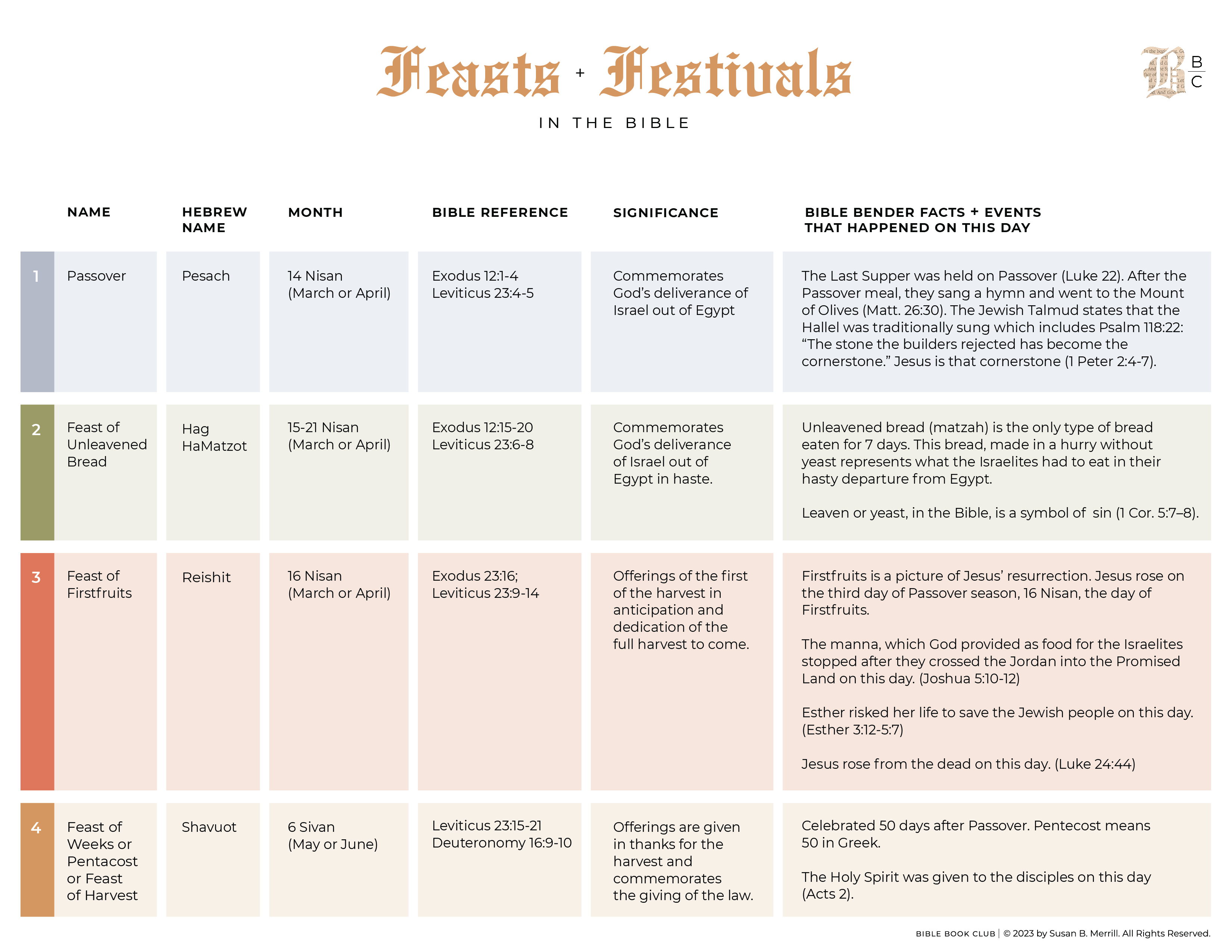
So far in chapter 3, the returned exiles are killing it, except for a small mention of their fear of those living around them. For people a generation removed from living in Jerusalem, they have not forgotten the commandments for any of the religious ceremonies laid out by Moses, even to the point of starting everything on that all-important number seven. For more on that, listen to the whole story in our Bible study on Exodus and on Deuteronomy. You can also check out the chart of Feasts and Festivals and the chart on types of offerings.
Scene 2: The Rebuild of the Temple Begins with the Foundation
Ezra 3:7-13
7 Then they gave money to the masons and carpenters, and gave food and drink and olive oil to the people of Sidon and Tyre, so that they would bring cedar logs by sea from Lebanon to Joppa, as authorized by Cyrus king of Persia.
8 In the second month of the second year after their arrival at the house of God in Jerusalem, Zerubbabel son of Shealtiel, Joshua son of Jozadak and the rest of the people (the priests and the Levites and all who had returned from the captivity to Jerusalem) began the work. They appointed Levites twenty years old and older to supervise the building of the house of the Lord. 9 Joshua and his sons and brothers and Kadmiel and his sons (descendants of Hodaviah) and the sons of Henadad and their sons and brothers—all Levites—joined together in supervising those working on the house of God.
10 When the builders laid the foundation of the temple of the Lord, the priests in their vestments and with trumpets, and the Levites (the sons of Asaph) with cymbals, took their places to praise the Lord, as prescribed by David king of Israel. 11 With praise and thanksgiving they sang to the Lord:
“He is good; his love toward Israel endures forever.”
And all the people gave a great shout of praise to the Lord, because the foundation of the house of the Lord was laid. 12 But many of the older priests and Levites and family heads, who had seen the former temple, wept aloud when they saw the foundation of this temple being laid, while many others shouted for joy. 13 No one could distinguish the sound of the shouts of joy from the sound of weeping, because the people made so much noise. And the sound was heard far away.
What is the difference between Solomon’s Temple, Zerubbabel’s Temple, and Herod’s Temple?
The Temple was built two times. The first Temple was built by Solomon. Zerubbabel’s rebuilding is the Second Temple. The Temple we read about in the New Testament is a renovated and expanded version of this Temple, built by Herod.
This Second Temple is an attempt to build the Temple as Solomon built the first Temple with resources from Sidon and Tyre. The timing of the building is also purposeful.
When did the construction of the Second Temple foundation begin?
Like the first Temple, the building of the Second Temple begins in the second month of the new year following Passover. The Passover is a reminder of God's deliverance from the first captivity in Egypt. Now they are celebrating another deliverance, this time from Babylon. Their sin exiled them to Babylon; God's faithfulness brought them back.
The completion of the foundation is huge, and the people celebrate with praise and thanks, but there are some mixed emotions. It is pure joy for the younger generation. We can assume most of the labor was done by them. The massive blocks for the foundation, most being 5x6 feet and weighing about 5,000 pounds each, are stones they would have labored to place. While Solomon had scores of laborers, the exiles are few and most likely lack the skill of the prior builders. So when they finished, they probably feel really good.
Why does the older generation weep when the Temple foundation is laid?
For the older generation, there is some weeping because they remember the glory of Solomon's Temple. This one, built among the ruins of what was, cannot compare. For them, it is a bittersweet moment.
What happened to the Second Temple in 70 AD?
In 70 AD, the Second Temple was completely destroyed by the Romans. Jesus prophesied in Matthew 24 that "not one stone will be left," and that is exactly what happened. Today the Temple Mount, where it once stood, is covered by the Dome of the Rock, which was built in 692 AD.
We covered a lot about this important site in the first three chapters of our Bible study on 2 Chronicles. That Bible study had a lot of great show notes. Here are just a couple of the videos:
- Video tour of the Temple Mount and the Dome of the Rock exterior on Mount Moriah
- Video of the inside of the Dome of the Rock.
The complete destruction in 70 AD means there has not been a Jewish Temple for worship for nearly 2,000 years. What does that mean for Christians? Once again, it is the Apostle Paul who explains.
1 Corinthians 3:10-17 10 By the grace God has given me, I laid a foundation as a wise builder, and someone else is building on it. But each one should build with care. 11 For no one can lay any foundation other than the one already laid, which is Jesus Christ. 12 If anyone builds on this foundation using gold, silver, costly stones, wood, hay or straw, 13 their work will be shown for what it is, because the Day will bring it to light. It will be revealed with fire, and the fire will test the quality of each person’s work. 14 If what has been built survives, the builder will receive a reward. 15 If it is burned up, the builder will suffer loss but yet will be saved—even though only as one escaping through the flames.
16 Don’t you know that you yourselves are God’s temple and that God’s Spirit dwells in your midst? 17 If anyone destroys God’s temple, God will destroy that person; for God’s temple is sacred, and you together are that temple.
How does the Apostle Paul redefine the concept of the Temple in 1 Corinthians?
For Christians, the need for a physical Temple is replaced by Christ. Christ is the foundation. The church is the Temple. We are the church; therefore, we are collectively and individually God's temple. The Word of God is how we build that temple, the church, and our faith.
What is the condition of your temple?
- Does it need a total rebuild? Perhaps it needs some foundation work.
- Is it feeling small? Perhaps you need to invest in expanding it.
- Or is your temple radiating with the golden glow that glorifies the Lord?
Scene 3: The Neighbors Oppose the Temple Rebuild
Ezra 4:1-5
1 When the enemies of Judah and Benjamin heard that the exiles were building a temple for the Lord, the God of Israel, 2 they came to Zerubbabel and to the heads of the families and said, “Let us help you build because, like you, we seek your God and have been sacrificing to him since the time of Esarhaddon king of Assyria, who brought us here.”
3 But Zerubbabel, Joshua and the rest of the heads of the families of Israel answered, “You have no part with us in building a temple to our God. We alone will build it for the Lord, the God of Israel, as King Cyrus, the king of Persia, commanded us.”
4 Then the peoples around them set out to discourage the people of Judah and make them afraid to go on building. 5 They bribed officials to work against them and frustrate their plans during the entire reign of Cyrus, king of Persia, and down to the reign of Darius, king of Persia.
There will always be opposition.
In Ezra 4 and Ezra 5-6, there are three rounds of opposition, and just to confuse us, they are not in chronological order. All of these attacks will be from outsiders. In Ezra 7-8 and Ezra 9-10, the opposition will be from internal struggles.
There was, is, and always will be opposition in this world. But not in the next! Opposition will die in the end, so hold out for that.
Lessons in Opposition
The books of Ezra, Nehemiah, and Esther are lessons in opposition. In many of the books prior to this, opposition took the form of dramatic military battles where God parted seas, dropped walls, and blinded the enemy. In contrast, the opposition in these books is sneakier. Stuff like political backstabbing, bureaucratic roadblocks, and lots of social and economic pressure tactics.
Israel is no longer an independent nation that can rely on military might. They are a vulnerable minority group and have to lean hard on their faith and divine help to survive and rebuild. Therefore, they have to learn to be politically smart, stay faithful, and trust that God will deliver behind the scenes. This is round one of opposition.
Who are the "enemies of Judah and Benjamin" mentioned in Ezra 4?
The “enemies of Judah and Benjamin” are a reference to the “Israelite versus Samaritan” rivalry. Years before, when many of the Israelites in the Northern Kingdom were exiled, foreigners moved in and occupied towns in Samaria, which was only about 35 miles north of Jerusalem. Some of the Israelites who escaped the exile intermarried with these foreigners, creating a kind of hybrid culture and religion that opposed God.
The Israelite versus Samaritan rivalry continued into the New Testament. Hence the stories of the Good Samaritan in Luke 10 and the Woman at the Well in John 4.
The Neighboring Enemies Oppose the Idea of Rebuilding the Temple.
Recall that the Israelites of the Northern Kingdom stopped worshipping at the Temple when the kingdoms split. Add to that the fact that they have mixed it up with other religions, and it is not surprising they are against the Temple project and all things related to God.
Why do Zerubbabel and Joshua refuse the Samaritans' offer to help rebuild?
Zerubbabel and Joshua give the Samaritans the stiff arm because enemies never really help. They may offer, but they are hiding a covert motive. And more often than not, they lie.
Our first lesson in lying enemies was in Genesis 3. The serpent, more crafty than the other animals, appeared to want to help Eve. He led her down a path of lies, and Eve fell for it to the detriment of all.
In Ezra 4, the neighbors insist they have been:
Ezra 4:2 2 “sacrificing to him since the time of Esarhaddon king of Assyria, who brought us here.”
But Zerubbabel and Joshua recognize their evil intent and refuse. The surrounding enemies of Judah are put out, and they are not going to give up.
What tactics do the Samaritans use to stop the Temple's reconstruction?
The Samaritans try to intimidate the exiles to keep them from building, and they bribe officials to work against them. This opposition goes on for years, from the time of King Cyrus to the reign of Darius.
Lessons on Enemies
How do Zerubbabel and Joshua recognize their evil intent? How can we know when something is not of the Lord but against Him?
- First and foremost, enemies don't self-identify. Therefore, you must study their profile and actions. The Samaritans are not believers. They lie. The serpent twisted Eve's words. He lied.
- Once identified, know that enemies who offer to help have an ulterior motive. Therefore, reject them definitively. Then brace yourself because…
- If rejected, enemies may invite you to compromise. Therefore, you must clearly know your objective and stick to it. The serpent was really good at leading Eve off her objective and used questions like, "Did God really say, 'You must not eat from any tree in the garden?’" The Israelites were sent into captivity because they were led astray by the promises of false gods and compromised their faith.
- When all else fails, enemies resort to psychological warfare and may accuse you of past sins, hoping self-doubt will stop you. Therefore, you must remember you are forgiven and a new creature in Christ.
For the returned exiles, the opposition is devastating. Discouragement sets in, and with it, delays. From the reign of Cyrus to Darius, the people falter. The principle for us to remember here is that nothing that is attempted for God will go unchallenged by the enemy. Therefore, we must be aware of anything or anyone who might hinder our faith.
Questions to Ponder
What form of enemy are you most susceptible to? Is there anyone who is in opposition to the growth of your temple or faith? What are you attempting that the enemy is attempting to thwart? How good are you at handling opposition in a Christ-like way? What can you do to be better at it?
We are living in an increasingly “anxious” world. Christ brought peace and perspective in His approach to opposition. In what conversations do you believe we as Christians can do the same, thereby building the body and the human temple today?
Scene 4: Political Opposition from the Neighbors
In this scene, it is many years later, during the time of King Xerxes and Artaxerxes. These attacks by the same pesky surrounding neighbors would have occurred during the time of Esther and Nehemiah. Xerxes is the King Esther married. Artaxerxes is the king in Nehemiah’s story.
Ezra 4:6-24
6 At the beginning of the reign of Xerxes, they lodged an accusation against the people of Judah and Jerusalem.
7 And in the days of Artaxerxes king of Persia, Bishlam, Mithredath, Tabeel and the rest of his associates wrote a letter to Artaxerxes. The letter was written in Aramaic script and in the Aramaic language.
8 Rehum the commanding officer and Shimshai the secretary wrote a letter against Jerusalem to Artaxerxes the king as follows:
9 Rehum the commanding officer and Shimshai the secretary, together with the rest of their associates—the judges, officials and administrators over the people from Persia, Uruk and Babylon, the Elamites of Susa, 10 and the other people whom the great and honorable Ashurbanipal deported and settled in the city of Samaria and elsewhere in Trans-Euphrates.
11 (This is a copy of the letter they sent him.)
12 The king should know that the people who came up to us from you have gone to Jerusalem and are rebuilding that rebellious and wicked city. They are restoring the walls and repairing the foundations.
13 Furthermore, the king should know that if this city is built and its walls are restored, no more taxes, tribute or duty will be paid, and eventually the royal revenues will suffer. 14 Now since we are under obligation to the palace and it is not proper for us to see the king dishonored, we are sending this message to inform the king, 15 so that a search may be made in the archives of your predecessors. In these records you will find that this city is a rebellious city, troublesome to kings and provinces, a place with a long history of sedition. That is why this city was destroyed. 16 We inform the king that if this city is built and its walls are restored, you will be left with nothing in Trans-Euphrates.
To Rehum the commanding officer, Shimshai the secretary and the rest of their associates living in Samaria and elsewhere in Trans-Euphrates:
18 The letter you sent us has been read and translated in my presence. 19 I issued an order and a search was made, and it was found that this city has a long history of revolt against kings and has been a place of rebellion and sedition. 20 Jerusalem has had powerful kings ruling over the whole of Trans-Euphrates, and taxes, tribute and duty were paid to them. 21 Now issue an order to these men to stop work, so that this city will not be rebuilt until I so order. 22 Be careful not to neglect this matter. Why let this threat grow, to the detriment of the royal interests?
23 As soon as the copy of the letter of King Artaxerxes was read to Rehum and Shimshai the secretary and their associates, they went immediately to the Jews in Jerusalem and compelled them by force to stop.
24 Thus the work on the house of God in Jerusalem came to a standstill until the second year of the reign of Darius king of Persia.
What is the content of the letter sent to King Artaxerxes?
Rehum and the rest of the surrounding peoples write a letter that accuses the returned Jews of rebuilding the former "wicked" city of Jerusalem. Their main proof is that the Judeans are rebuilding the walls. Walls are built to defend a city. Defense implies rebellion against taxation.
Rehum is very cunning, and after laying out the problem, he adds fuel to the fire by pointing out that Judah has done this before. The king can search for himself. It's all in the records. Well, of course, Judah has had many powerful kings. David, Solomon, and others had once been the powerhouses of the land.
For how many years does the Temple construction stop due to political opposition?
The work on the Temple stops for 16 years as a result of this political opposition. Until Nehemiah hears about the disrepair and sets the exact same king straight with the providential help of God. In verse 24, Ezra leaves his reminiscing about this opposition and brings us back to his original time period before Xerxes and Artaxerxes.
In other words, back to the first round of opposition we left behind in verse 5. The one where the neighbors put up a fight.
Fighting Opposition Today
There are lots of life lessons here for the opposition we face today. We must remember that a delay in the world is not a denial from God.
- Fight hard against discouragement.
- Pursue patience.
- Be still and give God time to reveal what He is doing behind the scenes.
- Watch out for distractions. The opposition loves to lead us astray.
- Pray for clarity and the eyes to see when you are getting sidetracked.
The Israelites suffered a delay. But in our Ezra 5-6 Bible study, they will persevere and faithfully complete the Temple despite even more opposition.
Group Discussion Questions for Ezra 3-4
- For Christians, Jesus replaced our need for a physical Temple. Now we are collectively and individually all God's Temple, and the Word of God builds that temple. What is the current state of your temple? Does it need any rebuilding, foundation work, or expansion? How could you work on your temple this week?
- To throw us off course, the enemy will subtly invite us to compromise our morals, goals, and our faith in who God is. Just as the serpent deceived Eve with questions like, "Did God really say you can’t eat from any tree” how has the enemy subtly invited you to compromise a belief, project, or area of your life?
- The Enemy may resort to psychological warfare, tormenting you with the memory of past sins. Have you ever felt paralyzed by past sins you’ve already confessed? How does remembering you are a "new creation in Christ" change your perspective?
Show Notes
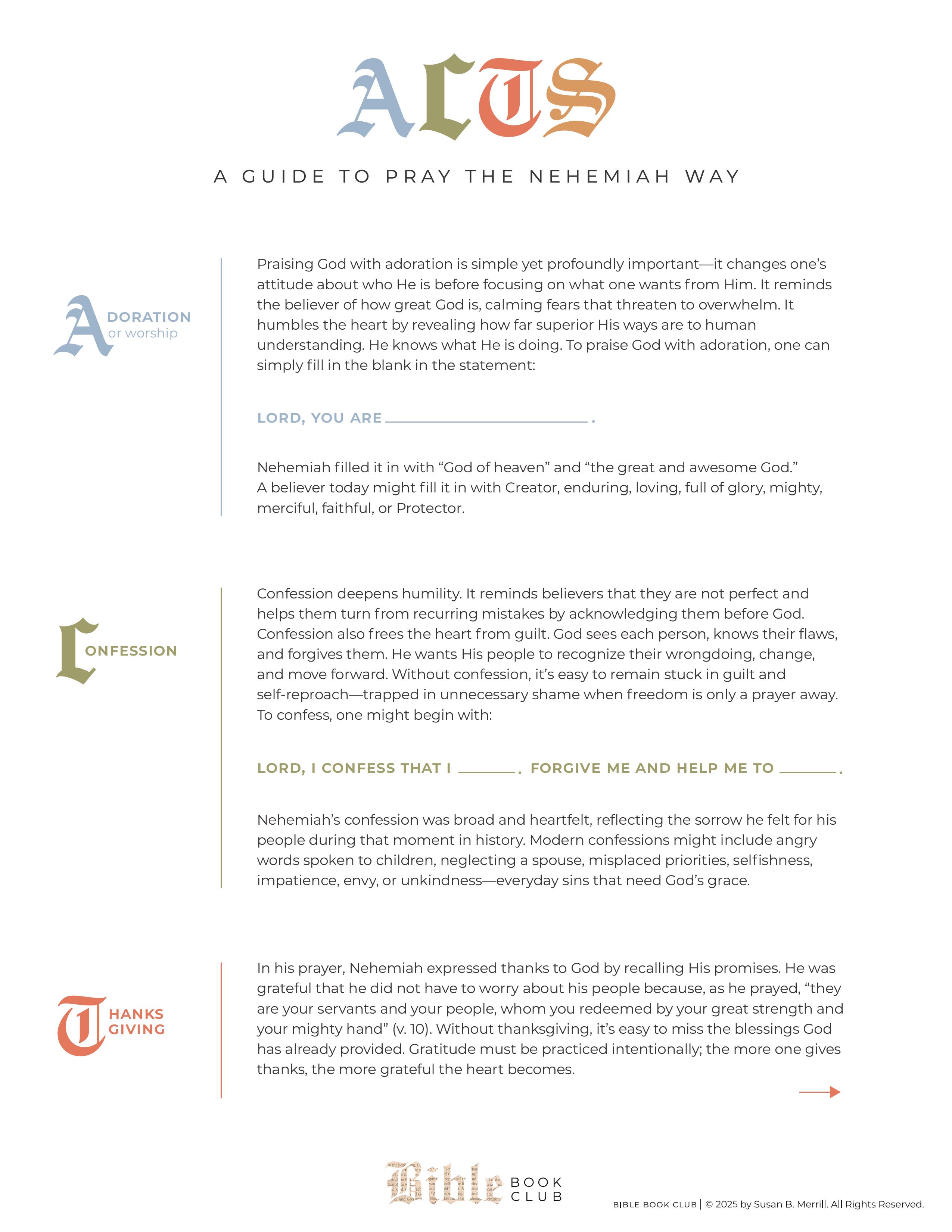
- ACTS Prayer Guide
- The Old Testament Books
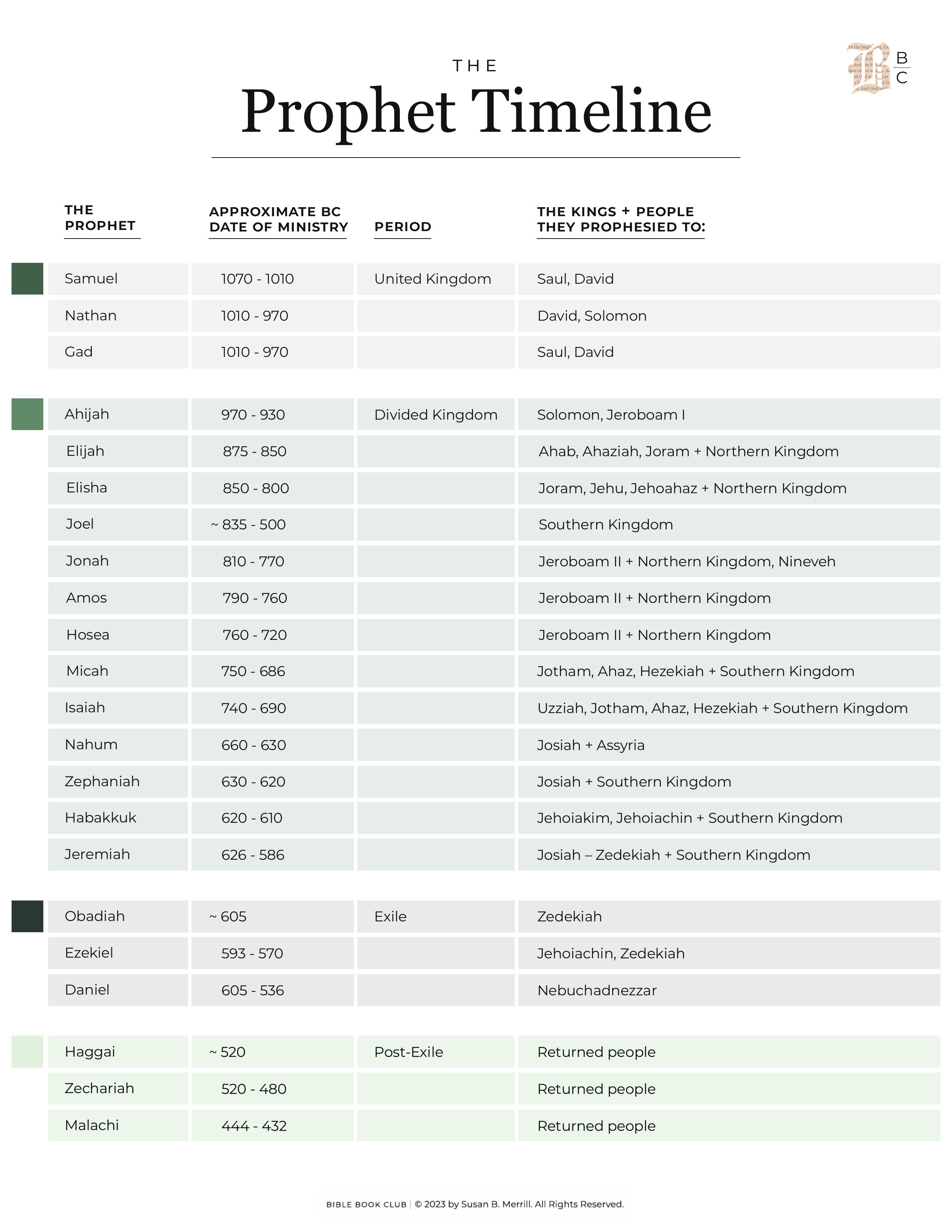
- Prophet Timeline
- Bible Prophets Timeline
- Feasts and Festivals
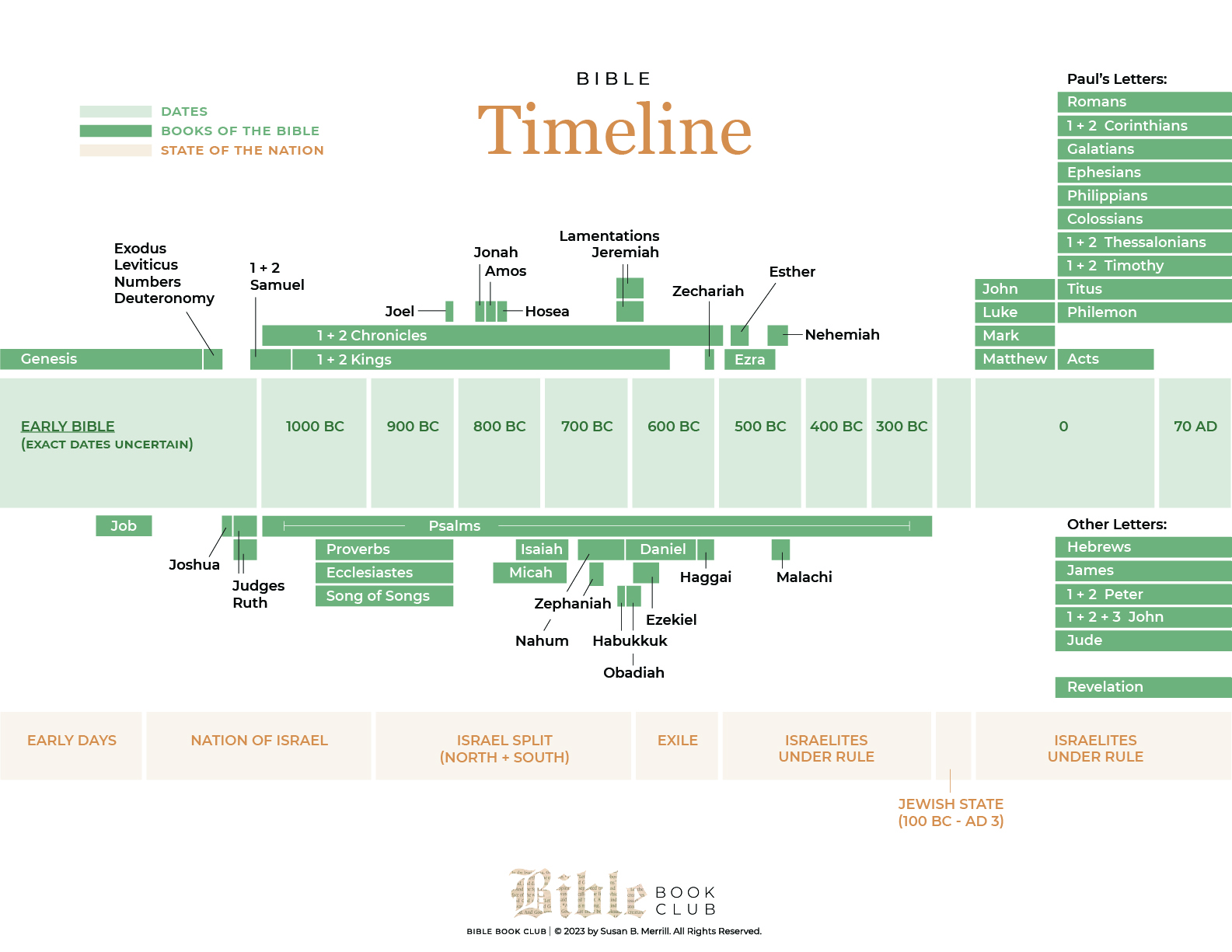
- Bible Timeline
- Types of offerings: Leviticus Offerings Chart
- Video tour of the Temple Mount and the Dome of the Rock exterior on Mount Moriah
- Feasts and Festivals in the Bible
- Video of the inside of the Dome of the Rock