Ezra 9-10 Introduction
Recall that Zerubbabel led the first return with over 42,000 exiles about 80 years before Ezra’s return. They have been doing life in Jerusalem and the surrounding towns for a long time. Our scene opens a few months after Ezra and his new leadership have settled in Jerusalem. Everything is under control and appears to be going as planned until…
Scene 1: Ezra Makes a Devastating Discovery
Ezra 9:1-4
1 After these things had been done, the leaders came to me and said, “The people of Israel, including the priests and the Levites, have not kept themselves separate from the neighboring peoples with their detestable practices, like those of the Canaanites, Hittites, Perizzites, Jebusites, Ammonites, Moabites, Egyptians and Amorites. 2 They have taken some of their daughters as wives for themselves and their sons, and have mingled the holy race with the peoples around them. And the leaders and officials have led the way in this unfaithfulness.”
3 When I heard this, I tore my tunic and cloak, pulled hair from my head and beard and sat down appalled. 4 Then everyone who trembled at the words of the God of Israel gathered around me because of this unfaithfulness of the exiles. And I sat there appalled until the evening sacrifice.
Why is Ezra devastated by the news of the Israelite intermarriages?
If the Israelites engage in the idolatry of foreign gods, as they have so many times before, they will end up right back where they started, in exile . Sometimes obedience to God doesn't always feel like a victory. Sometimes it is painful.
Ezra arrived in Jerusalem with a plan, and he was faithfully and obediently executing the plan for God. This discovery is a reveal he did not plan on, and it puts his entire mission at risk. He is thrown into agony and wonders why he was sent to lead the Israelites when their fate seems inevitable. His reaction is visceral. He tears his clothes and pulls out his hair.
Which specific nations are the Israelites forbidden from marrying in Ezra 9?
The Canaanites, Hittites, Perizzites, Jebusites, Ammonites, Moabites, and Amorites are the very people who have led Israel into idolatry for over 500 years. Moses commanded the Israelites about these nations before the Israelites even set foot in the Promised Land, first in our Exodus 34 Bible study and again in our Deuteronomy 7 Bible study.
Deuteronomy 7:1-4 1 When the Lord your God brings you into the land you are entering to possess and drives out before you many nations—the Hittites, Girgashites, Amorites, Canaanites, Perizzites, Hivites and Jebusites, seven nations larger and stronger than you— 2 and when the Lord your God has delivered them over to you and you have defeated them, then you must destroy them totally. Make no treaty with them, and show them no mercy. 3 Do not intermarry with them. Do not give your daughters to their sons or take their daughters for your sons, 4 for they will turn your children away from following me to serve other gods, and the Lord’s anger will burn against you and will quickly destroy you
Had the Israelites obeyed when they entered the Promised Land, these people would not exist to lead them astray in our current story. But the Israelites failed to obey.
The nation of Israel was given the Promised Land because of a promise to Abraham:
Genesis 15:12-16 12 As the sun was setting, Abram fell into a deep sleep, and a thick and dreadful darkness came over him. 13 Then the Lord said to him, “Know for certain that for four hundred years your descendants will be strangers in a country not their own and that they will be enslaved and mistreated there. 14 But I will punish the nation they serve as slaves, and afterward they will come out with great possessions. 15 You, however, will go to your ancestors in peace and be buried at a good old age. 16 In the fourth generation your descendants will come back here, for the sin of the Amorites has not yet reached its full measure.”
The land was given to the Israelites because the sin of the Amorites and related Canaanite people had reached a point of no return.
What is the theological reason for the original command to destroy the Canaanites?
God gave the Canaanites hundreds of years to repent, but their sin only escalated in evil to the point that they were sacrificing children while at the same time engaging in Temple prostitution for fertility. It was for this reason that God commanded the Israelites to wipe out the Canaanites. The current problem is that the people have broken God's laws again.
Foreign Wives and Intermarriage
The sin of intermarriage with these idolatrous people puts them at risk for idolatry, especially because the priests and Levites are a part of it. If you have been with us for our Bible studies of Leviticus, Numbers, and Deuteronomy, you are aware of the holiness required of the priesthood. Failure is looming. Ezra's return is too late. The people have returned to the ways of their forefathers.
On top of that, Ezra has an order from the King of Persia. In King Artaxerxes' decree, the King of Persia has clearly stated that Ezra is responsible.
Ezra 7:25-26 25 And you, Ezra, in accordance with the wisdom of you're God, which you possess, appoint magistrates and judges to administer justice to all the people of Trans-Euphrates—all who know the laws of you're God. And you are to teach any who do not know them. 26 Whoever does not obey the law of your God and the law of the king must surely be punished by death, banishment, confiscation of property, or imprisonment.
What authority did King Artaxerxes give Ezra to enforce God's Law?
It is Ezra's job to administer justice to lawbreakers by death, banishment, confiscation of that precious Promised Land, or imprisonment. Ezra is devastated. The people he came to save, he must now punish. In his grief, he can not even move.
Scene 2: Ezra Intercedes and Prays for Mercy
Ezra 9:5-15
5 Then, at the evening sacrifice, I rose from my self-abasement, with my tunic and cloak torn, and fell on my knees with my hands spread out to the Lord my God 6 and prayed: “I am too ashamed and disgraced, my God, to lift up my face to you, because our sins are higher than our heads and our guilt has reached to the heavens. 7 From the days of our ancestors until now, our guilt has been great. Because of our sins, we and our kings and our priests have been subjected to the sword and captivity, to pillage and humiliation at the hand of foreign kings, as it is today.
8 “But now, for a brief moment, the Lord our God has been gracious in leaving us a remnant and giving us a firm place in his sanctuary, and so our God gives light to our eyes and a little relief in our bondage. 9 Though we are slaves, our God has not forsaken us in our bondage. He has shown us kindness in the sight of the kings of Persia: He has granted us new life to rebuild the house of our God and repair its ruins, and he has given us a wall of protection in Judah and Jerusalem.
10 “But now, our God, what can we say after this? For we have forsaken the commands 11 you gave through your servants the prophets when you said: ‘The land you are entering to possess is a land polluted by the corruption of its peoples. By their detestable practices they have filled it with their impurity from one end to the other. 12 Therefore, do not give your daughters in marriage to their sons or take their daughters for your sons. Do not seek a treaty of friendship with them at any time, that you may be strong and eat the good things of the land and leave it to your children as an everlasting inheritance.’
13 “What has happened to us is a result of our evil deeds and our great guilt, and yet, our God, you have punished us less than our sins deserved and have given us a remnant like this. 14 Shall we then break your commands again and intermarry with the peoples who commit such detestable practices? Would you not be angry enough with us to destroy us, leaving us no remnant or survivor? 15 Lord, the God of Israel, you are righteous! We are left this day as a remnant. Here we are before you in our guilt, though because of it not one of us can stand in your presence.”
How does Ezra approach God?
Ezra approaches God with humility. His awareness of the human condition of sin is painful. His people's guilt is too embarrassing to comprehend. How could the people do this again in light of all God is now doing for them? God's kindness has afforded them the opportunity to return.
That word, kindness, is hesed in Hebrew. It means favor performed for a person in need in the context of a deep and enduring relationship between the two people. God has offered Israel a relationship. God has offered Israel love and loyalty. But Israel can't ever seem to return that love and loyalty.
Ezra, the one who has devoted himself to the study and observance of the Law of the Lord and to teaching its decrees and laws in Israel, recites the exact law they have broken. Then Ezra begs for mercy in a Moses-like fashion. For no one else in all the stories of the Bible had to do more interceding than Moses. Ezra acknowledges that God spared them when they deserved worse and gave them another chance, but they've sinned again. God is righteous, and they are guilty. They can only throw themselves on His mercy.
One has to wonder why God continues to offer them undeserved loyalty. But it’s because He promised Abraham He would in a vision, which ends with this:
Genesis 15:17-21 17 When the sun had set and darkness had fallen, a smoking firepot with a blazing torch appeared and passed between the pieces. 18 On that day the Lord made a covenant with Abram and said, “To your descendants I give this land, from the Wadi of Egypt to the great river, the Euphrates— 19 the land of the Kenites, Kenizzites, Kadmonites, 20 Hittites, Perizzites, Rephaites, 21 Amorites, Canaanites, Girgashites and Jebusites.”
God keeps His promises, and He promised Abraham a people and a place, a nation and a land. And though He exiled them for their consequences, He is giving it back, giving them another chance. And Ezra is hanging all hope on that promise to Abraham. The promise of a relationship between man and God. But that promise hinges on a covenant given to Moses, and there we are back to the Temple and worship, Ezra's job.
Scene 3: While Ezra Prays the People Plan
Ezra 10:1-6
1 While Ezra was praying and confessing, weeping and throwing himself down before the house of God, a large crowd of Israelites—men, women and children—gathered around him. They too wept bitterly.
2 Then Shekaniah son of Jehiel, one of the descendants of Elam, said to Ezra, “We have been unfaithful to our God by marrying foreign women from the peoples around us. But in spite of this, there is still hope for Israel. 3 Now let us make a covenant before our God to send away all these women and their children, in accordance with the counsel of my lord and of those who fear the commands of our God. Let it be done according to the Law. 4 Rise up; this matter is in your hands. We will support you, so take courage and do it.”
5 So Ezra rose up and put the leading priests and Levites and all Israel under oath to do what had been suggested. And they took the oath. 6 Then Ezra withdrew from before the house of God and went to the room of Jehohanan son of Eliashib. While he was there, he ate no food and drank no water, because he continued to mourn over the unfaithfulness of the exiles.
Here is where our story gets perplexing and challenging.
There is a lot of commentary about the right or wrong of what happens next. We will discuss it within the context of the period and through Ezra's eyes. Ezra's grief drew and convicted a crowd, and they too wept. The people have an awakened awareness of their sin, and a desire to "do something" arises. They take their idea to Ezra.
Ezra rises from his prayer of grief and does his job, the hard part of his job, to adhere to God's Law and the king's decree. He leads the priests, Levites, and people in an oath to send the foreign women and children away. Then Ezra withdraws to fast, pray, and mourn.
- Their repetitive unfaithfulness to God's Law.
- The crisis this sin is creating in families.
- The failure of his mission to teach them.
Then all he can do is pray for those being sent away and await God's response. Although the leaders have taken steps to correct the problem, it is not a guarantee that God will have mercy. Ezra's ultimate goal in banishing the foreigners is to avert God's wrath based on his knowledge of their history and God's word in Deuteronomy 7, which we read earlier. The problem is that God does not give any instructions on how to handle intermarriage after the fact. Just a few years later, Nehemiah will handle a similar situation differently.
Nehemiah 13:23-26 23 Moreover, in those days I saw men of Judah who had married women from Ashdod, Ammon and Moab. 24 Half of their children spoke the language of Ashdod or the language of one of the other peoples, and did not know how to speak the language of Judah. 25 I rebuked them and called curses down on them. I beat some of the men and pulled out their hair. I made them take an oath in God’s name and said: “You are not to give your daughters in marriage to their sons, nor are you to take their daughters in marriage for your sons or for yourselves. 26 Was it not because of marriages like these that Solomon king of Israel sinned? Among the many nations there was no king like him. He was loved by his God, and God made him king over all Israel, but even he was led into sin by foreign women.
Nehemiah is equally distraught but commands that they put an end to it by forbidding their half-Jewish children from marrying foreigners.
How does Nehemiah's handling of intermarriage differ from Ezra's approach?
Ezra's actions are harsher, but he views the return to Jerusalem as a second Exodus. If this is a new exodus, then the eviction of women and children equates to a reconquering of the Promised Land, and that means removing the foreigners from the land in totality. The very thing the Israelites failed to do after the first exodus.
Scene 4: A Painful Proclamation
Ezra 10:7-17
7 A proclamation was then issued throughout Judah and Jerusalem for all the exiles to assemble in Jerusalem. 8 Anyone who failed to appear within three days would forfeit all his property, in accordance with the decision of the officials and elders, and would himself be expelled from the assembly of the exiles.
9 Within the three days, all the men of Judah and Benjamin had gathered in Jerusalem. And on the twentieth day of the ninth month, all the people were sitting in the square before the house of God, greatly distressed by the occasion and because of the rain. 10 Then Ezra the priest stood up and said to them, “You have been unfaithful; you have married foreign women, adding to Israel’s guilt. 11 Now honor the Lord, the God of your ancestors, and do his will. Separate yourselves from the peoples around you and from your foreign wives.”
12 The whole assembly responded with a loud voice: “You are right! We must do as you say. 13 But there are many people here and it is the rainy season; so we cannot stand outside. Besides, this matter cannot be taken care of in a day or two, because we have sinned greatly in this thing. 14 Let our officials act for the whole assembly. Then let everyone in our towns who has married a foreign woman come at a set time, along with the elders and judges of each town, until the fierce anger of our God in this matter is turned away from us.” 15 Only Jonathan son of Asahel and Jahzeiah son of Tikvah, supported by Meshullam and Shabbethai the Levite, opposed this.
16 So the exiles did as was proposed. Ezra the priest selected men who were family heads, one from each family division, and all of them designated by name. On the first day of the tenth month they sat down to investigate the cases, 17 and by the first day of the first month they finished dealing with all the men who had married foreign women.
The Proclamation
The proclamation is severe and repeats the command King Artaxerxes gave Ezra.
Ezra 7:26 26 Whoever does not obey the law of your God and the law of the king must surely be punished by death, banishment, confiscation of property, or imprisonment.
Whoever does not obey the Law of God and the law of the king must be punished. Everyone is to attend. All exiles, those married to foreigners, and those not.
What are the legal consequences for exiles who ignored Ezra's proclamation?
If the exiles don’t attend the assembly, they will forfeit all property and be exiled from the community of exiles. Rather ironic. Being an exile is the threat of the day.
What is the significance of the " rainy season" during the assembly in Jerusalem?
It is raining, a visible manifestation of the tears they are trying to keep inside. The scene is heartbreaking. It's December and probably cold. Everyone is there. Everyone is afraid they could lose someone they love. Ezra tells them they must do two things.
- Separate themselves from all foreigners around them.
- Separate themselves from their foreign wives.
Why? Because they are guilty of unfaithfulness. Their guilt is now added to the mountain of guilt of their forefathers. Postexilic Israel is just as bad as preexilic Israel. Will they never change? The answer is no, if they continue to allow the Canaanites to live in the land.
The forced departure is not unlike the forced removal that God commanded through Joshua. The problem is that the removal is never completed. After Joshua's death, we learn that:
Judges 2:20-23 20 Therefore the Lord was very angry with Israel and said, “Because this nation has violated the covenant I ordained for their ancestors and has not listened to me, 21 I will no longer drive out before them any of the nations Joshua left when he died. 22 I will use them to test Israel and see whether they will keep the way of the Lord and walk in it as their ancestors did.” 23 The Lord had allowed those nations to remain; he did not drive them out at once by giving them into the hands of Joshua.
Judges 3:5-6 5 The Israelites lived among the Canaanites, Hittites, Amorites, Perizzites, Hivites and Jebusites. 6 They took their daughters in marriage and gave their own daughters to their sons, and served their gods.
So God left the Canaanites and others in the land to test Israel to see whether they would be faithful. But over and over again, they aren’t faithful. They fail the test.
What happens next is different.
Just when you think the Israelites will never change, they do something refreshing. They become totally self-aware and convinced that their reform will avert God's wrath. Except for a few, the whole assembly rationally confesses its guilt and readily agrees to the plan. It will take time, but they will work through it.
So, just as Abraham sent Hagar and Ishmael away, the Israelites send their foreign families away over the next three months. Where and with what, we do not know. What we do know is that in ancient Near Eastern culture, divorce typically involved some form of provision. However, we can't assume that it automatically applies here.
Some scholars argue that the careful, organized nature of the process suggests that provisions may have been made, even if not recorded. Others point out that Ezra's silence may itself be significant, either because no provisions are made or because his focus is entirely on the covenantal aspect rather than the social consequences. I am hopeful they are provided for because God provided for Hagar and Ishmael.
Scene 5: The Israelites Record the Cost
Listed are all the men who compromised their faith by marrying outside of their faith.
Ezra 10:18-44
18 Among the descendants of the priests, the following had married foreign women:
From the descendants of Joshua son of Jozadak, and his brothers: Maaseiah, Eliezer, Jarib and Gedaliah. 19 (They all gave their hands in pledge to put away their wives, and for their guilt they each presented a ram from the flock as a guilt offering.) 20 From the descendants of Immer: Hanani and Zebadiah. 21 From the descendants of Harim: Maaseiah, Elijah, Shemaiah, Jehiel and Uzziah. 22 From the descendants of Pashhur: Elioenai, Maaseiah, Ishmael, Nethanel, Jozabad and Elasah.
23 Among the Levites: Jozabad, Shimei, Kelaiah (that is, Kelita), Pethahiah, Judah and Eliezer.
24 From the musicians: Eliashib.
From the gatekeepers: Shallum, Telem and Uri.
25 And among the other Israelites: From the descendants of Parosh: Ramiah, Izziah, Malkijah, Mijamin, Eleazar, Malkijah and Benaiah. 26 From the descendants of Elam: Mattaniah, Zechariah, Jehiel, Abdi, Jeremoth and Elijah. 27 From the descendants of Zattu: Elioenai, Eliashib, Mattaniah, Jeremoth, Zabad and Aziza. 28 From the descendants of Bebai: Jehohanan, Hananiah, Zabbai and Athlai. 29 From the descendants of Bani: Meshullam, Malluk, Adaiah, Jashub, Sheal and Jeremoth. 30 From the descendants of Pahath-Moab: Adna, Kelal, Benaiah, Maaseiah, Mattaniah, Bezalel, Binnui and Manasseh. 31 From the descendants of Harim: Eliezer, Ishijah, Malkijah, Shemaiah, Shimeon, 32 Benjamin, Malluk and Shemariah. 33 From the descendants of Hashum: Mattenai, Mattattah, Zabad, Eliphelet, Jeremai, Manasseh and Shimei. 34 From the descendants of Bani: Maadai, Amram, Uel, 35 Benaiah, Bedeiah, Keluhi, 36 Vaniah, Meremoth, Eliashib, 37 Mattaniah, Mattenai and Jaasu. 38 From the descendants of Binnui: Shimei, 39 Shelemiah, Nathan, Adaiah, 40 Maknadebai, Shashai, Sharai, 41 Azarel, Shelemiah, Shemariah, 42 Shallum, Amariah and Joseph. 43 From the descendants of Nebo: Jeiel, Mattithiah, Zabad, Zebina, Jaddai, Joel and Benaiah.
44 All these had married foreign women, and some of them had children by these wives.
How does the book of Ezra conclude in comparison to its beginning?
The ending of the Book of Ezra brings us full circle because it began with a celebration: the energetic march of miraculously released exiles joyfully returning home. But as the book closes, the scene is eerily reversed: the quiet shuffle of frightened women and children tearfully leaving home. Two processions, both necessary, both heartbreaking in their own way.
- One procession brought people home.
- The other sent them away.
And somehow, in God's complex story of redemption, both are acts of faithfulness. How do we reconcile our hearts to that? By remembering that at this point in the greater story, God's story of redemption isn't finished yet. You see, what Ezra and his community can’t see is that all their efforts, from the rebuilt Temple and sacrifices to the painful separation of family, point toward a need for something greater.
The Wrong Solution
The Israelites are trying to solve a heart problem with external solutions. If they can just get the Law right, keep the bloodlines pure, and maintain proper worship, then they can be the people God called them to be. But God knows what they can’t yet see. That the real problem isn’t mixed marriages or forgotten festivals. The real problem is the human heart itself.
Centuries later, through the prophet Jeremiah, God will promise a New Covenant not written on stone tablets that can be broken, but written on human hearts that can be transformed. "I will give you a new heart," He will say, "and put a new spirit within you."
This Isn’t the End
The painful march out of Jerusalem in Ezra 10 isn’t the end of God's story. It is a chapter that will help His people understand their desperate need for a Savior who can do what the Law never could: change hearts from the inside out. Like the Israelites, we must learn that sometimes the hardest chapters aren't the end. They're preparation for something better to come.
In our next Bible study, we will begin Susan's favorite book in the Bible: Nehemiah.
Group Discussion Questions for Ezra 9-10
- God's hesed shows us His deep, enduring love and favor for a people who keep messing up. When has God offered you another chance in a big or even a small way when you least deserved it?
- Ezra and his community are trying to heal their struggling hearts with an external solution when what they really need is an internal solution. A Savior to heal them from the inside out. Where in your own life are you tempted to fix heartbreak with an external solution rather than first surrendering it to God?
- The Book of Ezra ends on a heavy, perplexing note rather than a neat bow, reminding us that God's story isn’t finished yet. Have you ever stepped out in obedience only to have the end result feel like a failure? How might it change the way you see that "failure" if you remember the story isn't finished yet?
Show Notes
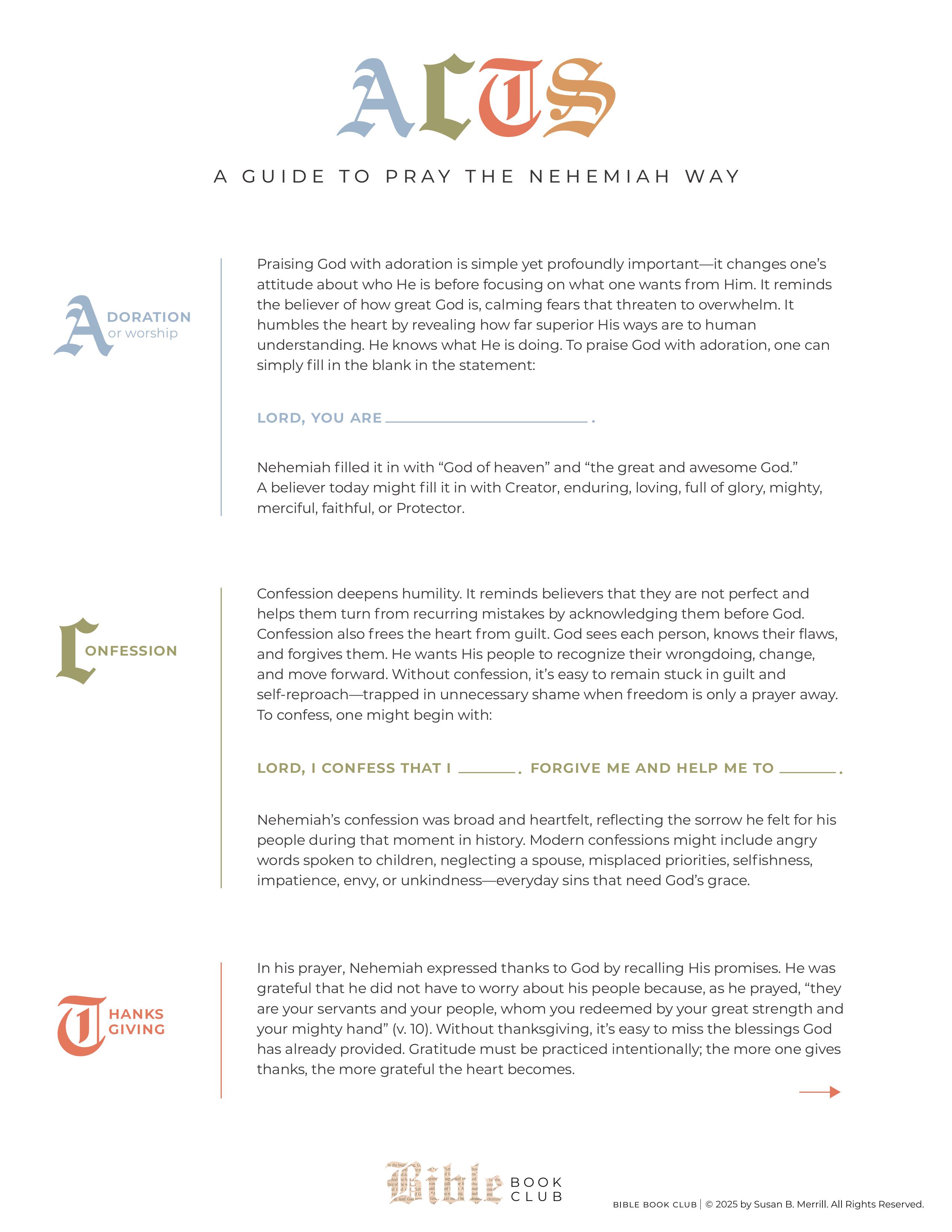
- ACTS Prayer Guide
- The Old Testament Books
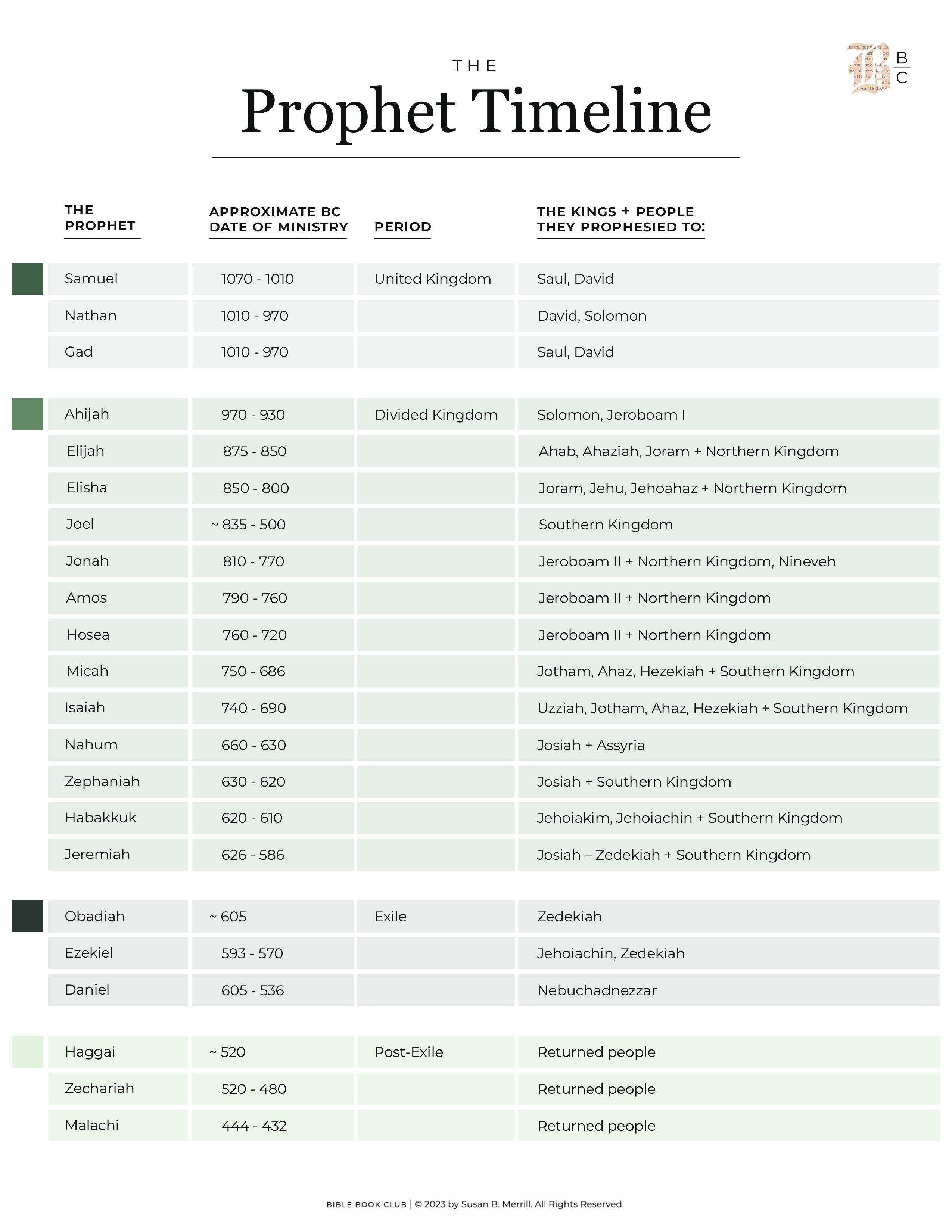
- Prophet Timeline
- Bible Prophets Timeline
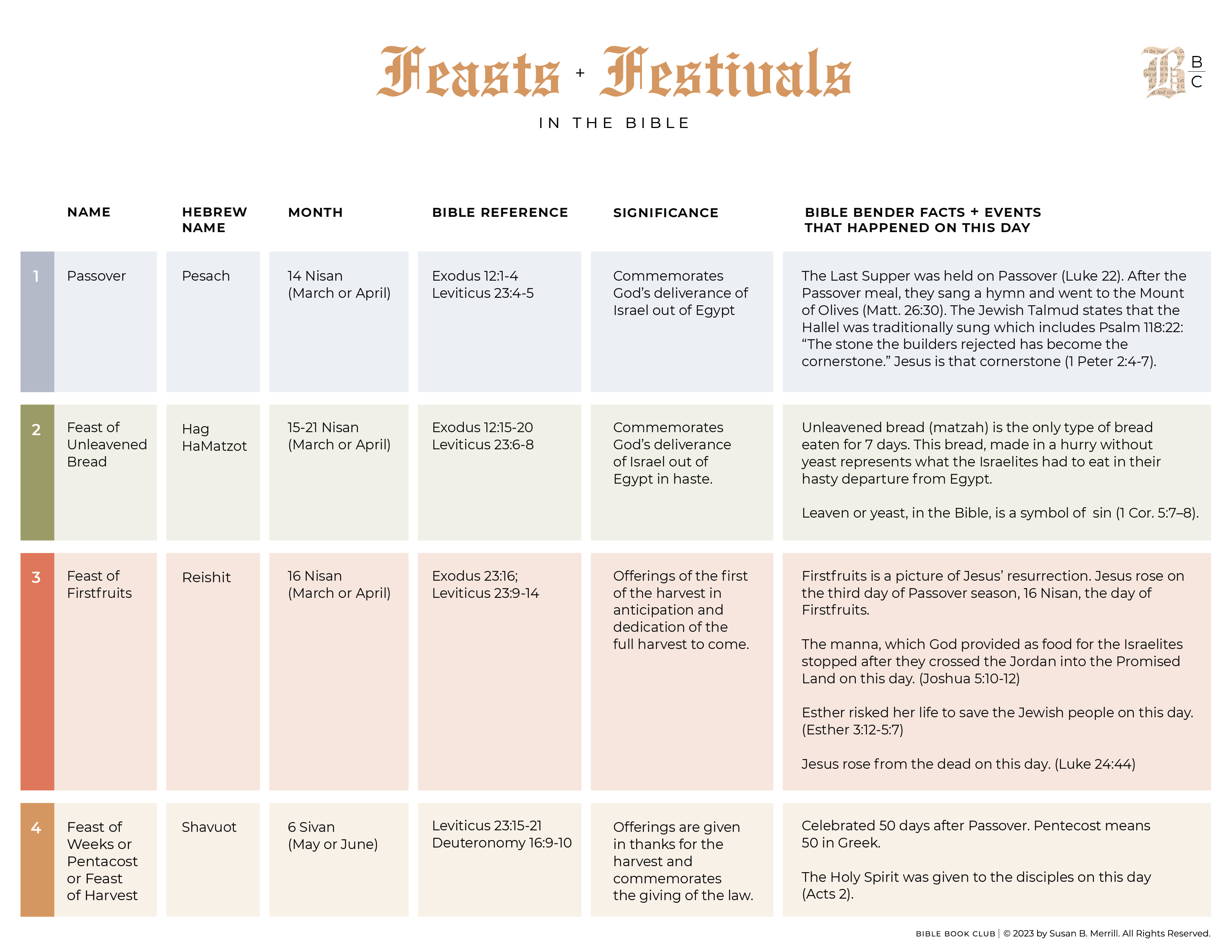
- Feasts and Festivals
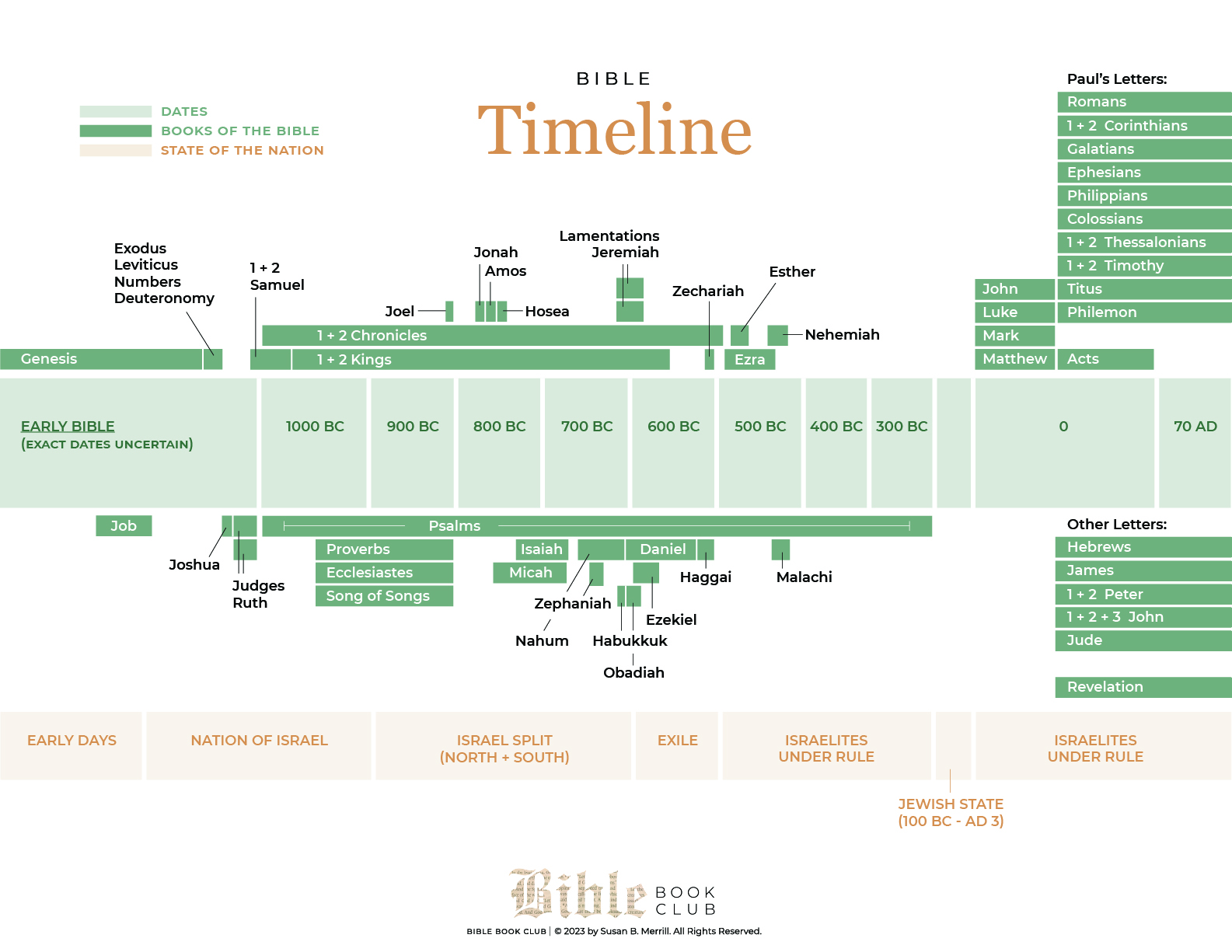
- Bible Timeline
- Types of offerings: Leviticus Offerings Chart
- Video tour of the Temple Mount and the Dome of the Rock exterior on Mount Moriah
- Feasts and Festivals in the Bible
- Video of the inside of the Dome of the Rock