Psalms 137-150 Introduction
This is our last episode of Psalms. So before we dive in, remember where we started. The Book of Psalms is one of five poetry and wisdom books in the Bible and focuses on the emotions of joy, worship, grief, and anger. The purpose of these books is to cause us to ponder:
- Where are we going?
- Why do people suffer?
- How do I navigate relationships?
- What makes life worth living?
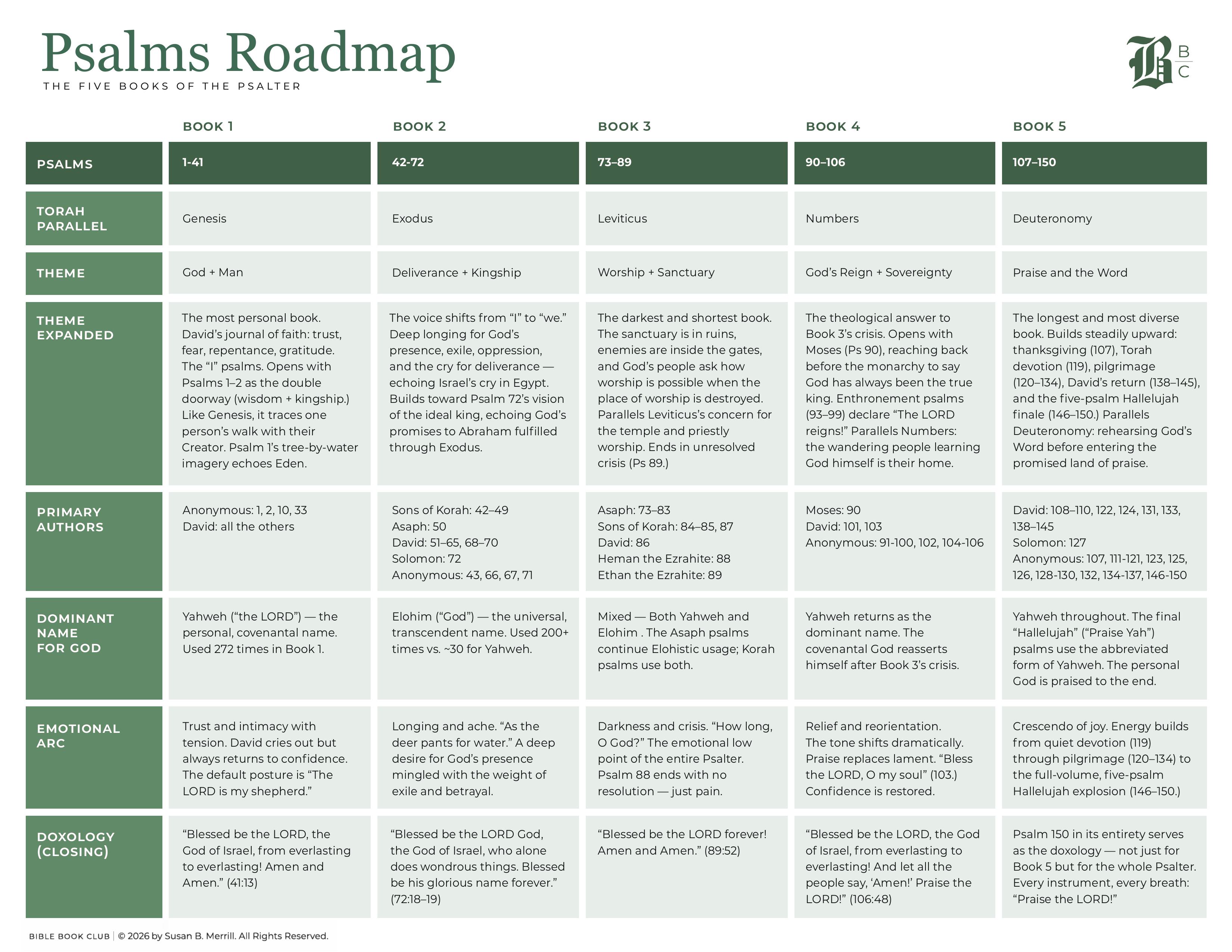
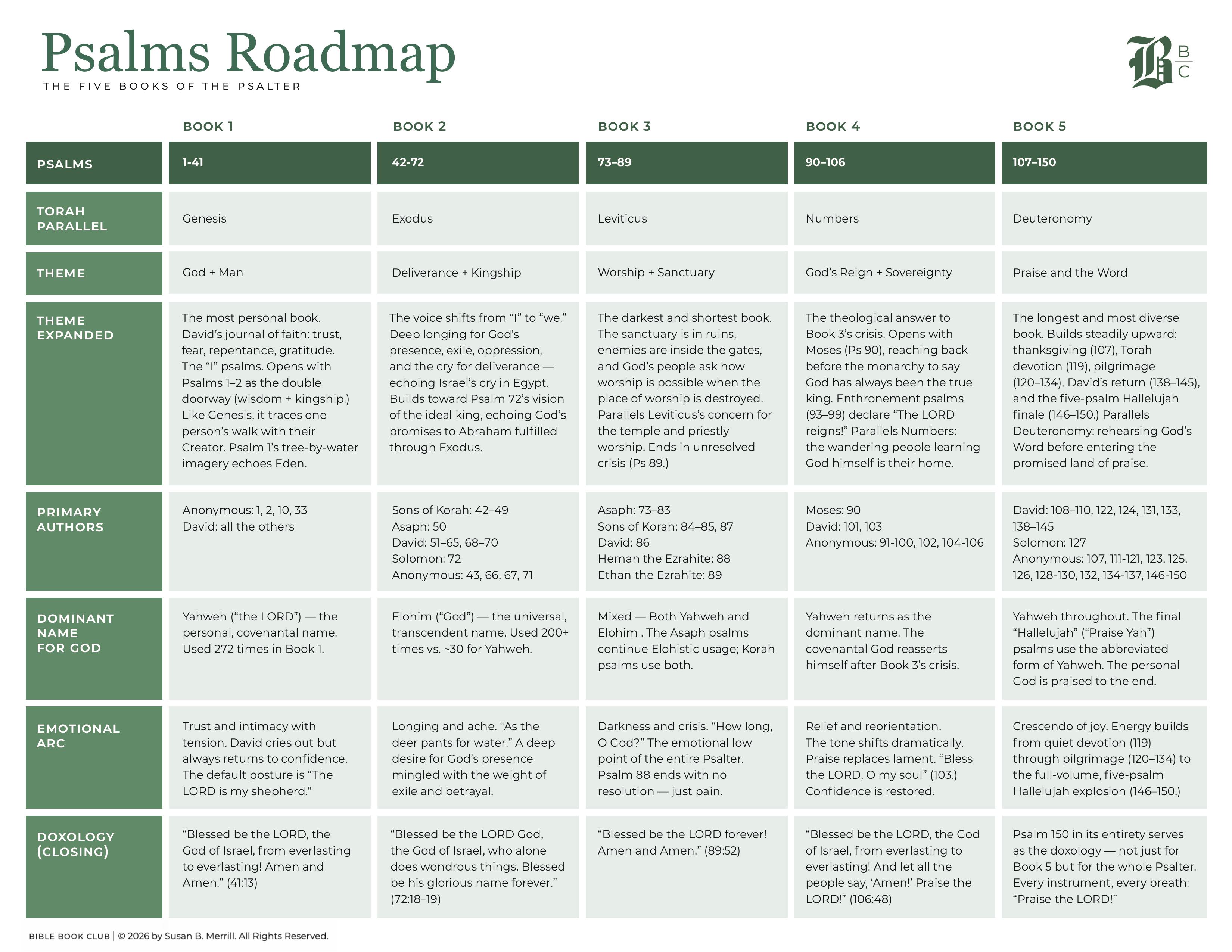
So we started this season with a map: five books of songs built to mirror the five books of the Torah. We called it the playlist of your heart because there's a song or psalm for every emotion known to the human heart. Now we've climbed the whole staircase of psalms:
- Book One: God and man.
- Book Two: deliverance and kingship.
- Book Three: the ruin of the sanctuary and loss of worship.
- Book Four: the Lord is sovereign and reigns forever.
- Book Five: glorious praise and the Word.
Within each book, there is a pattern: every single book ends in praise. And now we’re on the last step of the last book, Psalms 137-150. These final chapters are about to do what each book has done. One last climb out of the dark to end in praise. One more time but louder than ever.
We begin with the book's final lament, a reminder of the end of the southern kingdom of Judah. Recall that Babylon took the land of Judah and the Temple. They ended the Davidic king but not the line of David. The line continued without a king until Christ. So here we go. Our only lament in this episode is Psalm 137.
Psalm 137: By the Rivers of Babylon We Sat and Wept
Psalm 137
1 By the rivers of Babylon we sat and wept when we remembered Zion. 2 There on the poplars we hung our harps, 3 for there our captors asked us for songs, our tormentors demanded songs of joy; they said, “Sing us one of the songs of Zion!” 4 How can we sing the songs of the Lord while in a foreign land? 5 If I forget you, Jerusalem, may my right hand forget its skill. 6 May my tongue cling to the roof of my mouth if I do not remember you, if I do not consider Jerusalem my highest joy. 7 Remember, Lord, what the Edomites did on the day Jerusalem fell. “Tear it down,” they cried, “tear it down to its foundations!” 8 Daughter Babylon, doomed to destruction, happy is the one who repays you according to what you have done to us. 9 Happy is the one who seizes your infants and dashes them against the rocks.
What is the final lament in Psalm 137 about?
Psalm 137 is a deep physical, emotional, and spiritual pain originating from an inconceivable loss. Psalm 137 finds God's people sitting by the rivers of a foreign country. The Babylonians have taken them captive. They are far from home. The Temple, the place of God's presence and their place to meet with God, is gone. It has been destroyed.
They are empty. The playlist of their heart has been deleted, silenced. Their captors are taunting them, asking for a song.
Psalm 137:4 4 How can we sing the songs of the Lord while in a foreign land?
In 136 psalms, there are songs for everything. Now, empty silence. They can't sing. This is where the finale begins. Not with praise but with the ache that makes the coming praise all the more precious because of the contrast. Their song will ascend from a lament dark with pain to praise bright with joy.
- The captives weeping and refusing to sing songs of joy for the mocking Babylonians in verses one through four.
- The promise to never forget Jerusalem in verses five through six.
- The oath against Edom and Babylon in verses seven through nine.
The lament ends on what many commentaries quote as the Bible's most vengefully violent verse. It is a chilling statement that one day Babylon will finally be no more. More details on that to come in Revelation 18, a long way away.
From here, the Book of Psalms turns to climb its final crescendo, which fittingly begins with David's final psalms in the book.
Psalms 138-139: For You Created My Inmost Being
Psalm 138
1 I will praise you, Lord, with all my heart; before the “gods” I will sing your praise. 2 I will bow down toward your holy temple and will praise your name for your unfailing love and your faithfulness, for you have so exalted your solemn decree that it surpasses your fame. 3 When I called, you answered me; you greatly emboldened me. 4 May all the kings of the earth praise you, Lord, when they hear what you have decreed. 5 May they sing of the ways of the Lord, for the glory of the Lord is great. 6 Though the Lord is exalted, he looks kindly on the lowly; though lofty, he sees them from afar. 7 Though I walk in the midst of trouble, you preserve my life. You stretch out your hand against the anger of my foes; with your right hand you save me. 8 The Lord will vindicate me; your love, Lord, endures forever—do not abandon the works of your hands.
Psalm 139
For the director of music. Of David. A psalm.
1 You have searched me, Lord, and you know me. 2 You know when I sit and when I rise; you perceive my thoughts from afar. 3 You discern my going out and my lying down; you are familiar with all my ways. 4 Before a word is on my tongue you, Lord, know it completely. 5 You hem me in behind and before, and you lay your hand upon me. 6 Such knowledge is too wonderful for me, too lofty for me to attain. 7 Where can I go from your Spirit? Where can I flee from your presence? 8 If I go up to the heavens, you are there; if I make my bed in the depths, you are there. 9 If I rise on the wings of the dawn, if I settle on the far side of the sea, 10 even there your hand will guide me, your right hand will hold me fast. 11 If I say, “Surely the darkness will hide me and the light become night around me,” 12 even the darkness will not be dark to you; the night will shine like the day, for darkness is as light to you. 13 For you created my inmost being; you knit me together in my mother’s womb. 14 I praise you because I am fearfully and wonderfully made; your works are wonderful, I know that full well. 15 My frame was not hidden from you when I was made in the secret place, when I was woven together in the depths of the earth. 16 Your eyes saw my unformed body; all the days ordained for me were written in your book before one of them came to be. 17 How precious to me are your thoughts, God! How vast is the sum of them! 18 Were I to count them, they would outnumber the grains of sand—when I awake, I am still with you. 19 If only you, God, would slay the wicked! Away from me, you who are bloodthirsty! 20 They speak of you with evil intent; your adversaries misuse your name. 21 Do I not hate those who hate you, Lord, and abhor those who are in rebellion against you? 22 I have nothing but hatred for them; I count them my enemies. 23 Search me, God, and know my heart; test me and know my anxious thoughts. 24 See if there is any offensive way in me, and lead me in the way everlasting.
What are Psalms 138 and 139 about?
God knows us completely and made us wonderfully. I want to focus on Psalm 139 because we were created to crave what it promises, and we must comprehend what God is telling us for that craving to be comforted.
What does it mean that we are fearfully and wonderfully made in Psalm 139?
You were tenderly, intentionally created. You are not a random byproduct of nature. You are fully exposed to God, entirely safe. There is no need to perform for God. You are seen, pursued, and loved. You are known. The psalm begins and ends with David asking God to search Him or know Him.
In the middle, David states all the ways and reasons God knows him so well. One of the reasons is that He created us. Verses 13 through 18 are the most beautiful passages about conception and birth, and God's hand in it is wonderful. David knew that full well. Do we know that? It's something to ponder. The creation of life is precious to God, and that means you are precious to God.
The Apostle Paul confirms that God knows us in 1 Corinthians:
1 Corinthians 8:3 3 But whoever loves God is known by God.
We as believers are known by God. Of course God knows all things, but this verse implies more than just knowledge. We have been chosen by Christ to be revealed to God. Known implies relationship, and being known by God in relationship as a treasured son or daughter is something to wonder at with awe.
Romans 8:17 17 Now if we are children, then we are heirs—heirs of God and co-heirs with Christ, if indeed we share in his sufferings in order that we may also share in his glory.
To be known is to be rich in life, because our life is eternal, and it is a life that is beyond anything we can delight in here on earth. To be in relationship with God is a wonder that David appreciated as a man after God's heart, but I think we sometimes miss.
How should we respond to being known by God?
David ends this psalm as he so often does, by asking God to help him be better, to lead him in the way everlasting. When was the last time you ever prayed that? David's passion is one we desperately need today.
If we dwelt every day on how we are chosen, known, and will spend eternity in a state of joy with our Creator, what would our day look like? Less lonely, less anxious, less angry, and possibly, hopefully, more purposeful, more peaceful, more joyful.
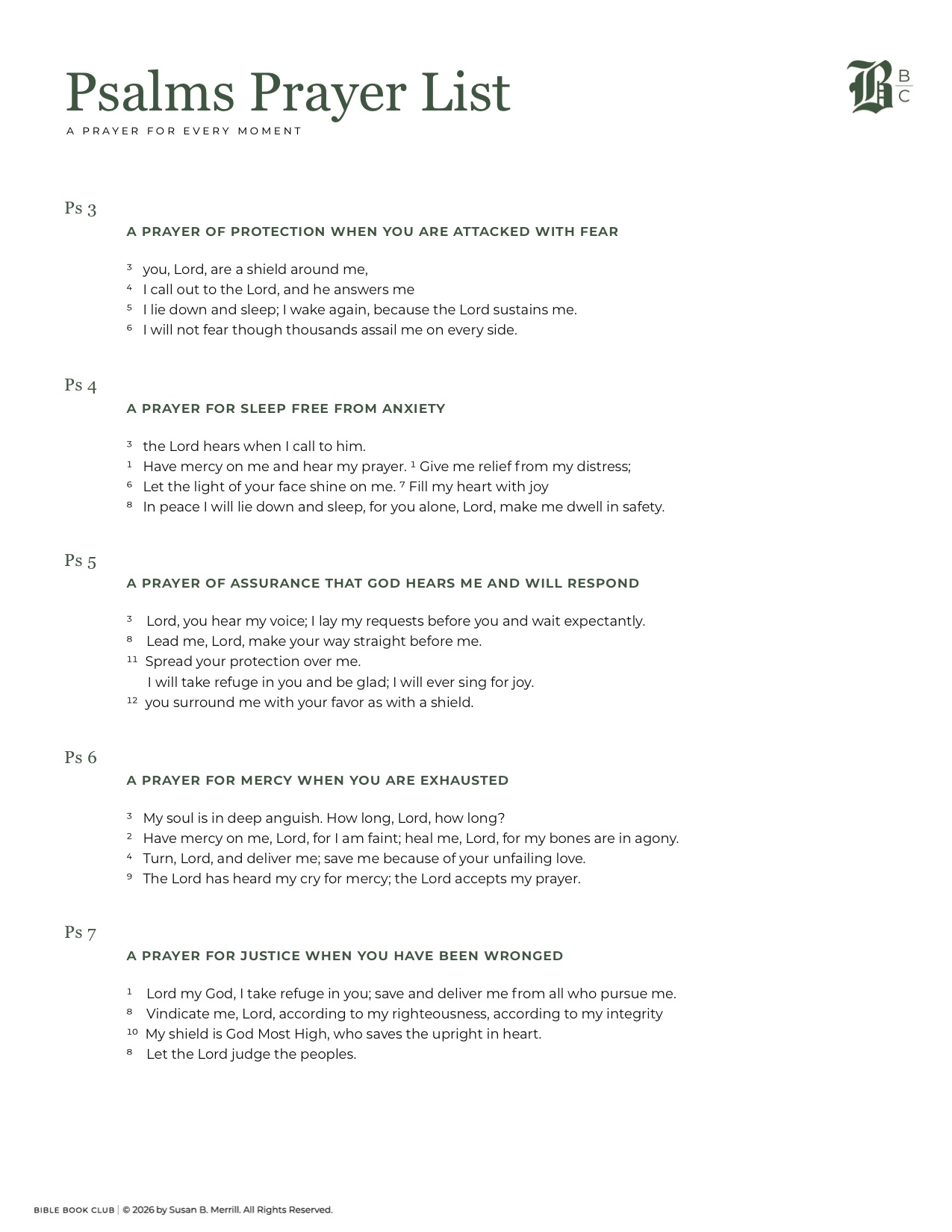
A Prayer from Psalm 139 to Praise God for Life and Ask Him to Lead You in the Way to Everlasting Life.
I praise you because I am fearfully and wonderfully made.
Your works are wonderful. I know that full well,
for you created my inmost being; you knit me together in my mother's womb.
Search me, God, and know my heart. Test me and know my anxious thoughts.
See if there is any offensive way in me, and lead me in the way everlasting.
Psalms 140-145: You Are My Refuge, My Portion
Psalm 140
For the director of music. A psalm of David.
1 Rescue me, Lord, from evildoers; protect me from the violent, 2 who devise evil plans in their hearts and stir up war every day. 3 They make their tongues as sharp as a serpent’s; the poison of vipers is on their lips. 4 Keep me safe, Lord, from the hands of the wicked; protect me from the violent, who devise ways to trip my feet. 5 The arrogant have hidden a snare for me; they have spread out the cords of their net and have set traps for me along my path. 6 I say to the Lord, “You are my God.” Hear, Lord, my cry for mercy. 7 Sovereign Lord, my strong deliverer, you shield my head in the day of battle. 8 Do not grant the wicked their desires, Lord; do not let their plans succeed. 9 Those who surround me proudly rear their heads; may the mischief of their lips engulf them. 10 May burning coals fall on them; may they be thrown into the fire, into miry pits, never to rise. 11 May slanderers not be established in the land; may disaster hunt down the violent. 12 I know that the Lord secures justice for the poor and upholds the cause of the needy. 13 Surely the righteous will praise your name, and the upright will live in your presence.
Psalm 141
A psalm of David.
1 I call to you, Lord, come quickly to me; hear me when I call to you. 2 May my prayer be set before you like incense; may the lifting up of my hands be like the evening sacrifice. 3 Set a guard over my mouth, Lord; keep watch over the door of my lips. 4 Do not let my heart be drawn to what is evil so that I take part in wicked deedsalong with those who are evildoers; do not let me eat their delicacies.
5 Let a righteous man strike me—that is a kindness; let him rebuke me—that is oil on my head.My head will not refuse it,
for my prayer will still be against the deeds of evildoers. 6 Their rulers will be thrown down from the cliffs, and the wicked will learn that my words were well spoken. 7 They will say, “As one plows and breaks up the earth, so our bones have been scattered at the mouth of the grave.” 8 But my eyes are fixed on you, Sovereign Lord; in you I take refuge—do not give me over to death. 9 Keep me safe from the traps set by evildoers, from the snares they have laid for me. 10 Let the wicked fall into their own nets, while I pass by in safety.
Psalm 142
A maskil of David. When he was in the cave. A prayer.
1 I cry aloud to the Lord; I lift up my voice to the Lord for mercy. 2 I pour out before him my complaint; before him I tell my trouble. 3 When my spirit grows faint within me, it is you who watch over my way. In the path where I walk people have hidden a snare for me. 4 Look and see, there is no one at my right hand; no one is concerned for me.I have no refuge; no one cares for my life.
5 I cry to you, Lord; I say, “You are my refuge, my portion in the land of the living.” 6 Listen to my cry, for I am in desperate need;rescue me from those who pursue me, for they are too strong for me.
7 Set me free from my prison, that I may praise your name. Then the righteous will gather about me because of your goodness to me.
Psalm 143
A psalm of David.
1 Lord, hear my prayer, listen to my cry for mercy; in your faithfulness and righteousness come to my relief. 2 Do not bring your servant into judgment, for no one living is righteous before you. 3 The enemy pursues me, he crushes me to the ground;he makes me dwell in the darkness like those long dead.
4 So my spirit grows faint within me; my heart within me is dismayed. 5 I remember the days of long ago; I meditate on all your works and consider what your hands have done. 6 I spread out my hands to you; I thirst for you like a parched land. 7 Answer me quickly, Lord; my spirit fails. Do not hide your face from me or I will be like those who go down to the pit. 8 Let the morning bring me word of your unfailing love, for I have put my trust in you. Show me the way I should go, for to you I entrust my life. 9 Rescue me from my enemies, Lord, for I hide myself in you. 10 Teach me to do your will, for you are my God;may your good Spirit lead me on level ground.
11 For your name’s sake, Lord, preserve my life; in your righteousness, bring me out of trouble. 12 In your unfailing love, silence my enemies; destroy all my foes, for I am your servant.
Psalm 144
Of David.
1 Praise be to the Lord my Rock, who trains my hands for war, my fingers for battle. 2 He is my loving God and my fortress, my stronghold and my deliverer, my shield, in whom I take refuge, who subdues peoples under me. 3 Lord, what are human beings that you care for them, mere mortals that you think of them? 4 They are like a breath; their days are like a fleeting shadow. 5 Part your heavens, Lord, and come down; touch the mountains, so that they smoke. 6 Send forth lightning and scatter the enemy; shoot your arrows and rout them. 7 Reach down your hand from on high; deliver me and rescue me from the mighty waters, from the hands of foreigners 8 whose mouths are full of lies, whose right hands are deceitful. 9 I will sing a new song to you, my God; on the ten-stringed lyre I will make music to you, 10 to the One who gives victory to kings, who delivers his servant David. From the deadly sword 11 deliver me; rescue me from the hands of foreigners whose mouths are full of lies, whose right hands are deceitful. 12 Then our sons in their youth will be like well-nurtured plants, and our daughters will be like pillars carved to adorn a palace. 13 Our barns will be filled with every kind of provision. Our sheep will increase by thousands, by tens of thousands in our fields; 14 our oxen will draw heavy loads. There will be no breaching of walls, no going into captivity, no cry of distress in our streets. 15 Blessed is the people of whom this is true; blessed is the people whose God is the Lord.
Psalm 145
A psalm of praise. Of David.
1 I will exalt you, my God the King; I will praise your name for ever and ever. 2 Every day I will praise you and extol your name for ever and ever. 3 Great is the Lord and most worthy of praise; his greatness no one can fathom. 4 One generation commends your works to another; they tell of your mighty acts. 5 They speak of the glorious splendor of your majesty—and I will meditate on your wonderful works. 6 They tell of the power of your awesome works—and I will proclaim your great deeds. 7 They celebrate your abundant goodness and joyfully sing of your righteousness. 8 The Lord is gracious and compassionate, slow to anger and rich in love. 9 The Lord is good to all; he has compassion on all he has made. 10 All your works praise you, Lord; your faithful people extol you. 11 They tell of the glory of your kingdom and speak of your might, 12 so that all people may know of your mighty acts and the glorious splendor of your kingdom. 13 Your kingdom is an everlasting kingdom, and your dominion endures through all generations. The Lord is trustworthy in all he promises and faithful in all he does. 14 The Lord upholds all who fall and lifts up all who are bowed down. 15 The eyes of all look to you, and you give them their food at the proper time. 16 You open your hand and satisfy the desires of every living thing. 17 The Lord is righteous in all his ways and faithful in all he does. 18 The Lord is near to all who call on him, to all who call on him in truth. 19 He fulfills the desires of those who fear him; he hears their cry and saves them. 20 The Lord watches over all who love him, but all the wicked he will destroy. 21 My mouth will speak in praise of the Lord. Let every creature praise his holy name for ever and ever.
What do Psalms 140-145 tell us?
Psalms 140-145 tell the story of David's progression from danger and desperation to victory and praise. These are the last psalms attributed to David, gathered near the end of the book just after the exile lament of 137. Many scholars think the arrangement is deliberate. That the community of exiles coming home from Babylon were handed David's own prayers through suffering to rebuild their trust in God.
We can't prove the editor's intent, but the placement is striking. The book's darkest memory, then David showing you how to pray your way back from it. Psalm 145 is the hinge between the last of the Davidic psalms and the final hallel. Many commentators feel as if it should be the beginning of the Hallel crescendo, which is up next.
A Prayer from Psalms 140-145 Asking for God to Show You the Way You Should Go
Set a guard over my mouth, Lord. Keep watch over the door of my lips.
Let the morning bring me word of your unfailing love, for I have put my trust in you.
Show me the way I should go, for to you I entrust my life.
The Lord is near to all who call on him, to all who call on him in truth.
Psalms 146-150: Let Everything That Has Breath Praise the Lord
This is the fifth and final doxology in the Book of Psalms. It is called the final Hallel. Think of it as the hallelujah chorus. Psalms 146 to 150 all begin and end with the word hallelujah, which is translated in the NIV version of the Bible as “praise the Lord.”
Psalm 146
1 Praise the Lord. Praise the Lord, my soul. 2 I will praise the Lord all my life; I will sing praise to my God as long as I live. 3 Do not put your trust in princes, in human beings, who cannot save. 4 When their spirit departs, they return to the ground; on that very day their plans come to nothing. 5 Blessed are those whose help is the God of Jacob, whose hope is in the Lord their God. 6 He is the Maker of heaven and earth, the sea, and everything in them—he remains faithful forever. 7 He upholds the cause of the oppressed and gives food to the hungry. The Lord sets prisoners free, 8 the Lord gives sight to the blind, the Lord lifts up those who are bowed down, the Lord loves the righteous. 9 The Lord watches over the foreigner and sustains the fatherless and the widow, but he frustrates the ways of the wicked. 10 The Lord reigns forever, your God, O Zion, for all generations. Praise the Lord.
Psalm 147
1 Praise the Lord. How good it is to sing praises to our God, how pleasant and fitting to praise him! 2 The Lord builds up Jerusalem; he gathers the exiles of Israel. 3 He heals the brokenhearted and binds up their wounds. 4 He determines the number of the stars and calls them each by name. 5 Great is our Lord and mighty in power; his understanding has no limit. 6 The Lord sustains the humble but casts the wicked to the ground. 7 Sing to the Lord with grateful praise; make music to our God on the harp. 8 He covers the sky with clouds; he supplies the earth with rain and makes grass grow on the hills. 9 He provides food for the cattle and for the young ravens when they call. 10 His pleasure is not in the strength of the horse, nor his delight in the legs of the warrior; 11 the Lord delights in those who fear him, who put their hope in his unfailing love. 12 Extol the Lord, Jerusalem; praise your God, Zion. 13 He strengthens the bars of your gates and blesses your people within you. 14 He grants peace to your borders and satisfies you with the finest of wheat. 15 He sends his command to the earth; his word runs swiftly. 16 He spreads the snow like wool and scatters the frost like ashes. 17 He hurls down his hail like pebbles. Who can withstand his icy blast? 18 He sends his word and melts them; he stirs up his breezes, and the waters flow. 19 He has revealed his word to Jacob, his laws and decrees to Israel. 20 He has done this for no other nation; they do not know his laws. Praise the Lord.
Psalm 148
1 Praise the Lord. Praise the Lord from the heavens; praise him in the heights above. 2 Praise him, all his angels; praise him, all his heavenly hosts. 3 Praise him, sun and moon; praise him, all you shining stars. 4 Praise him, you highest heavens and you waters above the skies. 5 Let them praise the name of the Lord, for at his command they were created, 6 and he established them for ever and ever—he issued a decree that will never pass away. 7 Praise the Lord from the earth, you great sea creatures and all ocean depths, 8 lightning and hail, snow and clouds, stormy winds that do his bidding, 9 you mountains and all hills, fruit trees and all cedars, 10 wild animals and all cattle, small creatures and flying birds, 11 kings of the earth and all nations, you princes and all rulers on earth, 12 young men and women, old men and children. 13 Let them praise the name of the Lord, for his name alone is exalted; his splendor is above the earth and the heavens. 14 And he has raised up for his people a horn, the praise of all his faithful servants, of Israel, the people close to his heart. Praise the Lord.
Psalm 149
1 Praise the Lord. Sing to the Lord a new song, his praise in the assembly of his faithful people. 2 Let Israel rejoice in their Maker; let the people of Zion be glad in their King. 3 Let them praise his name with dancing and make music to him with timbrel and harp. 4 For the Lord takes delight in his people; he crowns the humble with victory. 5 Let his faithful people rejoice in this honor and sing for joy on their beds. 6 May the praise of God be in their mouths and a double-edged sword in their hands, 7 to inflict vengeance on the nations and punishment on the peoples, 8 to bind their kings with fetters, their nobles with shackles of iron, 9 to carry out the sentence written against them—this is the glory of all his faithful people. Praise the Lord.
Psalm 150
1 Praise the Lord. Praise God in his sanctuary; praise him in his mighty heavens. 2 Praise him for his acts of power; praise him for his surpassing greatness. 3 Praise him with the sounding of the trumpet, praise him with the harp and lyre, 4 praise him with timbrel and dancing, praise him with the strings and pipe, 5 praise him with the clash of cymbals, praise him with resounding cymbals. 6 Let everything that has breath praise the Lord. Praise the Lord.
A Call to Praise God
Hallelujah is not a passive statement. It is a call or command for all the people to praise the Lord. So each of these final Hallel psalms is a call to something. Psalm 146 is a call to praise God in trust rather than trusting man, because God sustains us, lifts us up, and sets us free. Psalm 147 is a call to praise God because He alone determines all.
- He heals.
- He numbers.
- He provides.
- He strengthens.
- He grants.
- He sends.
In the middle of these five final praise songs, Psalm 148 is a call for all creation to praise the Lord.
- The heavens praise the Lord: the sky, angels, sun, moon, and sky again.
- The earth praises the Lord: creatures, the weather, mountains, trees, and animals.
- The people praise the Lord: kings, rulers, men, women, and children.
God created it all, and all will praise His name. Why should they praise? Because of the horn of the people, Jesus Christ.
What does the horn represent in Psalm 148:14?
A horn is a symbol of power, and it is used in the Old Testament to refer to God's anointed king. All creation will be rescued by this king, so all creation should praise Him. At the very end, God gives a reason why they should praise: "He has raised up for his people a horn, the praise of all his faithful servants."
In Psalm 132, we read, "Here I will make a horn grow for David and set up a lamp for my anointed one." The people should certainly praise all of God's creation, but most of all because God has provided an anointed king for His faithful servants. The people closest to His heart. God has provided a savior.
When I think of all the songs we have added to the playlist, the one that runs in my mind when I try to imagine the joy of what this means is Phil Wickham's Psalm 8, Hallé. It was chosen for the animated movie David.
Remember, God is going to raise up a horn from the line of David. Those two things tied together: the music and the man. The praise song of joy and the story of King David who loved the Lord so well. They capture the essence of what I believe we will feel when we truly understand what it means to know God. Psalm 149 is a call to praise God with music, singing, dancing, rejoicing, and this is how we should praise him.
What does Psalm 150 teach us about praise?
Psalm 150 ends with a call for everything that has breath to praise the Lord. The command to praise sounds 13 times in this one psalm. The command is to the community to sing together in one beautiful collective voice, and the song answers so many questions.
- Where do we praise? In the sanctuary.
- Why do we praise? Because of His unsurpassing power.
- How do we praise? With instruments and dancing.
- Who should praise? Everything that has breath.
This word breath in the final verse is so rich. Jewish commentators note that every single breath a human takes is essentially meant to be an involuntary hallelujah. Meaning you don't just say hallelujah; your breathing itself is a gift meant to praise the Giver.
What does neshama mean in Psalm 150?
In Hebrew, the word neshama used in Psalm 150 means breath or soul. It is the same word used in Genesis.
Genesis 2:7 7 Then the Lord God formed a man from the dust of the ground and breathed into his nostrils the breath of life, and the man became a living being.
So in the beginning God gave us the breath, or soul, of life. In the end, everything that has that soul or breathes will give it back to Him in praise.
I will close with this: in our Psalms 1-2 Bible study, we discussed that psalms are a conversation with God in song. You do not stand alone. You are singing to Him. It is an intimate conversation.
Here in our final psalms, we learn that you are not the sole singer. You are in a chorus singing to Him. Your voice is unique, as is your relationship with God, but your voice is also part of the creation chorus. A joyful noise that is beyond anything we can imagine.
The Book of Psalms is a story of God’s relationship with us told through a sacred playlist that turns our deepest struggles and highest hopes into a conversation with Him. Our hope is that this season of Psalms, even though it was long, will give you the words for a new kind of conversation with God. Our last prayer for the prayer list is a prayer from Psalms 146 to 150.
A Prayer Calling All Creation to Praise the Lord.
Praise the Lord my soul. I will praise the Lord all my life.
I will sing praise to my God as long as I live.
He heals the broken hearted and binds up their wounds.
For the Lord takes delight in his people. He crowns the humble with victory.
Let everything that has breath praise the Lord.
And that is a wrap! Amen on the Bible's third longest book. There are 150 psalms, and you just read every word! We want to give you some praise for going that long distance with us, and we hope you're going to join us in a book that I am really looking forward to: the Book of Proverbs.
Discussion Questions
- There is no need to perform for God. You are seen, pursued, and loved. Why do you think performance can become part of our relationship with God, even when we intellectually understand we don’t have to earn His love? How do you think your service to God might change if you began each day intentionally dwelling on the fact that you are completely known and loved without the need to perform?
- Psalms 140 to 145 tell the story of David's progression from danger and desperation to victory and praise. The returning exiles use these prayers to rebuild their trust in God. When you experience your darkest moments, does it help to remember God brought you, or someone else, through similar hard times? Like the returning exiles, have you ever borrowed the words of others when you're at a loss for how to pray?
- Every breath we take is meant to be a Hallelujah. Not just saying the word, but realizing our breath itself is a gift meant to praise the Giver. In the beginning, God gave us breath, or our soul, and in the end we will give it back to Him in praise. What’s one way you could praise God more throughout your day?