Psalm 120-136 Introduction
These next 15 psalms are a specific set that all begin with " a song of ascents, " or in Hebrew, " Shir Hama'alot. " Ten are anonymous, four from David, and one from Solomon.
What are the Songs of Ascents in Psalms 120-134?
The songs of ascent are the songs the people sang as they went up to Jerusalem for the three annual feasts:
- Passover in the spring.
- Feast of Weeks in early summer, which later became Pentecost.
- Tabernacles in the fall.
That’s why they are also known as the Pilgrim Psalms. The pilgrims sang these songs together as they traveled in family groups to Jerusalem, including Jesus and His parents.
Luke 2:41-44 41 Every year Jesus’ parents went to Jerusalem for the Festival of the Passover. 42 When he was twelve years old, they went up to the festival, according to the custom. 43 After the festival was over, while his parents were returning home, the boy Jesus stayed behind in Jerusalem, but they were unaware of it. 44 Thinking he was in their company, they traveled on for a day. Then they began looking for him among their relatives and friends.
The Hebrew term ma'alot, or ascent, can have a physical and spiritual meaning. First and most likely, the ascent referred to the physical climb to Jerusalem. Jerusalem sits on a high mountain ridge, and regardless of where the pilgrims came from, it was an uphill climb. These ascent songs are their road-trip playlist, and as they sing, it prepares their minds and hearts for the purpose of each celebration.
The term ascent may refer to the steps up to the Temple. According to a written collection of Jewish Oral Law, the Second Temple had a staircase with exactly 15 steps leading from the Women’s Court to the Court of Israel. There are 15 psalms and 15 steps.
Why are there 15 psalms of ascent and 15 Temple steps?
The Levite musicians would sing one of the 15 “Songs of Ascents” on each step while they climbed. The word ascent has a spiritual connotation. The 15 psalms express a spiritual journey. The journey of leaving the everyday world behind to ascend into the presence of God. For them, that is located in the Temple high above them in Jerusalem.
Preparing for these annual worship celebrations matters to their hearts and minds. The trip is not an empty march but framed in song. What is the parallel for the church? What do we do to prepare for worship?
How does church architecture reflect the physical "ascent" to God?
Throughout church history, architects used vertical lines to visually pull a worshipper's gaze upward: pointed arches, tall rib vaults, and slender columns, windows high, streaming light from above. This was a physical metaphor intended to redirect attention away from earthly concerns and raise thoughts toward God in heaven.
The soaring ceilings make us feel small. Stepping into soaring space creates awe and reverence, physically reminding us of God's transcendence. That God is infinitely greater than humanity.
The physical movement of ancient pilgrims ascending Mount Zion in Israel directly mirrors the architectural design of raising our eyes upward in a church. Both traditions use the physical body, specifically the eyes and the act of looking up, to train the human heart for worship. The physical act of looking up, whether at the actual hills of Jerusalem or at a rising church ceiling, is a visual metaphor. To go into the presence of God, the soul must "ascend" out of the ordinary.
Where we fall short is perhaps in the preparation as we enter. They sang hymns all the way in. My experience is a bit more rushed and unprepared. So here is our challenge or homework. Whether your church has soaring architecture or not, ponder how you can ascend in your mind and heart so you are reverently aware that you are about to worship.
Hebrews 4:14 14 Therefore, since we have a great high priest who has ascended into heaven, Jesus the Son of God, let us hold firmly to the faith we profess.
If you happen to love architecture and history, Ken Follett wrote a historical fiction bestseller titled "The Pillars of the Earth." The characters are fiction, but the architectural details of the transition to light-filled, soaring Gothic architecture in the mid-1100s are historically accurate. The book has forever changed how I view the beautiful churches throughout Europe and older cities of the US.
How are the Songs of Ascents divided into 5 groups of triads?
The Songs of Ascents, Psalms 120-134, are arranged in five groups of triads, so that’s five groups of three psalms each. Most triads follow the same pattern:
- Someone is in trouble.
- God protects them.
- They arrive at safety.
This is the story told over and over in Israel to build their faith. It is a smaller version of the Exodus from Egypt.
Psalms 120-122: I Lift Up My Eyes to the Mountains
Psalm 120
1 I call on the Lord in my distress,
and he answers me.
2 Save me, Lord,
from lying lips
and from deceitful tongues.3 What will he do to you,
and what more besides,
you deceitful tongue?
4 He will punish you with a warrior’s sharp arrows,
with burning coals of the broom bush.5 Woe to me that I dwell in Meshek,
that I live among the tents of Kedar!
6 Too long have I lived
among those who hate peace.
7 I am for peace;
but when I speak, they are for war.
Psalm 121
A song of ascents.
1 I lift up my eyes to the mountains—
where does my help come from?
2 My help comes from the Lord,
the Maker of heaven and earth.3 He will not let your foot slip—
he who watches over you will not slumber;
4 indeed, he who watches over Israel
will neither slumber nor sleep.5 The Lord watches over you—
the Lord is your shade at your right hand;
6 the sun will not harm you by day,
nor the moon by night.7 The Lord will keep you from all harm—
he will watch over your life;
8 the Lord will watch over your coming and going
both now and forevermore.
Psalm 122
A song of ascents. Of David.
1 I rejoiced with those who said to me,
“Let us go to the house of the Lord.”
2 Our feet are standing
in your gates, Jerusalem.3 Jerusalem is built like a city
that is closely compacted together.
4 That is where the tribes go up—
the tribes of the Lord—to praise the name of the
Lord
according to the statute given to Israel.
5 There stand the thrones for judgment,
the thrones of the house of David.6 Pray for the peace of Jerusalem:
“May those who love you be secure.
7 May there be peace within your walls
and security within your citadels.”
8 For the sake of my family and friends,
I will say, “Peace be within you.”
9 For the sake of the house of the Lord our God,
I will seek your prosperity.
What are Psalms 120, 121, and 122 about?
Psalms 120-122 are about departure, leaving worldly trouble behind.
- Psalm 120 begins with the trouble of living in a hostile place. The people are far from home, stuck living among people with lying lips and deceitful tongues.
- Psalm 121 describes God's protection as they leave. The people lift their eyes to the mountain, to the One who watches over them and will not let their foot slip.
- Psalm 122 celebrates their safe arrival. The people rejoice because their feet are standing in your gates, Jerusalem.
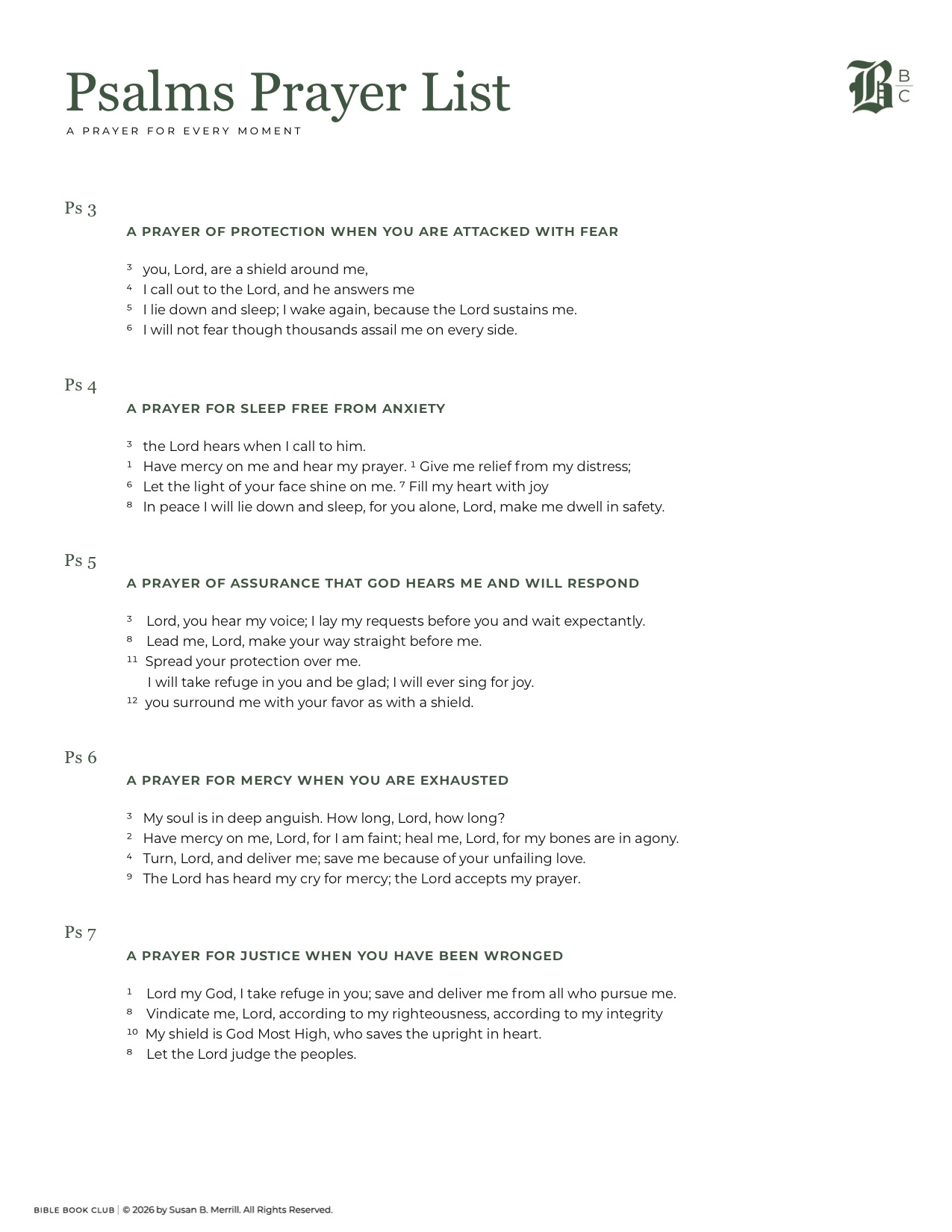
A Prayer from Psalm 120 and 121 When You Are in Distress and Need Help
120:1 I call on the Lord in my distress, and he answers me.
121:1 I lift up my eyes to the mountains—where does my help come from?
121:2 My help comes from the Lord, the Maker of heaven and earth.
121:8 The Lord will watch over your coming and going both now and forevermore.
Psalms 123-125: Our Help Is in the Name of the Lord
Psalm 123
A song of ascents.
1 I lift up my eyes to you,
to you who sit enthroned in heaven.
2 As the eyes of slaves look to the hand of their master,
as the eyes of a female slave look to the hand of her mistress,so our eyes look to the
Lord our God,
till he shows us his mercy.3 Have mercy on us, Lord, have mercy on us,
for we have endured no end of contempt.
4 We have endured no end
of ridicule from the arrogant,
of contempt from the proud.
Psalm 124
A song of ascents. Of David.
1 If the Lord had not been on our side—
let Israel say—
2 if the Lord had not been on our side
when people attacked us,
3 they would have swallowed us alive
when their anger flared against us;
4 the flood would have engulfed us,
the torrent would have swept over us,
5 the raging waters
would have swept us away.6 Praise be to the Lord,
who has not let us be torn by their teeth.
7 We have escaped like a bird
from the fowler’s snare;the snare has been broken,
and we have escaped.
8 Our help is in the name of the Lord,
the Maker of heaven and earth.
Psalm 125
A song of ascents.
1 Those who trust in the Lord are like Mount Zion,
which cannot be shaken but endures forever.
2 As the mountains surround Jerusalem,
so the Lord surrounds his people
both now and forevermore.3 The scepter of the wicked will not remain
over the land allotted to the righteous,for then the righteous might use
their hands to do evil.4 Lord, do good to those who are good,
to those who are upright in heart.
5 But those who turn to crooked ways
the Lord will banish with the evildoers.
What are Psalms 123, 124, and 125 about?
Psalms 123-125 are about trusting God along the way.
- Psalm 123 begins with the trouble of the ongoing trial of travel. The people are being treated with contempt. They have endured no end of ridicule from the arrogant, of contempt from the proud.
- Psalm 124 describes God's protection. If the Lord had not been on their side when people attacked them, they would have swallowed us alive.
- Psalm 125 celebrates their safe arrival. The people find peace because those who trust in the Lord are like Mount Zion, which cannot be shaken.
A Prayer from Psalm 124 and 125 When an Attack Has You Shaken
124:8 Our help is in the name of the Lord, the Maker of heaven and earth.
124:2 if the Lord had not been on our side when people attacked us,
124:3 they would have swallowed us alive when their anger flared against us.125:1 Those who trust in the Lord are like Mount Zion, which cannot be shaken but endures forever.
Psalms 126-128: Unless the Lord Builds the House
Psalm 126
A song of ascents.
1 When the Lord restored the fortunes of Zion,
we were like those who dreamed.
2 Our mouths were filled with laughter,
our tongues with songs of joy.Then it was said among the nations,
“The Lord has done great things for them.”
3 The Lord has done great things for us,
and we are filled with joy.4 Restore our fortunes, Lord,
like streams in the Negev.
5 Those who sow with tears
will reap with songs of joy.
6 Those who go out weeping,
carrying seed to sow,will return with songs of joy,
carrying sheaves with them.
Psalm 127
A song of ascents. Of Solomon.
1 Unless the Lord builds the house,
the builders labor in vain.Unless the
Lord watches over the city,
the guards stand watch in vain.
2 In vain you rise early
and stay up late,toiling for food to eat—
for he grants sleep to those he loves.3 Children are a heritage from the Lord,
offspring a reward from him.
4 Like arrows in the hands of a warrior
are children born in one’s youth.
5 Blessed is the man
whose quiver is full of them.They will not be put to shame
when they contend with their opponents in court.
Psalm 128
A song of ascents.
1 Blessed are all who fear the Lord,
who walk in obedience to him.
2 You will eat the fruit of your labor;
blessings and prosperity will be yours.
3 Your wife will be like a fruitful vine
within your house;your children will be like olive shoots
around your table.
4 Yes, this will be the blessing
for the man who fears the Lord.5 May the Lord bless you from Zion;
may you see the prosperity of Jerusalem
all the days of your life.
6 May you live to see your children’s children—
peace be on Israel.
What are Psalm 126, 127, and 128 about?
Psalms 126-128 are about joy in restoration, family, and the blessings of God.
- Psalm 126 begins with trouble, but this time from the past. The people's fortunes have been restored, and those who go out weeping, carrying seed to sow, will return with songs of joy.
- Psalm 127 describes God's protection. Unless the Lord builds the house or watches over a city, the builders labor in vain and the guards stand watch in vain.
- Psalm 128 celebrates their safe arrival. The people are blessed, and they will see the prosperity of Jerusalem all the days of your life.
Let's pause here for a minute to focus on Psalm 127, which randomly jumps from building a house and guarding a city to this proverb-like statement about children and arrows. Psalm 127 is one of only two psalms written by Solomon, hence the proverb-like statement. He wrote the Book of Proverbs too.
Why are children compared to "arrows in the hand of a warrior" in Psalm 127:4?
Solomon's point is that building a house or guarding a city does no good if there isn't a future generation to keep the nation going. The psalm specifically says:
Psalm 127:3-5 3 Children are a heritage from the Lord, offspring a reward from him.
4 Like arrows in the hands of a warrior are children born in one’s youth.
5 Blessed is the man whose quiver is full of them.
Now, not everyone is called to have children or marry. But all of us can value children and the family that nurtures them. This has become a growing concern because of the global decline in birth rates. Most developed nations, including my own, sit far below the population replacement level of 2.1 children per woman.
In a recent Pew Research Center study, many single men and women said they do not plan to have children. Why? Largely because they perceive that the benefits do not outweigh the sacrifice. Yet God states here in Psalm 127 that they are a blessing. It begs the question: what is our culture teaching us about children, and is this a strategy of the Enemy?
A Prayer from Psalm When Your Obedience Has Brought Blessing
128:1 Blessed are all who fear the Lord, who walk in obedience to him.
127:1 Unless the Lord builds the house, the builders labor in vain.
126:5 Those who sow with tears will reap with songs of joy.
126:3 The Lord has done great things for us, and we are filled with joy.
Psalms 129-131: Out of the Depths
Psalm 129
A song of ascents.
1 “They have greatly oppressed me from my youth,”
let Israel say;
2 “they have greatly oppressed me from my youth,
but they have not gained the victory over me.
3 Plowmen have plowed my back
and made their furrows long.
4 But the Lord is righteous;
he has cut me free from the cords of the wicked.”5 May all who hate Zion
be turned back in shame.
6 May they be like grass on the roof,
which withers before it can grow;
7 a reaper cannot fill his hands with it,
nor one who gathers fill his arms.
8 May those who pass by not say to them,
“The blessing of the Lord be on you;
we bless you in the name of the Lord.”
Psalm 130
A song of ascents.
1 Out of the depths I cry to you, Lord;
2 Lord, hear my voice.Let your ears be attentive
to my cry for mercy.3 If you, Lord, kept a record of sins,
Lord, who could stand?
4 But with you there is forgiveness,
so that we can, with reverence, serve you.5 I wait for the Lord, my whole being waits,
and in his word I put my hope.
6 I wait for the Lord
more than watchmen wait for the morning,
more than watchmen wait for the morning.7 Israel, put your hope in the Lord,
for with the Lord is unfailing love
and with him is full redemption.
8 He himself will redeem Israel
from all their sins.
Psalm 131
A song of ascents. Of David.
1 My heart is not proud, Lord,
my eyes are not haughty;I do not concern myself with great matters
or things too wonderful for me.
2 But I have calmed and quieted myself,
I am like a weaned child with its mother;
like a weaned child I am content.3 Israel, put your hope in the Lord
both now and forevermore.
What are Psalms 129, 130, and 131 about?
Psalms 129-131 are about persevering faith: Enduring persecution, seeking forgiveness, and practicing humility.
- Psalm 129 begins with the trouble. The people are oppressed.
- Psalm 130 describes God's protection. The people have hope because with God there is forgiveness.
- Psalm 131 describes safe arrival. The people are calmed. Like a weaned child I am content.
A Prayer from Psalm 130 and 131 When You Need Forgiveness and Hope
130:1 Out of the depths I cry to you, Lord;
131:1 My heart is not proud, Lord, my eyes are not haughty
130:3 If you, Lord, kept a record of sins, Lord, who could stand?
130:4 But with you there is forgiveness, so that we can, with reverence, serve you.
130:5 I wait for the Lord, my whole being waits, and in his word I put my hope.
Psalms 132-134: When God's People Live Together in Unity
Psalm 132
A song of ascents.
1 Lord, remember David
and all his self-denial.2 He swore an oath to the Lord,
he made a vow to the Mighty One of Jacob:
3 “I will not enter my house
or go to my bed,
4 I will allow no sleep to my eyes
or slumber to my eyelids,
5 till I find a place for the Lord,
a dwelling for the Mighty One of Jacob.”6 We heard it in Ephrathah,
we came upon it in the fields of Jaar:
7 “Let us go to his dwelling place,
let us worship at his footstool, saying,
8 ‘Arise, Lord, and come to your resting place,
you and the ark of your might.
9 May your priests be clothed with your righteousness;
may your faithful people sing for joy.’”10 For the sake of your servant David,
do not reject your anointed one.11 The Lord swore an oath to David,
a sure oath he will not revoke:“One of your own descendants
I will place on your throne.
12 If your sons keep my covenant
and the statutes I teach them,then their sons will sit
on your throne for ever and ever.”13 For the Lord has chosen Zion,
he has desired it for his dwelling, saying,
14 “This is my resting place for ever and ever;
here I will sit enthroned, for I have desired it.
15 I will bless her with abundant provisions;
her poor I will satisfy with food.
16 I will clothe her priests with salvation,
and her faithful people will ever sing for joy.17 “Here I will make a horn grow for David
and set up a lamp for my anointed one.
18 I will clothe his enemies with shame,
but his head will be adorned with a radiant crown.”
Psalm 133
A song of ascents. Of David.
1 How good and pleasant it is
when God’s people live together in unity!2 It is like precious oil poured on the head,
running down on the beard,running down on Aaron’s beard,
down on the collar of his robe.
3 It is as if the dew of Hermon
were falling on Mount Zion.For there the
Lord bestows his blessing,
even life forevermore.
Psalm 134
A song of ascents.
1 Praise the Lord, all you servants of the Lord
who minister by night in the house of the Lord.
2 Lift up your hands in the sanctuary
and praise the Lord.3 May the Lord bless you from Zion,
he who is the Maker of heaven and earth.
What are Psalms 132, 133, and 134 about?
Psalms 132-134 are about worship in the Sanctuary: Arriving at the Temple, corporate unity, and final blessing. This triad is different. It focuses on safe arrival.
- Psalm 132 begins with God choosing Zion as his dwelling place and promising David's throne.
- Psalm 133 describes community gathered there together in unity.
- Psalm 134 is the benediction. The pilgrim is home, the people are one, and the blessings flow with a chorus of praise.
The songs of ascent crescendo on a note of praise.
A Prayer from Psalms 132, 133, and 134 Praising God for Church and Community
133:1 How good and pleasant it is when God’s people live together in unity!
132:7 “Let us go to his dwelling place, let us worship at his footstool,
134:2 Lift up your hands in the sanctuary and praise the Lord.
133:3 For there the Lord bestows his blessing, even life forevermore.
Psalms 135-136: The Great Hallel
Some refer to the Great Hallel as just Psalm 136. Others include 135. We will read them together. There are three collections of Hallel, or praise songs, in the Psalms:
- Egyptian Hallel, which we already discussed.
- Great Hallel.
- Daily Hallel.
Like the Egyptian Hallel, the Great Hallel is recited at Passover.
Psalm 135
Praise the name of the Lord;
praise him, you servants of the Lord,
2 you who minister in the house of the Lord,
in the courts of the house of our God.3 Praise the Lord, for the Lord is good;
sing praise to his name, for that is pleasant.
4 For the Lord has chosen Jacob to be his own,
Israel to be his treasured possession.5 I know that the Lord is great,
that our Lord is greater than all gods.
6 The Lord does whatever pleases him,
in the heavens and on the earth,
in the seas and all their depths.
7 He makes clouds rise from the ends of the earth;
he sends lightning with the rain
and brings out the wind from his storehouses.8 He struck down the firstborn of Egypt,
the firstborn of people and animals.
9 He sent his signs and wonders into your midst, Egypt,
against Pharaoh and all his servants.
10 He struck down many nations
and killed mighty kings—
11 Sihon king of the Amorites,
Og king of Bashan,
and all the kings of Canaan—
12 and he gave their land as an inheritance,
an inheritance to his people Israel.13 Your name, Lord, endures forever,
your renown, Lord, through all generations.
14 For the Lord will vindicate his people
and have compassion on his servants.15 The idols of the nations are silver and gold,
made by human hands.
16 They have mouths, but cannot speak,
eyes, but cannot see.
17 They have ears, but cannot hear,
nor is there breath in their mouths.
18 Those who make them will be like them,
and so will all who trust in them.19 All you Israelites, praise the Lord;
house of Aaron, praise the Lord;
20 house of Levi, praise the Lord;
you who fear him, praise the Lord.
21 Praise be to the Lord from Zion,
to him who dwells in Jerusalem.
Psalm 36
1 Give thanks to the Lord, for he is good.
4 to him who alone does great wonders,
His love endures forever.
5 who by his understanding made the heavens,
His love endures forever.
6 who spread out the earth upon the waters,
His love endures forever.
7 who made the great lights—
His love endures forever.
8 the sun to govern the day,
His love endures forever.
9 the moon and stars to govern the night;
His love endures forever.10 to him who struck down the firstborn of Egypt
His love endures forever.
11 and brought Israel out from among them
His love endures forever.
12 with a mighty hand and outstretched arm;
His love endures forever.13 to him who divided the Red Sea asunder
His love endures forever.
14 and brought Israel through the midst of it,
His love endures forever.
15 but swept Pharaoh and his army into the Red Sea;
His love endures forever.16 to him who led his people through the wilderness;
His love endures forever.17 to him who struck down great kings,
His love endures forever.
18 and killed mighty kings—
His love endures forever.
19 Sihon king of the Amorites
His love endures forever.
20 and Og king of Bashan—
His love endures forever.
21 and gave their land as an inheritance,
His love endures forever.
22 an inheritance to his servant Israel.
His love endures forever.23 He remembered us in our low estate
His love endures forever.
24 and freed us from our enemies.
His love endures forever.
25 He gives food to every creature.
His love endures forever.26 Give thanks to the God of heaven.
His love endures forever.
Why is Psalm 136 called the "great hallel"?
The word Hallel means "Praise" in Hebrew (the root of Hallelujah, or "Praise Yahweh"). It is called the "Great" Hallel for a couple of reasons.
- It has a grand structure.
While other praise psalms focus on a single event or specific attributes of God, Psalm 136 covers the grand, sweeping narrative of all reality. It moves from creation (making the heavens, sun, and moon), to redemption (bringing Israel out of Egypt), to providence (providing food for all living creatures).
- The Refrain
Every single verse in Psalm 136 ends with the exact same response: For His steadfast love endures forever. This repetitive declaration of God's enduring covenant love gives the psalm a majestic cadence unlike any other passage.
What is Psalm 135 and 136 about?
Praising God for creation and thanking God for his enduring love.
Why does every verse in Psalm 136 repeat, "His love endures forever"?
In Psalm 135, the word “praise” is used 11 times. In Psalm 136, “give thanks to God” is commanded four times. Why? Because his love endures forever, which is repeated 26 times. Mic drop. The message is clear.
But note, this is not a new message. This same refrain was used in:
- 1 Chronicles 16 when David brought the Ark to Jerusalem.
- 2 Chronicles 5 and 7 when Solomon dedicated the Temple.
- 2 Chronicles 20 by King Jehoshaphat.
- Ezra 3 and Jeremiah 33.
- Psalms 107-118, most recently.
The fact remains today. God is good. His love really does endure forever. And because of it, like this psalmist, we should give thanks to the God of heaven.
A Prayer from Psalm 135 and 136
135:3 Praise the Lord, for the Lord is good; sing praise to his name,
135:13 Your name, Lord, endures forever, your renown, Lord, through all generations.
136:1 Give thanks to the Lord, for he is good. His love endures forever.
136:26 Give thanks to the God of heaven. His love endures forever.
New Psalms Playlist Song
- “I Lift My Eyes Up” by Brian Doerksen (Psalm 121)
Listen to the entire Psalms Playlist on Apple Music or Spotify.
Group Discussion Questions for Psalms 120-136
- The Israelite pilgrims sang on their way up to Jerusalem. What can you do to prepare your heart for Sunday worship?
- Each triad follows the same pattern: trouble, protection, and safe arrival. Can you spot a time in your life when you’ve seen this pattern play out?
- In Psalm 127, Solomon points out the importance of future generations. How does this psalm challenge or affirm the way you think about the next generation?