Subscribe to BBC on Apple, Spotify , or Amazon.
A New King, an Old Promise: Solomon Seeks the Lord
If you were with us as we studied 1 Chronicles, you might recall 1 and 2 Chronicles were originally written as one book. As we begin our study of 2 Chronicles 1, we’re actually in the middle of the story.
The author, or Chronicler as we call him, is telling the story of Israel’s history to remind the returning exiles of their spiritual heritage and God’s faithfulness to His covenant promise to David.
He wants this retelling to encourage them and inspire them to be faithful, even though their situation is difficult, so he portrays David and Solomon in the best possible light. Their stories of the past provide hope for the future.
It’s also helpful to remember the role Chronicles plays in the greater story of the Bible.
- 1 and 2 Kings explain why the exile happened and are written during the exile.
- 1 and 2 Chronicles encourage faith and hope after the exile.
- The books of the Prophets call for repentance and warn of judgement. They were written before and after the exile.
In 1 Chronicles 28:9, David had a few final words for his son Solomon. Our story opens in 2 Chronicles 1:1-6 with Solomon as the new king of Israel, and he is doing exactly what David commanded.
He gathers all Israel and marches them up to the Tent of Meeting at Gibeon, which is the old place of worship established by their forefathers. Then he publicly inquires of the Lord and makes a thousand burnt offerings.
Solomon seeks the Lord because his father, David, said if you seek Him you will find Him. The word inquire or seek is a theme in Chronicles. It denotes a quest of faith to discern God’s will.
The tendency to inquire of God is a measure of faithfulness with the kings of Israel. For example, when Saul stopped inquiring of the Lord, he failed.
Solomon’s heart is clearly in the right place. He is on the right track both as a king and as the first son of the Davidic Covenant to inherit the promise.
Reflection Point
Is the tendency to inquire of God still a measure of our faithfulness today? The answer is yes.
We must ask ourselves:
- Am I inquiring of the Lord?
- First? Before others?
- Last? Only when desperate?
- Or never?
Wisdom Over Wealth: Seeking God and Loving Others
When Solomon seeks God with all Israel in tow at Gibeon, God does not disappoint. He is pleased and promptly responds to Solomon’s faithfulness in 2 Chronicles 1:7-13.
Solomon demonstrated his love for God when he worshiped at the Tent of Meeting. He demonstrates his love for others in his request for wisdom to lead the people.
Love God, love people, love life. Sound familiar? It’s exactly what Solomon’s father, David, told him to do in our last chapters.
Jesus, the final King from the line of David, taught us this too. In Matthew 22:36-40, Jesus tells us to love God first and love people second. All the law and the prophets hang on these two commandments.
From Moses to David and on to our next books of Ezra and Nehemiah and beyond–everything hangs on these two simple commandments. If we get these right, we live a righteous life. If we get these wrong, none of our other actions will make up for it, because everything else hinges on us loving God and loving others.
Love God and Love others and you will love life. That doesn’t mean it will be easy or perfect. It wasn’t for David, Solomon, Abraham, Jacob, Ruth, Esther or anyone else. But to live life in the will of God is to live in peace despite the seasonal storms.
In 2 Chronicles 1:14-17, Solomon put others ahead of wealth by asking for wisdom instead of wealth. God rewards his priorities being in order by giving him wisdom and wealth.
Solomon uses his wealth wisely for God’s glory and becomes famous in his own right. In fact, he becomes so famous people will come to learn about the God of Solomon.
The lesson to learn from Solomon is simple. Before making decisions, go to God first. Then, think beyond yourself to what is best for others. Be humble and open to accept God’s response, and seek wisdom over wealth. God’s will over your will.
Cracks in the Foundation: Signs of Compromise in Solomon’s Rise
The way Solomon got the horses and chariots is a problem because it is a direct violation of Moses’ command in Deuteronomy 17. It shows reliance on military might rather than God’s strength, and it establishes trade relationships with Egypt.
Some believe it may have been acceptable by this time because Solomon was establishing Israel as a power for peace. The Chronicle doesn’t present it as sinful.
However, if you look at the fruits of these actions–the accumulation of horses and wives, all forbidden in Deuteronomy 17–it contributes to Solomon’s spiritual decline and the kingdom’s division. So it probably wasn’t the best choice. While Solomon was on the rise up, the enemy was worming his way in.
Building for Glory: Solomon’s Wisdom and the Temple Vision
Based on all the preparations David made before his death, you’d think Solomon would have everything he needs to break ground on the Temple. But Solomon is a masterclass in wisdom.
Because God has increased Israel’s wealth, Solomon’s vision for the Temple has grown. He wants the best for the One he and his father love the most. So he puts his wisdom to work and phones an old friend. He needs King Hiram’s legendary craftsmen, and Lebanon’s towering cedars, things Israel simply doesn’t have.
Partners and Pitfalls: Solomon’s Alliance with Hiram
Hiram, King of Tyre was a powerful king of the Phoenician city-state of Tyre and an old friend of King David’s. In fact, he was the one who supplied David with the cedar and skilled workers for his Palace in 1 Chronicles 14.
Hiram was a good friend to have and a shrewd businessman who controlled the eastern Mediterranean’s most important trade routes and access to Lebanon’s legendary cedar forests. He also possessed the ancient world’s finest craftsman and seafaring expertise.
As a businessman, Hiram respects David and Solomon’s God, because he sees how much they’ve prospered. Unfortunately, his respect didn’t lead to faith. Their God is simply a good business decision in Hiram’s eyes.
In 2 Chronicles 2:1-10 it’s clear Hiram is more of a business partner to Solomon than a political alliance. Hiram and Solomon’s arrangement in 2 Chronicles 2:11-18 is simple. Israel will trade wheat, barley, olive oil, and wine for cedar, skilled labor, and craftsmanship.
Solomon also hired 153,600 workers for the Temple project and both kingdoms benefited. However, the relationship became problematic when it got personal.
Although Solomon was a wise man, in 1 Kings 11:1-6 it’s clear that temptation can lead even the wisest man down a foolish path.
In the end, Solomon married many foreign wives, including some from Sidon, a major city in Phoenicia. These wives led him astray and he began following other gods including Ashtoreth the goddess of Phoenicia.
As we know from 1 and 2 Kings, the Israelite kings who came after Solomon followed his example. It became progressively worse later during King Ahab’s dynasty with his marriage to Jezebel, a Phoenician princess.
To hear more about the havoc Jezebel caused on both the Northern Kingdom and Judah, go back to Season 11 and start with Episode 15–Ahab and Jezebel: Israel’s Most Wicked Couple.
Of course the Chronicler doesn’t cover Solomon’s sin. Like David and Bathsheba, those stories are documented in the books of Kings. Instead, the Chronicler chooses to create a highlight reel of sorts–like a motivating video to fire up the home team–Israel’s returning exiles.
Mount Moriah: Finally, the Temple Build Begins
Everything about the Temple has purpose or a historical significance. In 2 Samuel we learned that the temple is built on the threshing floor located on Mount Moriah.
In this divine placement, God connects the Temple to His covenant with Abraham and later with David and Solomon. It is the spot where God saved Isaac. The spot where God saved David and his line from the plague. Mount Moriah is a place tied to obedience, faith, and redemption.
Even to this day, the site where Solomon built the Temple is the most sacred and disputed real estate in the world. It is a holy place for Muslims, Jews, and Christians.
Muslims
The Muslim’s believe the rock on Mount Moriah is the place from which the Prophet Muhammad ascended into heaven. The Dome of the Rock is a shrine that was completed in 692 and completely covers the rock.
Muslims also consider Abraham a prophet. However, instead of Abraham sacrificing Isaac on this rock, the Quran suggests Ishmael was the sacrificial son.
Jews
The Jews also regard the location of the stone inside the Dome of the Rock as the holiest spot on Earth, because it is where Isaac was almost sacrificed and it is the site of the Holy of Holies in Solomon’s Temple where the Ark of the Covenant sat.
Because Muslim authorities have refused to permit Jewish prayer on the Temple Mount, the Jews developed a custom of praying near the Western Wall.
Christians
To Christians, the rock–formerly the Temple–is sacred because it is where the baby Jesus was presented in the Temple. It’s where Jesus was found among the teachers as a 12-year-old.
This is the place where Jesus prayed, taught, and drove the moneychangers out of the Temple precincts. It’s where the veil was torn when Jesus died on the cross. The Temple represents all that Jesus fought to give us access to without the never-ending constraints of sacrificing for atonement.
Exploring the Temple: Resources for a Deeper Dive
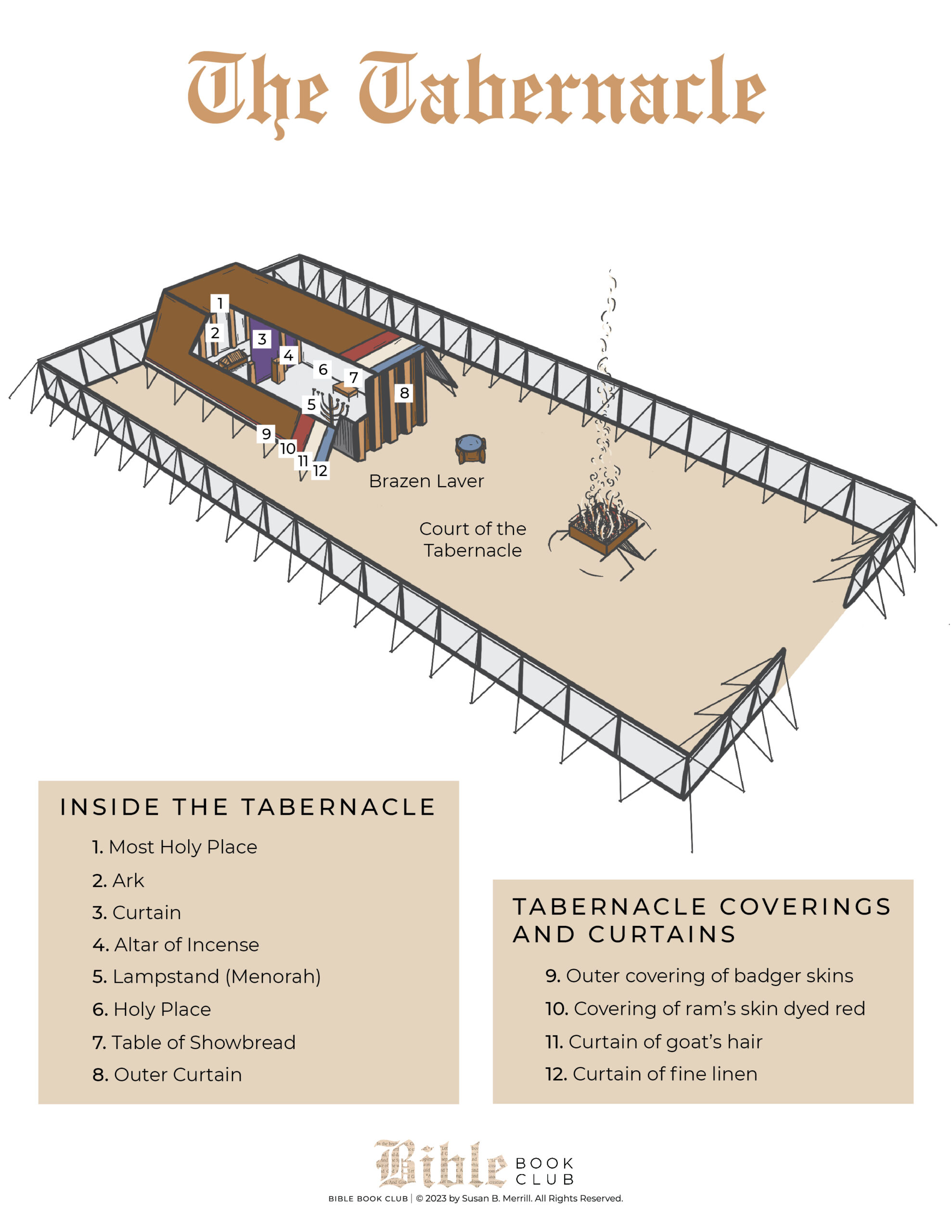
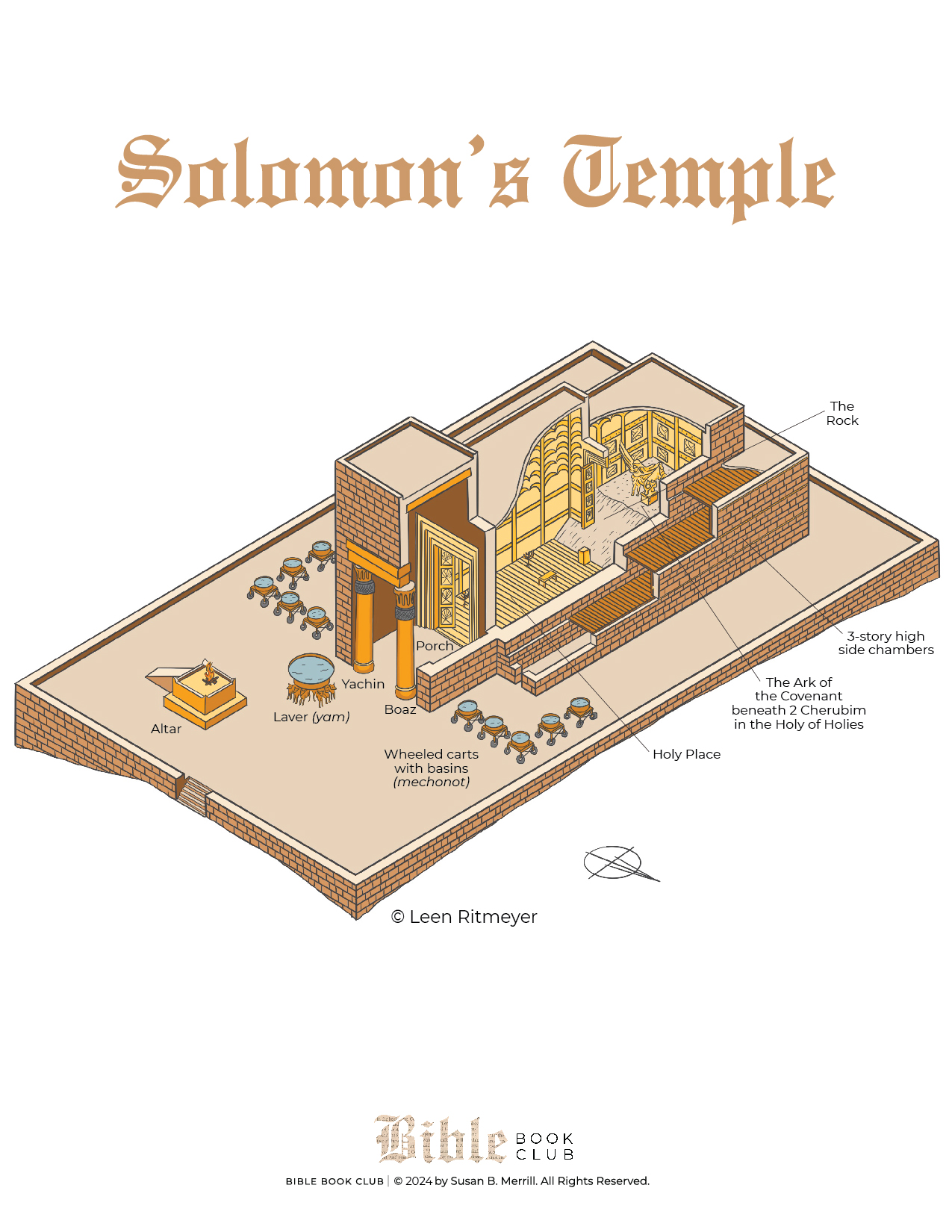
To get a sense of how the Temple and the Tabernacle compare, check out our show notes for both the Drawing of the Tabernacle and the Temple.
If you are curious about where the Temple was built, here are a few resources where you can dive deeper:
- Map of Mount Moriah and the temple
- Video tour of the Temple Mount and the dome of the Rock exterior on Mount Moriah
- Video of the inside of the Dome of the Rock
- Picture of the Rock inside the dome
The Chronicler keeps his description of the building brief because the returning exiles are in the process of rebuilding the Temple and very aware of what it needs to look like. Instead, he focuses on the Temple’s spiritual significance and its role in worship.
He also doesn’t take time to describe Solomon’s Palace, which was adjacent to the Temple. If you would like a more detailed description of the building, Solomon’s Palace, and God’s instructions to Solomon, listen to Bible Book Club Season 11 Episode 4.
Solomon Begins the Temple Construction–2 Chronicles 3
In 2 Chronicles 3:1-4, it’s finally time for Solomon to build the Temple!
The exterior measures about 90 feet long, 30 feet wide, and 45 feet high. The front porch adds another ten cubits. Around three exterior walls they build three-story side rooms.
The Temple is double the size of the Tabernacle. Still, it’s small compared to the other buildings Solomon constructed. The Temple is part of a much larger royal compound and the adjacent Palace.
The interior includes a long, narrow main hall or Holy Place. The Inner Sanctuary at the end of the main hall for the Ark is called The Most Holy Place or Holy of Holies.
The entrance to the Sanctuary is through the front porch. The entrance to the side rooms and stairs are on the south side of the Temple.
The Most Holy Place: A Sanctuary for God’s Presence
In 2 Chronicles 3:5-13, Solomon built the Inner Sanctuary of the Most Holy Place. This was the resting place for the Ark of the Covenant. It is a perfect 20-cubit square cube. For reference, a Biblical cubit was about 1.5 feet. (In other ancient cultures, it was longer.)
The walls, floor, and ceiling of the Most Holy Place are all overlaid with gold, and it takes up the entire last third of the temple–about 30 feet. The first two thirds of the Temple–about 60 feet–is the Main Hall or Holy Place. This room is also gold. Solomon loved his gold.
Inside the Most Holy Place are two 15-feet tall cherubim with 15-feet wing spans, expanding the entire width of the room and touching in the middle. In the drawing of the Temple we have in the show notes, you can see the cherubim likely stood right behind or over the Ark with their wings touching above it.
Jakin and Boaz: Pillars of Strength and Promise
In 2 Chronicles 3:14-17, the pillars of Jakin and Boaz are huge. From 1 Kings we know each pillar was about six feet wide and had a capital on top that made the entire pillar 34 feet tall. The capitals are in the shape of lilies decorated with tightly woven chainwork in a net pattern and lots of pomegranates.
The pillars’ names have meaning as well. Jakin means, “He will establish.” Boaz means, “In Him is strength.” When combined, they send a message, or prayer, that God will establish His people, or the line of David, and He is the strength of the nation and its king.
🎧 Ready to dive deeper? Listen to episodes of the Bible Book Club Podcast here.
Themes of this podcast:
Seek God first as the foundation of a faithful life. True wisdom and success come from prioritizing God above all else. Solomon shows us inquiring of the Lord should be our first response, not our last resort.
The blueprint for righteous living. When we love God and love others, everything else falls into place. Solomon shows us this when he asks for wisdom rather than wealth–genuine love for God naturally flows into love for others, which is how we can live a righteous life.
God’s faithfulness across generations and sacred places. From Abraham’s near-sacrifice of Isaac to David’s deliverance from the plague and Solomon’s Temple construction, God remains faithful to His people across time and generations.
Show Notes:
Map of Mount Moriah and the temple
Video tour of the Temple Mount and the dome of the Rock exterior on Mount Moriah
Video of the inside of the Dome of the Rock
Picture of the Rock inside the dome