
The Psalms Summary You’ve Always Needed
Most people read the Psalms the way they eat from a buffet…a little from here, a favorite from there. But the Psalter is a carefully architected five-book collection, and once you see its structure, everything changes.
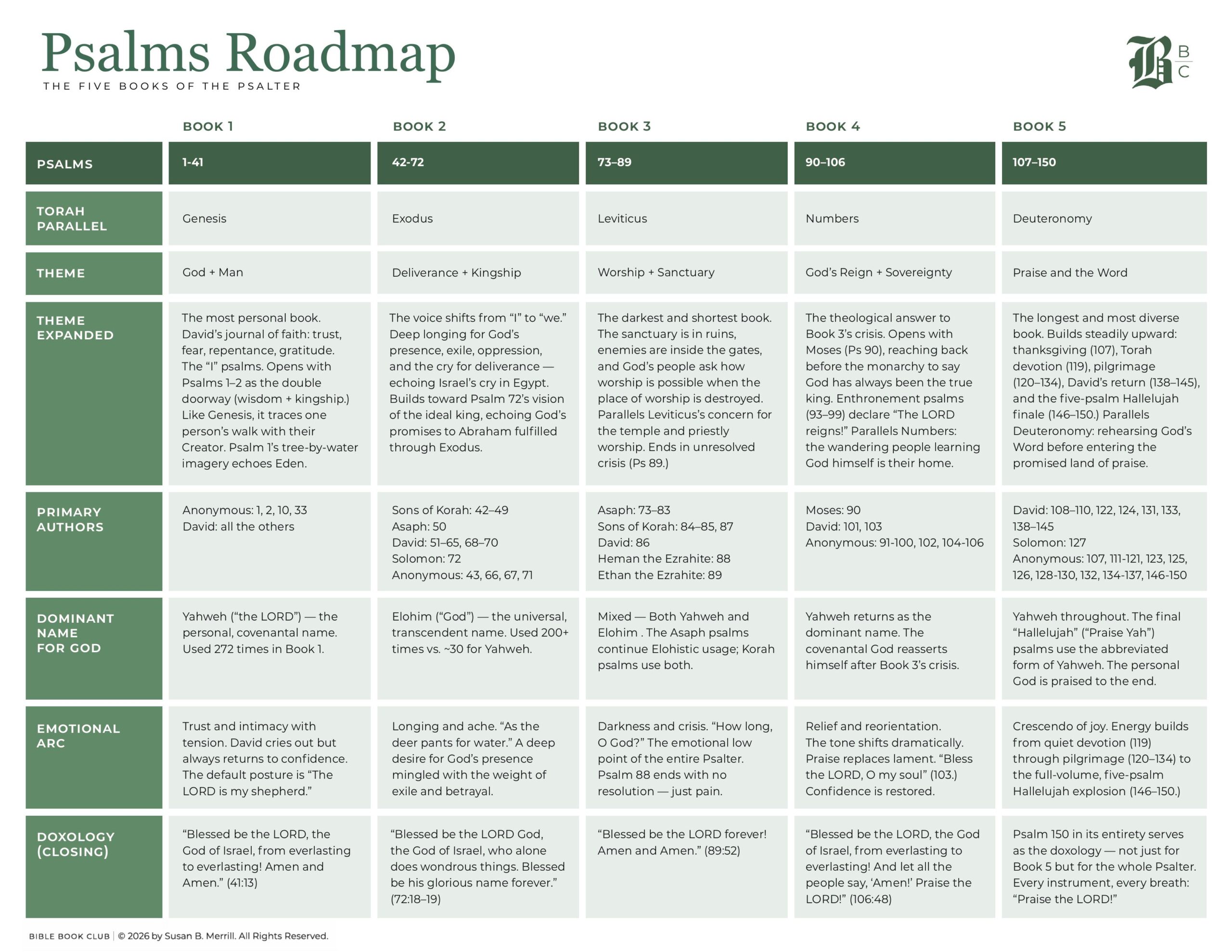
This Psalms summary chart gives you the full roadmap at a glance. Each of the five books beautifully mirrors a book of the Torah, has a specific theme, unique authors, a specific dominant name for God, and carries its own emotional arc.
- Book 1 (Psalms 1–41): The most personal. David’s unfiltered journal of faith, trust, fear, repentance, and gratitude.
- Book 2 (Psalms 42–72): The voice shifts from “I” to “we,” and a deep longing for God’s presence and deliverance.
- Book 3 (Psalms 73–89): This is the Psalter’s darkest and shortest book. The sanctuary is in ruins, enemies are inside the gates, and this book ends in unresolved crisis.
- Book 4 (Psalms 90–106): This book is the theological answer to Book 3’s crisis, opening with Moses and declaring that God has always been the true king.
- Book 5 (Psalms 107–150): This is the longest and most diverse book building steadily toward thanksgiving, Torah devotion, pilgrimage, David’s return, and the five-Psalm Hallelujah.
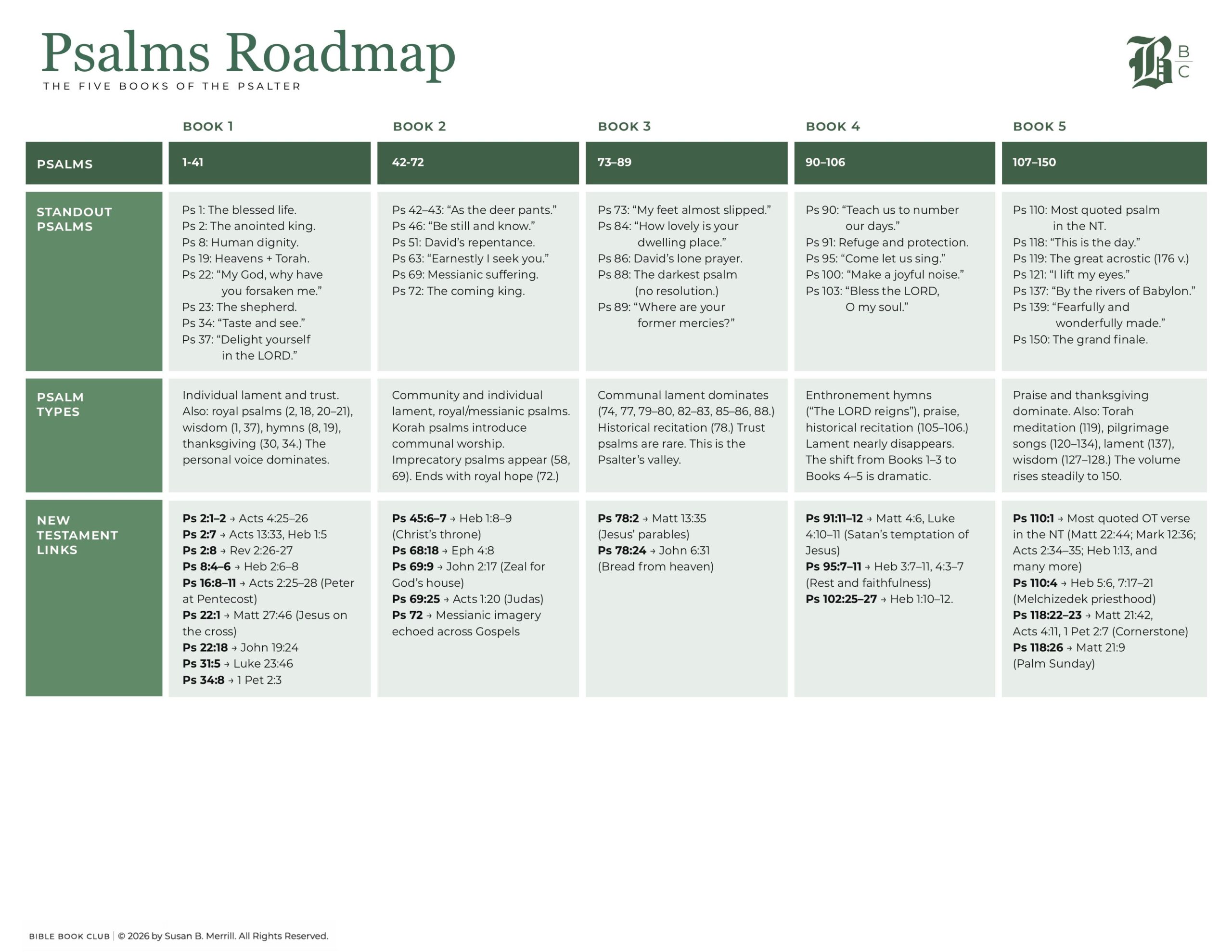
In this Psalms Roadmap, we give you standout Psalms, the doxology that closes each book, insight into the types of Psalms, and specific verses that link the Psalms and the New Testament. We hope this chart gives you greater clarity and confidence as you read through the Book of Psalms with us in the Bible Book Club!
Please feel free to download the chart, keep it in your Bible, and use it every time you open the Psalter.
