Nehemiah 5-6 Introduction
In chapters 5-6, we will learn two more tactics to battle four more types of opposition while also addressing a little community governance.
Scene 1: The Opposition Attacks with Conflict
Internal conflict is a form of opposition that divides. When the enemy fails in creating enough opposition from without, he goes to work stirring up opposition from within. While focusing on opposition outside the wall, internal opposition develops within the walls.
Nehemiah 5:1-13
1 Now the men and their wives raised a great outcry against their fellow Jews. 2 Some were saying, “We and our sons and daughters are numerous; in order for us to eat and stay alive, we must get grain.”
3 Others were saying, “We are mortgaging our fields, our vineyards and our homes to get grain during the famine.”
4 Still others were saying, “We have had to borrow money to pay the king’s tax on our fields and vineyards. 5 Although we are of the same flesh and blood as our fellow Jews and though our children are as good as theirs, yet we have to subject our sons and daughters to slavery. Some of our daughters have already been enslaved, but we are powerless, because our fields and our vineyards belong to others.”
6 When I heard their outcry and these charges, I was very angry. 7 I pondered them in my mind and then accused the nobles and officials. I told them, “You are charging your own people interest!” So I called together a large meeting to deal with them 8 and said: “As far as possible, we have bought back our fellow Jews who were sold to the Gentiles. Now you are selling your own people, only for them to be sold back to us!” They kept quiet, because they could find nothing to say.
9 So I continued, “What you are doing is not right. Shouldn’t you walk in the fear of our God to avoid the reproach of our Gentile enemies? 10 I and my brothers and my men are also lending the people money and grain. But let us stop charging interest! 11 Give back to them immediately their fields, vineyards, olive groves and houses, and also the interest you are charging them—one percent of the money, grain, new wine and olive oil.”
12 “We will give it back,” they said. “And we will not demand anything more from them. We will do as you say.”
Then I summoned the priests and made the nobles and officials take an oath to do what they had promised. 13 I also shook out the folds of my robe and said, “In this way may God shake out of their house and possessions anyone who does not keep this promise. So may such a person be shaken out and emptied!”
At this the whole assembly said, “Amen,” and praised the Lord. And the people did as they had promised.
The people are falling apart.
They are weary, physically exhausted from building the wall and standing watch on the wall, and emotionally exhausted from the threat of war lurking maliciously beyond the wall. To make matters worse, the economy has become strained, the city is overcrowded, and food is scarce. Those who have land are mortgaging houses, fields, and vineyards to buy food. Others are borrowing to pay taxes on their already mortgaged land.
Some have fallen so far financially that they are using their children to pay off debt. This is not slavery as we know it, but it is close. These sons and daughters are more like indentured servants, unpaid laborers working to pay off their family's debt. Unfortunately, it sounds as if there is some abuse of the system and the conditions are beginning to resemble slavery. The wealthy Israelites are exploiting their own people.
How do the wealthy Israelites violate Mosaic Law during the wall's construction?
Slavery in Egypt was what Moses had fought to free the Israelites from, and he gave specific laws about lending, servitude, and slavery.
Laws on Lending Money
One of Moses’ commands was that the people should lend money without interest.
Exodus 22:25 25 "If you lend money to one of my people among you who is needy, do not treat it like a business deal; charge no interest.
Laws on Debt Servitude
The laws also heavily regulated debt servitude to prevent it from becoming slavery.
- Debt servitude is to be of limited duration.
Exodus 21:2 2 "If you buy a Hebrew servant, he is to serve you for six years. But in the seventh year, he shall go free, without paying anything.
- The servant can be redeemed at any time if someone can settle the remaining debt.
Leviticus 25:47-49 47 “‘If a foreigner residing among you becomes rich and any of your fellow Israelites become poor and sell themselves to the foreigner or to a member of the foreigner’s clan, 48 they retain the right of redemption after they have sold themselves. One of their relatives may redeem them: 49 An uncle or a cousin or any blood relative in their clan may redeem them. Or if they prosper, they may redeem themselves.
- They are to be treated as hired workers, not slaves, and can not be ruthlessly ruled over.
Leviticus 25:39-43 39 “‘If any of your fellow Israelites become poor and sell themselves to you, do not make them work as slaves. 40 They are to be treated as hired workers or temporary residents among you; they are to work for you until the Year of Jubilee. 41 Then they and their children are to be released, and they will go back to their own clans and to the property of their ancestors. 42 Because the Israelites are my servants, whom I brought out of Egypt, they must not be sold as slaves. 43 Do not rule over them ruthlessly, but fear your God.
The returned exiles either had never learned or had chosen to ignore Moses’ laws.
What internal issues caused the Israelites to protest in Nehemiah Chapter 5?
The abuse from the well-to-do nobles, along with the people's fatigue, stress, debt, and poverty, created internal conflict. Internal conflict is a form of opposition that divides nations, churches, and families. And Nehemiah is not having it. He is righteously angry.
However, unlike Ezra, who also uncovered some law-breaking Israelites in our Bible study on Ezra, Nehemiah does not pull his hair out or fall into paralysis. Nehemiah does what I would like to do more of in tough situations: he ponders!
- Nehemiah does not react to what happens around him.
- He gets mad, but his anger does not distract him or blind him.
- He ponders, or in other words, he carefully considers his words and actions.
- Then Nehemiah makes his case.
What is Nehemiah's strategy for resolving internal conflict among the Jews?
Nehemiah goes first to those at the top: the nobles and officials. It says, "He deals with them."
- Nehemiah challenges the nobles and officials to stop. He and his brothers are lending without interest; therefore, they should do the same.
- He commands them to give it all back: the fields, vineyards, olive groves, and houses.
- He tells them to forgive all the debt and return the collateral.
And they do it! I would have liked to witness that because the man is a force, and I could use a few tips in this area. The guilty nobles and officials are speechless. What can they say? Nehemiah ends by shaking out his robes, illustrating the curse that will befall anyone who doesn’t follow through. They will be shaken out of their precious wealth and fall to nothing.
Scene 2: Nehemiah Leads By Example
Nehemiah 5:14-19
14 Moreover, from the twentieth year of King Artaxerxes, when I was appointed to be their governor in the land of Judah, until his thirty-second year—twelve years—neither I nor my brothers ate the food allotted to the governor. 15 But the earlier governors—those preceding me—placed a heavy burden on the people and took forty shekels of silver from them in addition to food and wine. Their assistants also lorded it over the people. But out of reverence for God I did not act like that. 16 Instead, I devoted myself to the work on this wall. All my men were assembled there for the work; we did not acquire any land.
17 Furthermore, a hundred and fifty Jews and officials ate at my table, as well as those who came to us from the surrounding nations. 18 Each day one ox, six choice sheep and some poultry were prepared for me, and every ten days an abundant supply of wine of all kinds. In spite of all this, I never demanded the food allotted to the governor, because the demands were heavy on these people.
19 Remember me with favor, my God, for all I have done for these people.
What is the meaning of the food allowance in Nehemiah 5?
During this time period, governors had a food allowance, which was money the people paid to support their leader. This isn’t corruption; it is part of the deal. However, the governors before Nehemiah took advantage. They required food, wine, and 40 shekels of silver, and the people were poor.
Why did Nehemiah refuse the governor's food allowance for twelve years?
Out of reverence for God, Nehemiah does not take the governor’s food allowance . He gives up a right as governor to do what is right for God. Not only does Nehemiah give up the perks of being governor, he personally works on the wall instead of relaxing back at the office. Nehemiah also personally funds the 150 people who regularly eat with him.
Nehemiah hosts, feeds, and cares for the people out of his own pocket, because he has:
- Perceived the situation: The people are poor.
- Pondered his options, and he chooses God's way.
It isn’t the easy way. There will be no earthly reward for it. But his last words say it all, " Remember me with favor, my God." There it is… favor. One of my favorite words! So many great Bible characters make favor their goal. There is no earthly prize greater than to find favor with our Father in heaven.
Scene 3: The Opposition Attacks With Temptation
Temptation is a form of opposition that distracts.
Nehemiah 6:1-4
1 When word came to Sanballat, Tobiah, Geshem the Arab and the rest of our enemies that I had rebuilt the wall and not a gap was left in it—though up to that time I had not set the doors in the gates— 2 Sanballat and Geshem sent me this message: “Come, let us meet together in one of the villages on the plain of Ono.”
But they were scheming to harm me; 3 so I sent messengers to them with this reply: “I am carrying on a great project and cannot go down. Why should the work stop while I leave it and go down to you?” 4 Four times they sent me the same message, and each time I gave them the same answer.
The Opposition is Desperate
Sanballat, Tobiah, and Geshem will not give up. They are desperate. The wall is complete except for the gates, and once the gates are up, Jerusalem will be secure. I can almost imagine their panic like, “How did we let this lowly little group get this far?” Their only hope to stop Israel's momentum is to bring down the man behind the wall: Nehemiah.
They invite Nehemiah to a friendly meeting. A chance to get on the same page, discuss things, in Ono. However, their choice of location demonstrates a lack of subterfuge. Ono is hardly a neutral location, because it is near Sanballat's Samaria, making it an ideal place to plan an ambush on Nehemiah. It is also a day's travel away, which will remove Nehemiah from the city for two to three days. This is genius manipulation, actually.
What is the purpose of the invitation to meet at the plain of Ono?
Meeting at the plain of Ono will allow Sanballat, Tobiah, and Geshem to kill Nehemiah and, at the same time, attack Jerusalem. The scheme echoes Satan's temptations of Jesus in Matthew 4. Nehemiah says he won't go down to their meeting, and when Satan tells Jesus to throw himself down from the mountain, Jesus says he won’t go down either.
How did Nehemiah respond to the four invitations from Sanballat and Geshem?
Four times they ask, and four times Nehemiah dismisses their deception. Nehemiah is focused on God's work, and everything else is not worth pondering.
- He is not fooled, and therefore he is not tempted.
- He is not distracted from his work.
- He doesn’t waste time trying to figure out what they are up to.
- He doesn’t waste energy worrying about his life.
Nehemiah just moves on and goes back to work. But the fifth invitation is more overt.
Scene 4: The Opposition Attacks With Lies
Lying is a form of opposition that creates confusion.
Nehemiah 6:5-9
5 Then, the fifth time, Sanballat sent his aide to me with the same message, and in his hand was an unsealed letter 6 in which was written:
“It is reported among the nations—and Geshem says it is true—that you and the Jews are plotting to revolt, and therefore you are building the wall. Moreover, according to these reports you are about to become their king 7 and have even appointed prophets to make this proclamation about you in Jerusalem: ‘There is a king in Judah!’ Now this report will get back to the king; so come, let us meet together.”
8 I sent him this reply: “Nothing like what you are saying is happening; you are just making it up out of your head.”
9 They were all trying to frighten us, thinking, “Their hands will get too weak for the work, and it will not be completed.”
But I prayed, “Now strengthen my hands.”
Why does Sanballat send an unsealed letter as the fifth invitation?
Sanballat does not seal the letter in hopes that others will read it on its way to Nehemiah and spread seeds of doubt about Nehemiah throughout Jerusalem. Many people probably did read the letter, because letters are the only form of communication and change many hands on the way to their recipient. An open letter would have been an open invitation to read.
What false accusations are written in Sanballat's open letter to Nehemiah?
In the letter, Sanballat accuses Nehemiah of planning a revolt against the king and of planning to become king himself. Nehemiah never even gives a thought to who might have seen the lies. It will take too much time from his work.
One of the hardest things in life is to ignore liars and people who slander us. But if we become too concerned with how people perceive us and what we do–what we believe–and endlessly try to respond to them, we will drive ourselves mad and waste a lot of time and energy.
Nehemiah recognizes this attempt for what it is: a desperate effort to create confusion and doubt amongst the Israelites. And he is not having it. He is almost disdainful in his response, like, “You are ridiculous, and making this up in your head.”
A Lesson for Us
There is a lesson from Nehemiah that is crucial for our generation. We have access to so much information about friends, community, the nation, and the world. All that information is a temptation. We can be drawn in to the point that we are wasting time and energy on navigating truth, lies, and opinion. In the end, it distracts us from the work in front of us. The very things we can do something about. The lesson is to determine how to avoid distracting drama.
Nehemiah sees the attempt for what it is: an attempt from the opposition to:
- Create confusion and doubt that will drain him.
- Take him away from where God wants him. On the wall.
So where do you get your information? And how much time do you spend there? Is it a healthy amount of information and time? Or are you spiraling out into conspiracy theories about people and the world to the point that you are confused and losing trust in humanity? We must take our eyes off the world and look up, in trust, to God. He is the author of truth, and that truth is written out for us in his Word, the Bible.
Scene 5: The Opposition Attacks Nehemiah Personally
Personal attacks are a form of opposition that destroys credibility.
Nehemiah 6:10-14
10 One day I went to the house of Shemaiah son of Delaiah, the son of Mehetabel, who was shut in at his home. He said, “Let us meet in the house of God, inside the temple, and let us close the temple doors, because men are coming to kill you—by night they are coming to kill you.”
11 But I said, “Should a man like me run away? Or should someone like me go into the temple to save his life? I will not go!” 12 I realized that God had not sent him, but that he had prophesied against me because Tobiah and Sanballat had hired him. 13 He had been hired to intimidate me so that I would commit a sin by doing this, and then they would give me a bad name to discredit me.
14 Remember Tobiah and Sanballat, my God, because of what they have done; remember also the prophet Noadiah and how she and the rest of the prophets have been trying to intimidate me.
Why is the opposition getting personal?
The opposition has been personally humiliated, over and over again, failing to thwart Nehemiah. Therefore, their anger burns against him. Forget the wall. In revenge, they want to destroy the man.
Sanballat and Tobiah's strategy is to discredit Nehemiah in his leadership and faith. He has been the driving force behind the people's growing faith. His example is exemplary, and they want to bring him down, hoping to bring down the revival of Jerusalem. So they hire a prophet named Shemaiah.
Shemaiah is confined to his home, a detail that explains why Nehemiah goes to him. It also makes the prophet appear more isolated and believable. Shemaiah is the son of Delaiah, who was mentioned in Ezra 2:59 in the list of exiles who returned but could not show that their families were descended from Israel. So he may have been from a priestly line, and he may not. His legitimacy is somewhat suspect, which makes him a good hire for the opposition.
How does the prophet Shemaiah attempt to discredit Nehemiah's leadership?
Shemaiah's plan sounds like a prophecy directly from God, but in reality the message is a cleverly fear-based trap. Shemaiah is using his own credibility as a prophet to get Nehemiah to believe his death is imminent. He wants Nehemiah to believe God has given him a plan for Nehemiah’s protection.
Shemaiah offers this solution as if he is a partner in protecting Nehemiah. He says, " let us " meet in the Temple and close the doors. He implies it’s okay because he is going to do it too.
Nehemiah is not having it. He cannot be fooled into being foolish. He knows God's laws. The Temple is sacred. Only priests are allowed in the Temple, and Nehemiah is not a priest. If Nehemiah is found in the Temple, the guards will arrest him or possibly kill him on the spot. Either way, Nehemiah's leadership would come to an end. His sin would discredit him, and all he had worked for would be at risk. Sanballat and Tobiah know this. They are no longer trying to kill Nehemiah with words or swords. They are trying to kill him with the Law of his own God at the hands of his own people.
A Lesson for Us
While Shemaiah is a prophet and his plan may sound like prophecy, it isn’t because it contradicts the Word of God. Nehemiah knows it is a trap because he knows God's laws. But in the same situation, would we? People, even believers, may give you advice that has not been run through the filter of the Bible. We must know the Word, or how to search for the Word, to avoid a fall. So says Psalm 119, which is most likely written by David, another man who loved the Lord and was chased by the opposition (King Saul) and often tempted to sin.
Psalm 119:9-16 9 How can a young person stay on the path of purity?By living according to your word. 10 I seek you with all my heart; do not let me stray from your commands. 11 I have hidden your word in my heart that I might not sin against you. 12 Praise be to you, Lord;
teach me your decrees. 13 With my lips I recount all the laws that come from your mouth. 14 I rejoice in following your statutes as one rejoices in great riches. 15 I meditate on your precepts and consider your ways. 16 I delight in your decrees; I will not neglect your
word.
The Bible will keep us focused. It will teach us discernment, the ability to know if something is from God or the opposition. Nehemiah knows right away, for he doesn't even hesitate. Personal attacks are a form of opposition that destroy credibility. The solution to overcoming personal attacks is discernment.
What are the six types of opposition identified in Nehemiah Chapters 4 through 6?
Over the last two chapters, we have covered six types of opposition: ridicule, threats, internal conflict, temptation, lies, and personal attacks.
- Ridicule is a form of opposition that can lead to losing heart.
- Threats are a form of opposition that can lead to fear.
- Internal conflict is a form of opposition that divides.
- Temptation is a form of opposition that distracts.
- Lies are a form of opposition that create confusion.
- Personal attacks are a form of opposition that destroy credibility.
All six are very much alive today. Every single one of them has the same purpose: to distract you from God. The enemy wants to tear down that wall you are building with faith, and the faith you may be building in others. Why? Because we aren't just in a battle with temptation from the opposition. We are in a battle for our witness, our credibility as believers. We are in a battle to be a light in the darkness. The apostle Paul warned of these common sins that can distract and discredit us.
2 Corinthians 12:20 20 For I am afraid that when I come I may not find you as I want you to be, and you may not find me as you want me to be. I fear that there may be discord, jealousy, fits of rage, selfish ambition, slander, gossip, arrogance and disorder.
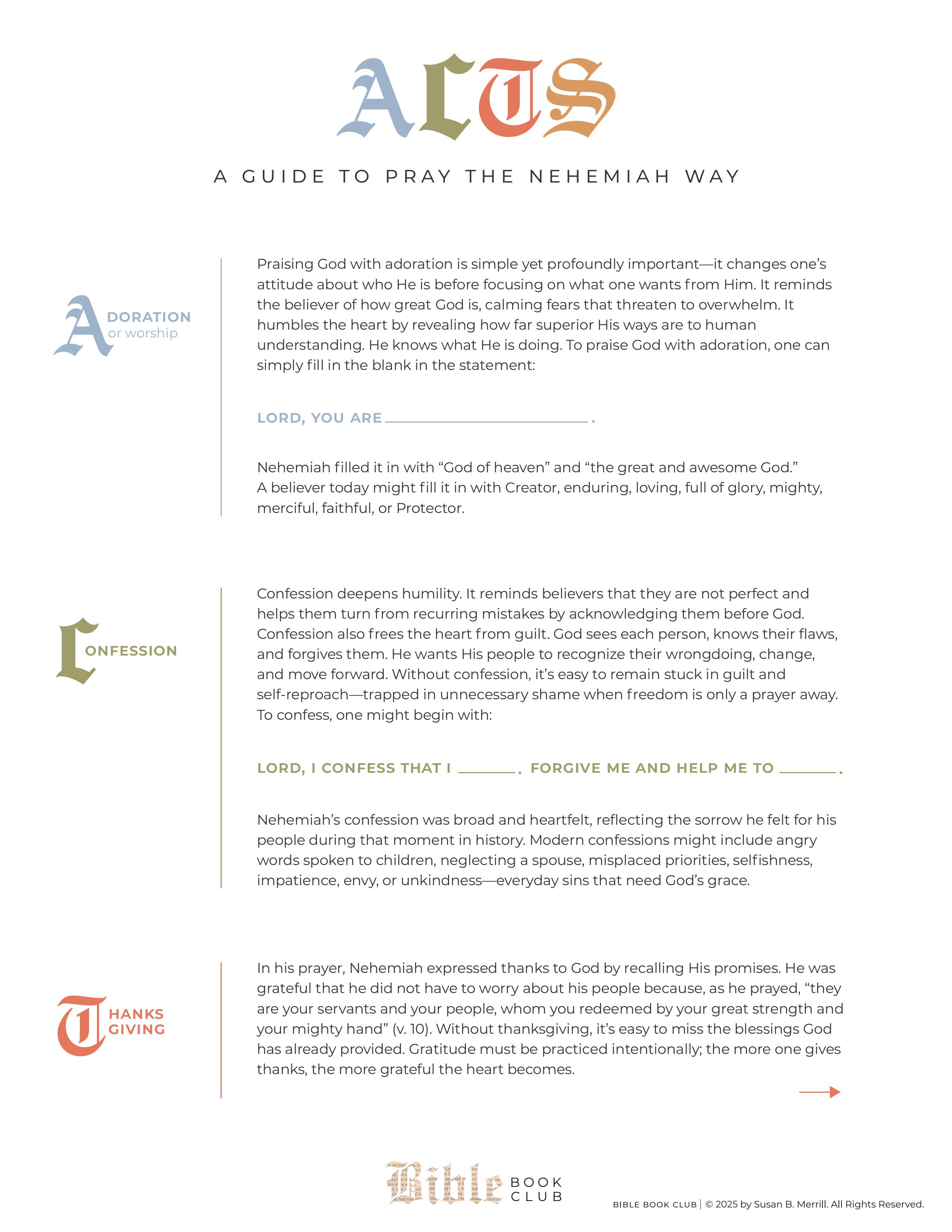
The Solution is to discern and dissent, to recognize and resist. Do what Nehemiah would do. This is where Nehemiah's pattern of P's comes back into play.
What is the "pattern of P's" Nehemiah uses to overcome opposition?
- Pray for strength to stop.
- Perceive what is actually happening.
- Ponder a better response.
- Plan a way out of it.
- Prepare for it to happen.
You can be victorious over temptations that discredit you, your faith, and your work. You do not have to be:
- Defeated by ridicule.
- Paralyzed by threats.
- Divided by internal conflict.
- Destroyed by personal attacks.
You can overcome the opposition. The Lord will give you strength. The last thing He wants is for His people to lose heart, fear, become divided, and lose their credibility. He has called us to be a light to the world. He has given us Nehemiah as an example. We can do this!
Join us for our Nehemiah 6-7 commentary!
Group Discussion Questions for Nehemiah 5
- Sanballat sent an unsealed letter to spread false news about Nehemiah. Back then, they had letters. Today, where do you get your information, and how much time do you spend there? Is it a healthy amount of information and time, or is it causing you to lose trust in humanity? How might you take your eyes off the news and look up in trust to God, the author of truth?
- Nehemiah recognizes Shemaiah as a false prophet because Nehemiah knows God’s Word and His Laws. When people, even believers, give you advice, what’s one way you can run it through the filter of the Bible to make sure it’s true?
- Nehemiah's pattern is to pray, perceive, ponder, plan, and prepare rather than react. Which of those five steps do you most often skip, and what would change if you didn't?