Scene 1: The Israelites Seal the Covenant Deal
First up in this episode is who is sealed in the agreement.
Nehemiah 10:1-29
1 Those who sealed it were: Nehemiah the governor, the son of Hakaliah. Zedekiah, 2 Seraiah, Azariah, Jeremiah, 3 Pashhur, Amariah, Malkijah, 4 Hattush, Shebaniah, Malluk, 5 Harim, Meremoth, Obadiah, 6 Daniel, Ginnethon, Baruch, 7 Meshullam, Abijah, Mijamin, 8 Maaziah, Bilgai and Shemaiah. These were the priests.
9 The Levites: Jeshua son of Azaniah, Binnui of the sons of Henadad, Kadmiel, 10 and their associates: Shebaniah, Hodiah, Kelita, Pelaiah, Hanan, 11 Mika, Rehob, Hashabiah, 12 Zakkur, Sherebiah, Shebaniah, 13 Hodiah, Bani and Beninu.
14 The leaders of the people: Parosh, Pahath-Moab, Elam, Zattu, Bani, 15 Bunni, Azgad, Bebai, 16 Adonijah, Bigvai, Adin, 17 Ater, Hezekiah, Azzur, 18 Hodiah, Hashum, Bezai, 19 Hariph, Anathoth, Nebai, 20 Magpiash, Meshullam, Hezir, 21 Meshezabel, Zadok, Jaddua, 22 Pelatiah, Hanan, Anaiah, 23 Hoshea, Hananiah, Hasshub, 24 Hallohesh, Pilha, Shobek, 25 Rehum, Hashabnah, Maaseiah, 26 Ahiah, Hanan, Anan, 27 Malluk, Harim and Baanah.
28 “The rest of the people—priests, Levites, gatekeepers, musicians, temple servants and all who separated themselves from the neighboring peoples for the sake of the Law of God, together with their wives and all their sons and daughters who are able to understand— 29 all these now join their fellow Israelites the nobles, and bind themselves with a curse and an oath to follow the Law of God given through Moses the servant of God and to obey carefully all the commands, regulations and decrees of the Lord our Lord.
What do the people sign?
The people sign a promise to keep the covenant. They make a commitment to God, because promises mean nothing without a commitment behind them. Note the community in this commitment. All the people join their fellow Israelites and the nobles, even the nobles whom you will recall in Chapter 5 are somewhat adversarial.
Who are the primary individuals who sign the binding agreement in Nehemiah 10?
Nehemiah is the first to sign the binding agreement in Nehemiah 10. The priests follow him. The Levites follow the priests. The leaders of the people are last. There are 84 signatures altogether.
Now we know, in hindsight, that the Israelites do not keep this commitment. It is an impossible promise. One that simply demonstrates the need for a new deal. The one we get in Jesus Christ. And our deal is sealed with the Holy Spirit, which makes it irrevocable.
Ephesians 1:13-14 13 And you also were included in Christ when you heard the message of truth, the gospel of your salvation. When you believed, you were marked in him with a seal, the promised Holy Spirit, 14 who is a deposit guaranteeing our inheritance until the redemption of those who are God’s possession—to the praise of his glory.
We have a seal guaranteeing our inheritance. A promise from God. He is committed. He made a way for us to get out of the cycle of the Old Covenants. The question is, how committed are we to the covenant? Do we fully appreciate what it cost God to provide the way? It cost His one and only Son. Do we take advantage of that guarantee, or are we coasting on the promise?
Scene 2: Nehemiah Addresses Three Potential Problems
Nehemiah 10:30-39
30 “We promise not to give our daughters in marriage to the peoples around us or take their daughters for our sons.
31 “When the neighboring peoples bring merchandise or grain to sell on the Sabbath, we will not buy from them on the Sabbath or on any holy day. Every seventh year we will forgo working the land and will cancel all debts.
32 “We assume the responsibility for carrying out the commands to give a third of a shekel each year for the service of the house of our God: 33 for the bread set out on the table; for the regular grain offerings and burnt offerings; for the offerings on the Sabbaths, at the New Moon feasts and at the appointed festivals; for the holy offerings; for sin offerings to make atonement for Israel; and for all the duties of the house of our God.
34 “We—the priests, the Levites and the people—have cast lots to determine when each of our families is to bring to the house of our God at set times each year a contribution of wood to burn on the altar of the Lord our God, as it is written in the Law.
35 “We also assume responsibility for bringing to the house of the Lord each year the firstfruits of our crops and of every fruit tree.
36 “As it is also written in the Law, we will bring the firstborn of our sons and of our cattle, of our herds and of our flocks to the house of our God, to the priests ministering there.
37 “Moreover, we will bring to the storerooms of the house of our God, to the priests, the first of our ground meal, of our grain offerings, of the fruit of all our trees and of our new wine and olive oil. And we will bring a tithe of our crops to the Levites, for it is the Levites who collect the tithes in all the towns where we work. 38 A priest descended from Aaron is to accompany the Levites when they receive the tithes, and the Levites are to bring a tenth of the tithes up to the house of our God, to the storerooms of the treasury. 39 The people of Israel, including the Levites, are to bring their contributions of grain, new wine and olive oil to the storerooms, where the articles for the sanctuary and for the ministering priests, the gatekeepers and the musicians are also kept.
“We will not neglect the house of our God.”
Did Ezra and Nehemiah have a conversation?
I feel like there is a missing conversation between the covenant signing and the next three warnings to the people. A conversation that most likely would have happened between Ezra and Nehemiah. Perhaps Ezra pulls Nehemiah aside and says, “Okay, this is good; the entire community is all in on the covenant. But, uh, Nehemiah, I have to tell you, based on my experience (see Ezra chapter 9), the people love weddings, and they are not discerning about who they marry. Their bad marriage choices lead to idolatry.”
Then maybe Nehemiah says, “I’m not having it.” So he makes them agree to a family commitment.
Then can you imagine Ezra, the priest who cares deeply about the Sabbath, saying, “ Well, Nehemiah, while I have you, the people are conducting business on the Sabbath. They are not keeping the Sabbath, the sabbatical year, or the year of Jubilee.”
This Sabbath distraction leads to distraction from God. And I imagine Nehemiah says, “I’m not having it.” So he makes them agree to a faith commitment.
Then maybe Ezra, the priest who is responsible for much of the work at the Temple, says something like, “Nehemiah, just one more thing. We have so much work to do at the Temple now that the people want to atone for their sins. However, the people are not financially supporting the work to hold ceremonies, worship, and festivals.”
And perhaps Nehemiah says, “I’m not having it.” So he makes them agree to a financial commitment.
Of course, we don't really know how the following commitments come into being, but I would bet Ezra is in Nehemiah's ear, because these are all sins he has to deal with. The point is, Nehemiah adds to the covenant commitments.
What are the three specific social and religious problems Nehemiah addressed in the covenant?
The people agree they will not intermarry. They will honor the Sabbath. They will tithe: a third of a shekel, the first fruits of their crops, the firstborn of their sons and herds, and the first of their grain, wine, and oil.
Let me explain the requirement for the firstborn son, because it has a cool tie to the Exodus and is used in reference to Jesus.
Why do the Israelites have to redeem their firstborn sons according to the Law?
In Exodus, after God saved the Israelites from Egypt, He commanded:
Exodus 13:1-2 1 The Lord said to Moses, 2 “Consecrate to me every firstborn male. The first offspring of every womb among the Israelites belongs to me, whether human or animal.”
Then God told them that when they got to Canaan, they were to:
Exodus 13:11-16 11 “After the Lord brings you into the land of the Canaanites and gives it to you, as he promised on oath to you and your ancestors, 12 you are to give over to the Lord the first offspring of every womb. All the firstborn males of your livestock belong to the Lord. 13 Redeem with a lamb every firstborn donkey, but if you do not redeem it, break its neck. Redeem every firstborn among your sons.
14 “In days to come, when your son asks you, ‘What does this mean?’ say to him, ‘With a mighty hand the Lord brought us out of Egypt, out of the land of slavery. 15 When Pharaoh stubbornly refused to let us go, the Lord killed the firstborn of both people and animals in Egypt. This is why I sacrifice to the Lord the first male offspring of every womb and redeem each of my firstborn sons.’ 16 And it will be like a sign on your hand and a symbol on your forehead that the Lord brought us out of Egypt with his mighty hand.”
To commemorate God's saving grace on the night the Egyptian’s firstborns died, the Israelites are to bring their firstborn son to the Lord. Not for them to serve in the Temple, but to offer a lamb in their place. Just as God redeemed their firstborn sons with the blood of a lamb in Egypt, they are to redeem their firstborn sons with a lamb in the Promised Land. What is cool is that Mary and Joseph kept this commitment. They redeemed Jesus, their firstborn son.
Luke 2:22-24 22 When the time came for the purification rites required by the Law of Moses, Joseph and Mary took him to Jerusalem to present him to the Lord 23 (as it is written in the Law of the Lord, “Every firstborn male is to be consecrated to the Lord”), 24 and to offer a sacrifice in keeping with what is said in the Law of the Lord: “a pair of doves or two young pigeons.”
Note that they sacrificed a pair of doves and two pigeons. This act of presenting the firstborn son also met the requirement in Leviticus 12 for the purification of the mother after childbirth, which states that if the parents cannot afford a lamb, they are to sacrifice two doves or pigeons.
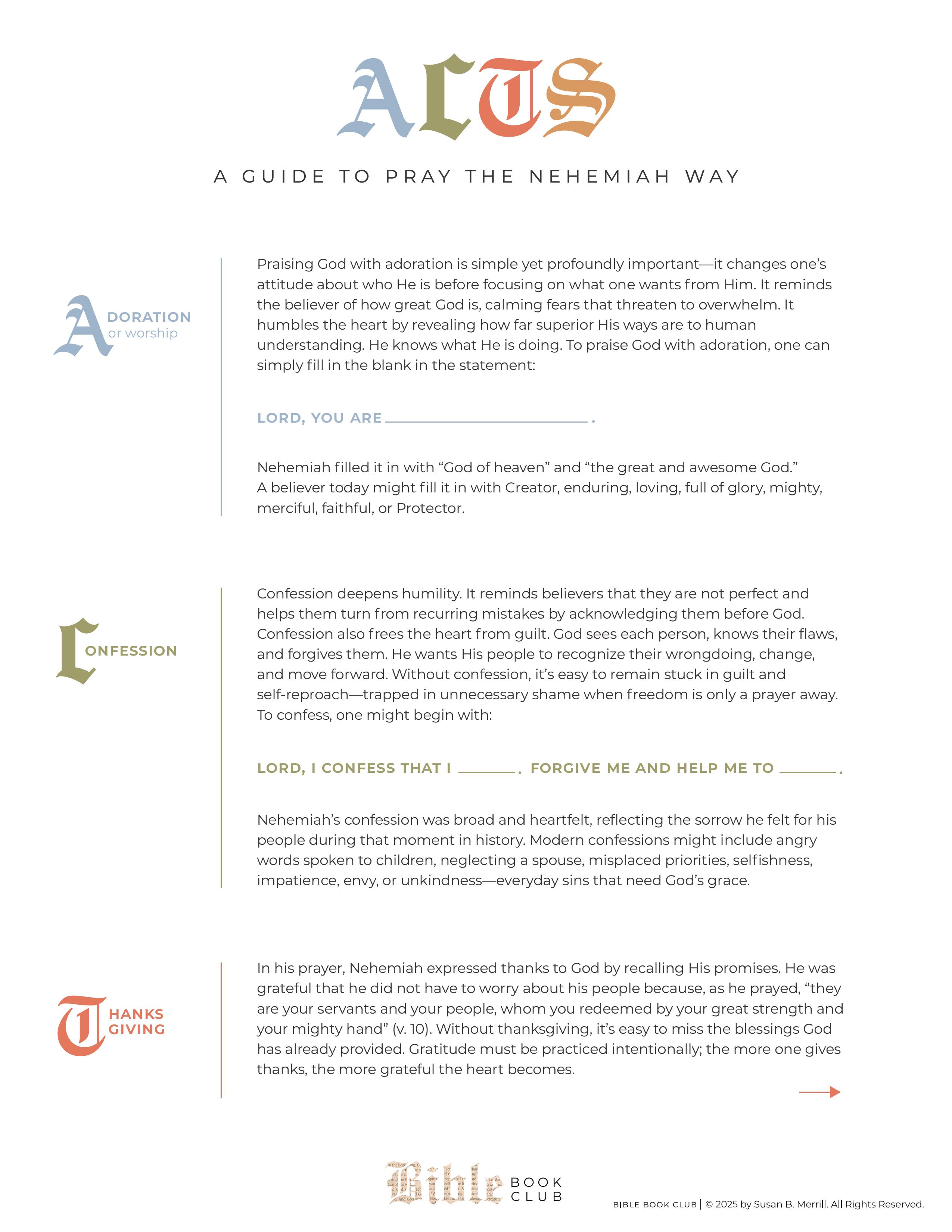
The thought to ponder is: What are our commitments to God regarding family, faith, and finances? What is our commitment to marriage, the Sabbath, and supporting the church? What does God want us to do today? We will find out when we get to the New Testament. Until then, ponder like Nehemiah.
Scene 3: The Jerusalem Repopulation Plan
Nehemiah 11:1-19
1 Now the leaders of the people settled in Jerusalem. The rest of the people cast lots to bring one out of every ten of them to live in Jerusalem, the holy city, while the remaining nine were to stay in their own towns. 2 The people commended all who volunteered to live in Jerusalem.
3 These are the provincial leaders who settled in Jerusalem (now some Israelites, priests, Levites, temple servants and descendants of Solomon’s servants lived in the towns of Judah, each on their own property in the various towns, 4 while other people from both Judah and Benjamin lived in Jerusalem):
From the descendants of Judah: Athaiah son of Uzziah, the son of Zechariah, the son of Amariah, the son of Shephatiah, the son of Mahalalel, a descendant of Perez; 5 and Maaseiah son of Baruch, the son of Kol-Hozeh, the son of Hazaiah, the son of Adaiah, the son of Joiarib, the son of Zechariah, a descendant of Shelah. 6 The descendants of Perez who lived in Jerusalem totaled 468 men of standing.
7 From the descendants of Benjamin: Sallu son of Meshullam, the son of Joed, the son of Pedaiah, the son of Kolaiah, the son of Maaseiah, the son of Ithiel, the son of Jeshaiah, 8 and his followers, Gabbai and Sallai—928 men. 9 Joel son of Zikri was their chief officer, and Judah son of Hassenuah was over the New Quarter of the city.
10 From the priests: Jedaiah; the son of Joiarib; Jakin; 11 Seraiah son of Hilkiah, the son of Meshullam, the son of Zadok, the son of Meraioth, the son of Ahitub, the official in charge of the house of God, 12 and their associates, who carried on work for the temple—822 men; Adaiah son of Jeroham, the son of Pelaliah, the son of Amzi, the son of Zechariah, the son of Pashhur, the son of Malkijah, 13 and his associates, who were heads of families—242 men; Amashsai son of Azarel, the son of Ahzai, the son of Meshillemoth, the son of Immer, 14 and his associates, who were men of standing—128. Their chief officer was Zabdiel son of Haggedolim.
15 From the Levites: Shemaiah son of Hasshub, the son of Azrikam, the son of Hashabiah, the son of Bunni; 16 Shabbethai and Jozabad, two of the heads of the Levites, who had charge of the outside work of the house of God; 17 Mattaniah son of Mika, the son of Zabdi, the son of Asaph, the director who led in thanksgiving and prayer; Bakbukiah, second among his associates; and Abda son of Shammua, the son of Galal, the son of Jeduthun. 18 The Levites in the holy city totaled 284.
19 The gatekeepers: Akkub, Talmon and their associates, who kept watch at the gates—172 men.
Nehemiah Has Done the Impossible
Nehemiah has done what most thought was impossible.
- The wall is complete.
- The enemies are quiet.
- The Book of the Law is read.
- The people are convicted and repented.
- The covenant is renewed.
- The people are committed.
However, there is still a critical problem: Jerusalem is an ugly mess due to years of war and neglect. Walls protect no one if there's nobody living there. Jerusalem has all the infrastructure of a great city, but it is a ghost town. So Nehemiah faces a leadership question still faced today: how do you get people to commit not just in their hearts but with their lives? Many of the returned exiles have built new homes outside of Jerusalem in the suburbs where they have space for a two-cart garage. Nehemiah needs to spark an urban redevelopment. But how?
What method does Nehemiah use to decide who will live inside the city of Jerusalem?
Nehemiah casts lots to decide who will live inside the city of Jerusalem. If the lot falls to you, that means God has chosen you to move back. Ouch, I’m not sure everyone likes this process, but faith in God requires obedience.
Some families have to sacrifice the comfort of where they want to live for where God wants them to live. Some families volunteer to move back, seeing it as a mission or duty. All who obey the call to move are celebrated. Their sacrifice is a big deal to Nehemiah and Ezra. So big that Nehemiah records their sacrifice for eternity in his book.
Which two tribes of Israel provide the laypeople for the repopulation of Jerusalem?
The lay people who settle in Jerusalem are from two tribes: Judah and Benjamin. In the category of lay people, it is interesting to note that from the tribe of Judah we have descendants of Perez and Shelah.
Nehemiah references Genesis 38, stating that these families are descendants of two of Judah's sons and the grandsons of Jacob. Perez carries the line of Christ and is listed in both Matthew's and Luke's genealogies.
How many "men of standing" from the tribe of Judah settle in the city?
A total of 468 men of standing come from Judah. The "men of standing" is a distinction and implies that these men have been honored for courage. From the tribe of Benjamin, we have twice the number of men, at 928 men returning to live in Jerusalem.
From the priests, we have 822 associates, 242 heads of family, and 128 men of standing. It sounds as if Seraiah is the high priest at the time, but Eliashib is cited as high priest at the time in Nehemiah 3. Seraiah is a high-ranking Temple official. Nehemiah may have intentionally left out the mention of Eliashib here. It could be because he already established his return to Jerusalem in chapter 3. Or it could be because Nehemiah doesn’t approve of Eliashib, and for very good reasons we will get to in our Nehemiah 12-13 commentary!
There are a lot of Levites and a lot of roles. These are the men from the tribe of Levi who keep the Temple and worship going on a daily basis.
Who are the gatekeepers responsible for guarding the walls and Temple storerooms?
Akkub, Talmon, and their associates are the men stationed on Nehemiah's beloved wall, whom we learned in Nehemiah 7 would have been under the charge of the two men Nehemiah trusts most: his brother Hanani and the commander of the citadel, Hananiah.
Scene 4: Everyone Else Lives Beyond the Walls
Everyone else lives beyond the walls on their ancestral properties that were allocated when Joshua and the 12 tribes settled in the Promised Land.
Nehemiah 11:20-36
20 The rest of the Israelites, with the priests and Levites, were in all the towns of Judah, each on their ancestral property.
21 The temple servants lived on the hill of Ophel, and Ziha and Gishpa were in charge of them.
22 The chief officer of the Levites in Jerusalem was Uzzi son of Bani, the son of Hashabiah, the son of Mattaniah, the son of Mika. Uzzi was one of Asaph’s descendants, who were the musicians responsible for the service of the house of God. 23 The musicians were under the king’s orders, which regulated their daily activity.
24 Pethahiah son of Meshezabel, one of the descendants of Zerah son of Judah, was the king’s agent in all affairs relating to the people.
25 As for the villages with their fields, some of the people of Judah lived in Kiriath Arba and its surrounding settlements, in Dibon and its settlements, in Jekabzeel and its villages, 26 in Jeshua, in Moladah, in Beth Pelet, 27 in Hazar Shual, in Beersheba and its settlements, 28 in Ziklag, in Mekonah and its settlements, 29 in En Rimmon, in Zorah, in Jarmuth, 30 Zanoah, Adullam and their villages, in Lachish and its fields, and in Azekah and its settlements. So they were living all the way from Beersheba to the Valley of Hinnom.
31 The descendants of the Benjamites from Geba lived in Mikmash, Aija, Bethel and its settlements, 32 in Anathoth, Nob and Ananiah, 33 in Hazor, Ramah and Gittaim, 34 in Hadid, Zeboim and Neballat, 35 in Lod and Ono, and in Ge Harashim.
36 Some of the divisions of the Levites of Judah settled in Benjamin.
Scene 5: Not to Be Forgotten, the Priests Who Returned First
To finish out the list, Nehemiah provides details about who’s who in the priestly leadership since the beginning of the return. He begins with the first wave of exiles under Zerubbabel.
Nehemiah 12:1-26
Priests and Levites
1 These were the priests and Levites who returned with Zerubbabel son of Shealtiel and with Joshua: Seraiah, Jeremiah, Ezra, 2 Amariah, Malluk, Hattush, 3 Shekaniah, Rehum, Meremoth, 4 Iddo, Ginnethon, Abijah, 5 Mijamin, Moadiah, Bilgah, 6 Shemaiah, Joiarib, Jedaiah, 7 Sallu, Amok, Hilkiah and Jedaiah.
These were the leaders of the priests and their associates in the days of Joshua. 8 The Levites were Jeshua, Binnui, Kadmiel, Sherebiah, Judah, and also Mattaniah, who, together with his associates, was in charge of the songs of thanksgiving. 9 Bakbukiah and Unni, their associates, stood opposite them in the services. 10 Joshua was the father of Joiakim, Joiakim the father of Eliashib, Eliashib the father of Joiada, 11 Joiada the father of Jonathan, and Jonathan the father of Jaddua.
12 In the days of Joiakim, these were the heads of the priestly families: of Seraiah’s family, Meraiah; of Jeremiah’s, Hananiah; 13 of Ezra’s, Meshullam; of Amariah’s, Jehohanan; 14 of Malluk’s, Jonathan; of Shekaniah’s, Joseph; 15 of Harim’s, Adna; of Meremoth’s, Helkai; 16 of Iddo’s, Zechariah; of Ginnethon’s, Meshullam; 17 of Abijah’s, Zikri; of Miniamin’s and of Moadiah’s, Piltai; 18 of Bilgah’s, Shammua; of Shemaiah’s, Jehonathan; 19 of Joiarib’s, Mattenai; of Jedaiah’s, Uzzi; 20 of Sallu’s, Kallai; of Amok’s, Eber; 21 of Hilkiah’s, Hashabiah; of Jedaiah’s, Nethanel.
22 The family heads of the Levites in the days of Eliashib, Joiada, Johanan and Jaddua, as well as those of the priests, were recorded in the reign of Darius the Persian. 23 The family heads among the descendants of Levi up to the time of Johanan son of Eliashib were recorded in the book of the annals. 24 And the leaders of the Levites were Hashabiah, Sherebiah, Jeshua son of Kadmiel, and their associates, who stood opposite them to give praise and thanksgiving, one section responding to the other, as prescribed by David the man of God.
25 Mattaniah, Bakbukiah, Obadiah, Meshullam, Talmon and Akkub were gatekeepers who guarded the storerooms at the gates. 26 They served in the days of Joiakim son of Joshua, the son of Jozadak, and in the days of Nehemiah the governor and of Ezra the priest, the teacher of the Law.
Everything is Organized
Nothing in the lives of the people from the first return to now is left unorganized. Everyone is accounted for. Everyone has a purpose in town or out of town, as a layperson or a religious servant. For all, it is a new beginning. They have a religious center and a capital. They have land and Levites to teach them wherever they live. And they have a renewed covenant and relationship with God.
- Where to live
- How to live
- Why they should live
All of it is God's plan so they can be a witness to the nations.
Deuteronomy 4:5-8 5 See, I have taught you decrees and laws as the Lord my God commanded me, so that you may follow them in the land you are entering to take possession of it. 6 Observe them carefully, for this will show your wisdom and understanding to the nations, who will hear about all these decrees and say, “Surely this great nation is a wise and understanding people.” 7 What other nation is so great as to have their gods near them the way the Lord our God is near us whenever we pray to him? 8 And what other nation is so great as to have such righteous decrees and laws as this body of laws I am setting before you today?
That is Israel's purpose, and ours in the New Testament is the same.
1 Peter 2:9-12 9 But you are a chosen people, a royal priesthood, a holy nation, God’s special possession, that you may declare the praises of him who called you out of darkness into his wonderful light. 10 Once you were not a people, but now you are the people of God; once you had not received mercy, but now you have received mercy.
11 Dear friends, I urge you, as foreigners and exiles, to abstain from sinful desires, which wage war against your soul. 12 Live such good lives among the pagans that, though they accuse you of doing wrong, they may see your good deeds and glorify God on the day he visits us.
We Are Like the Israelites
We are so, so, so much like the Israelites of old. We too:
- Are exiles.
- Are the people of God.
- Battle a war of temptation in our souls.
- Must sacrifice our will for God's will.
- Must praise His story of faithfulness to us, despite our times of faith less ness.
- Must commit to walking with Him.
- Must declare the wonders of his mercy and love, so that all the nations will declare His praises.
And, with that, we have just one more Bible study in the book of Nehemiah.
Group Discussion Questions for Nehemiah 10-11
- Nehemiah requires commitments in three areas: family, faith, and finances. Which of these three areas is most challenging for you personally to consistently maintain your commitments out of respect for the Lord?
- Some families are chosen by lot to sacrifice the comfort of where they live for where God wants them. How do you think you would have felt if you were one of the families chosen to give up life in the suburbs and move into the city?
- The Israelites are described as being much like us in the New Testament: exiles, God's people, battling temptation, needing to commit to walking with Him. Where do you see the clearest parallel between the Israelites of Nehemiah's day and your own life today?