Subscribe to BBC on Apple, Spotify , or Amazon
The Rescue and Romance of Rahab
As we wrap up Joshua 6 and head into our Joshua 7 summary, we return to the rescue and romance of Rahab and the spy who loved her. This is a story we began in our Bible Book Club podcast about Joshua 1-2, so if you haven’t listened to that podcast episode you might want to go back and do so. It will give you Rahab’s backstory and the intriguing theories about the spies’ identities.
For all the reasons we discussed in our summary of Joshua 2, Salmon is our hero today and most likely the spy who loved Rahab. But don’t start picturing Rahab as a wilting princess in the window of a tower in the wall of Jericho.
Rahab is a force to be reckoned with, and she has a mind of her own. After all, she runs her own inn and knows the truth when she hears it. From the traveling merchants, she has heard about the God of the Israelites, and she believes He is real.
How is Rahab related to Jesus?
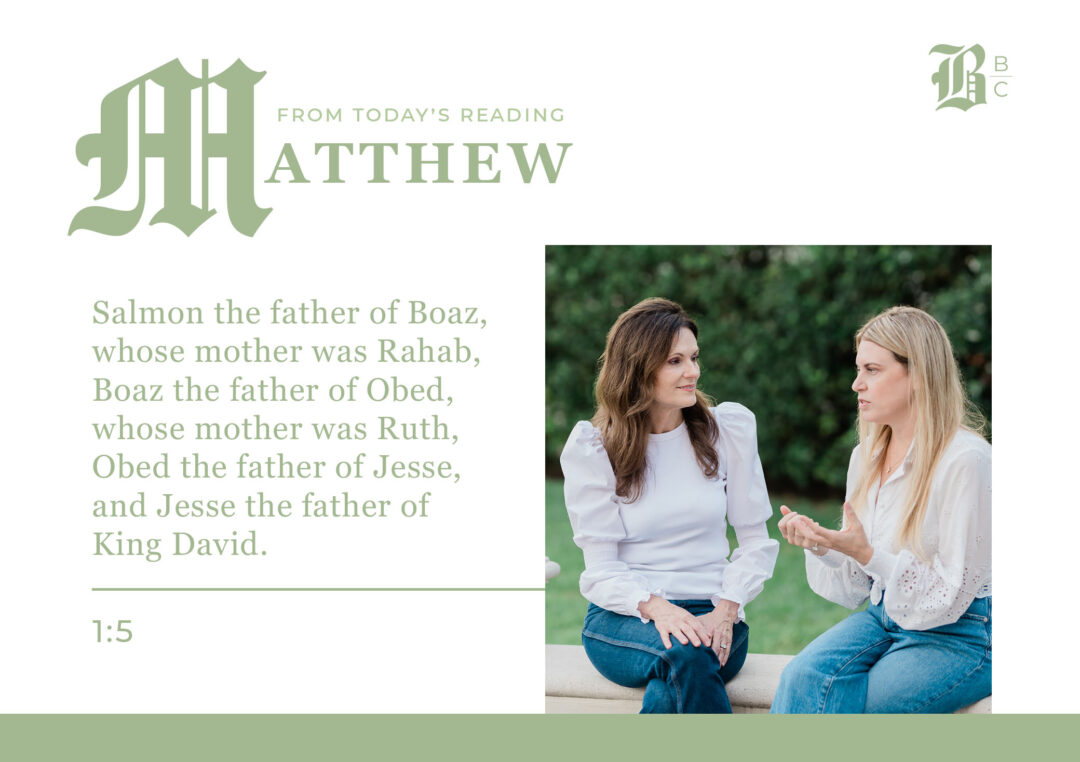
Matthew 1:5-6 mentions Rahab is in the lineage of Jesus, a lineage from the tribe of Judah, which only lists five women by name. Rahab is the mother of Boaz’ so she is the great, great-grandmother of King David and Jesus’ great grandmother by several generations.
How many times is Rahab mentioned in the Bible?
In addition to her appearances in the books of Joshua and Matthew, Rahab is mentioned a few times in the Bible. Once in the Hebrew Hall of Faith in Hebrews 11:30-31 right after the miracle of the walls of Jericho. Then her last Bible mention in James 2:20-25 describes her as righteous. She is indeed a righteous example of faith with deeds. She acts in faith by saving the spies. Then, by her faith, she is saved.
Rahab’s Remarkable Character
Rahab has an extraordinary ability to manage people.
- Even though Rahab is a Gentile, specifically a Caananite, the Israelite spies trust her.
- Despite the fact that she’s a prostitute who is lying, the Jericho soldiers believe her.
- Even though she is young, her family listens to her.
And if all that isn’t enough to make you love this heroine despite her profession, Rahab is a catch! We can assume she is attractive based on what she does for a living. But there must be more to her because an Israelite prince is willing to forgo marrying a virginal hometown beauty for this courageous, Canaanite outcast.
Rescuing Rahab
In Joshua 6:16-17 we read that there is but one Canaanite family that will come out of Jericho alive, Rahab’s family. Rahab has negotiated her future, and it won’t be on the edge of society in some crumbly wall. She is moving up! As a loving daughter/sister/niece/cousin, she is taking her family with her.
Picking up in Joshua 6:22-25, the same two spies who made the deal to spare Rahab go and get her. Then she and her family are put in a place outside the camp. This makes sense as many aliens or non-Jews live outside the camp. This new place to live has a sweet element because the family she is perhaps estranged from and not living with due to her profession is now with her.
The Romance Begins
But Rahab does not end up living outside the camp for long. It may have just been a time of purification or cleansing for marriage and life in the camp. The need for cleansing doesn’t come from being physically dirty. It’s related to being ritually unclean, and there are lots of rules about what that means in Leviticus, Season 3 of the Bible Book Club Podcast.
According to Deuteronomy 21:11-13, marrying a captive is allowed. One of the spies apparently thought Rahab was beautiful and now he wants her for a wife. Has he had a conversation with Joshua about his intentions? Is that why Joshua specifically asks the same two spies to go get her?
Joshua 2:12-14 provides another hint of a marriage in the making when Rahab asks for a sign. The same word used here for sign or token in these verses is also used as a sign of a covenant. It make us wonder if there was already more than we know between Rahab and the spy. Maybe she’s asking for a personal commitment. Or perhaps a smitten spy takes the request quite literally and makes more of a commitment than she intends.
A Hidden Clue
The name Salmon comes from the root salmah or simlah which means garment. This is the same word they use in Deuteronomy 21:13 when talking about putting aside the clothes the future bride was wearing when captured, the garment of her captivity. Could Salmon’s name be a clue as to what he means to Rahab? Is he the man who removes the garment of her captivity when he rescues her in return for her rescue of him?
Rahab’s Marriage into the Tribe of Judah
Rahab does not live outside the camp for long. By Joshua 6:25 it says “and she lives among the Israelites to this day.” The Hebrew word for “lives among” or “dwells” implies “with them” and no longer an outsider. The word dwell can also be used in the sense of marriage. But we don’t learn anything about Rahab’s marriage in the entire Old Testament. Are the Jews embarrassed by it?
We know from Matthew 1 that Salmon, the man Rahab marries, is in the lineage of Christ and thus from the tribe of Judah. Therefore, she dwells in the midst of the Israelites by marrying a prince in the kingly line. It is likely Salmon was one of the spies chosen from the tribe of Judah to honor his relative Caleb who was one of the original 12 spies from the tribe of Judah sent by Moses the first time.
What does the story of Rahab teach us?
- Hope. Rahab is a figure of hope for us. She defies the culture she was raised in and chooses something better. Her belief in the God of the Israelites leads to a faith willing to take risks, which eventually save her life and the lives of her family.
- Hesed. Rahab shows Hesed to the spies who are in a life-threatening situation and asks for Hesed in return when she is in a life-threatening situation. When the spies promise Rahab “our lives for your lives” they are entering into a covenantal-like relationship by extending acts of extraordinary mercy to each other. They are protecting each other’s lives, and it is deeply meaningful. And Rahab might have been getting more than she realized because, in the end, the spy who loves her certainly gives her his life, a life lived together.
- Faith. Even though Rahab was a sinful woman, she was brought out of an idolatrous, corrupt culture and saved by grace. Through faith she is given a place of honor in the Lord’s plan for another provision of divine grace, the opportunity for us to be saved from our sin through Jesus Christ.
Was Jericho ever rebuilt?
Jericho was never rebuilt because in Joshua 6:26-27 Joshua pronounces it cursed and never to be rebuilt again. The remains of the city are to be a memorial of God’s justice for evil and a reminder for Israel of God’s first victory and deliverance in the Promised Land.
The curse on Jericho is fulfilled five centuries later when Hiel of Bethel lays the foundation of Jericho in 1 Kings 16. As a result, he loses both his firstborn and his youngest son.
Joshua 7 Summary
Joshua and the people have to be feeling so good at this point. They are in the Promised Land eating real food, and their first victory is under their belt. Then Joshua learns the hard lesson Moses had to learn, success is short lived. People are rebellious and you never know when they will mess up again.
Verse 1 in our Joshua 7 summary reveals the problem. The Israelites know devoted things are part of the herem and must be destroyed or devoted to the Lord, but Achan just has to have some. The “I see it, I want it, I take it” sin is at it again. This sin began with Eve and the apple, but it didn’t end there.
If you’ve wandered through the wilderness with us for the last four seasons of Bible Book Club podcast, you know Achan’s sin is a common one for the Israelites. Even way back in Genesis Rachel stole some family idols from her father and God called Jacob out on it. And David succumbed to it when he saw Bathsheba, wanted her, and took her.
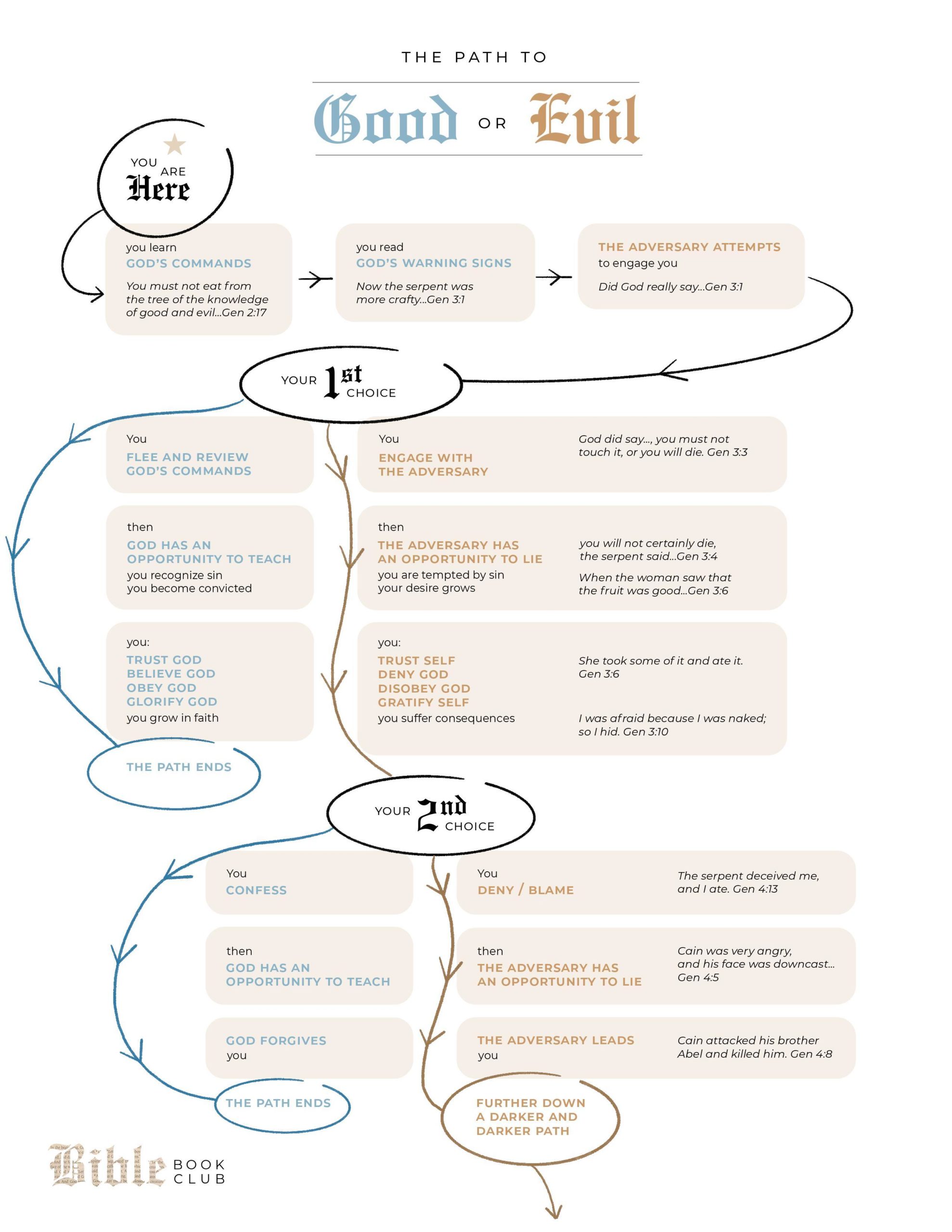
We discuss sin, temptation, and choices a lot in Genesis, season 1 of the Bible Book Club podcast. Right and wrong choices lead to paths, and the paths lead to life or death. We’ll put our printable of the Path to Good or Evil in the show notes. It is a great comparison of choices for good and choices for evil and how they can lead us to a place we never intended to go.
The Battle is Lost
Moving on in Joshua 7 summary, in verses 2-5 the battle against Ai, which was supposed to be a piece of cake, ends in defeat and death. Joshua must be stunned in disbelief.
Some commentaries think Joshua could have prevented the deaths if he had consulted God about the battle first. But the Bible doesn’t record whether he did or did not consult God. What we do know is that God did not chastise Joshua. Therefore we may assume God does not hold him responsible.
Joshua’s Response to Defeat
Joshua’s response mirrors Moses’ response when the nation sins, which makes sense. He was with Moses and observed Moses’ interactions with God. So he knows God has the answers, and he knows how to approach God. He throws himself into a posture of submission and begs for answers in frustrated confusion.
In Joshua 7:6-12 God is kind to Joshua. This isn’t his fault and God doesn’t make him guess why they were defeated. He is, however, going to make the Israelites guess who did it in a very visible example to the entire community…tribe by tribe, family by family.
The Identification and Judgment of Achan
In Joshua 7:13-15 God outlines His plan. This would have been a really good time for the guilty party to come forward on their own. You can’t hide from God. If you try, it’s a definite sign you aren’t repentant.
Can there be mercy and forgiveness without repentance? In Romans 9:14-18 Paul quotes Moses. Yes, there can be mercy anytime God chooses to show mercy. However, in Achan’s case today, God must have decided his lack of repentance indicated a hardened heart similar to Pharoah’s.
Who was Achan in the Bible?
In Joshua 7:16-26 Achan is identified as the thief who stole from God when the Israelites conquered Jericho. Israel must close the door to Achan’s sin in order to open up a new door of hope, so Achan is stoned in the Valley of Achor.
The Hebrew name Achor means trouble, so this valley is also called the Valley of Trouble. Much later, when Israel falls into idolatry, God promises to make the Valley of Achor a door of hope in Hosea 2:14. The verse looks forward to a time when this place of judgement will be a place of restoration.
The promise parallels what Hosea is being asked to do…marry the prostitute Gome. God is using a seemingly hopeless situation. Hosea was asked to love her and watch in hope for God to restore her.
God knew what was coming for Israel. That years from not their situation would be as hopeless as Gomer’s. Israel would become the prostitute, unfaithful to the God who redeemed them from Egypt. But just as with Hosea, God promised the door of hope would be there through the Valley of Achor.
Fortunately for us, Jesus opened that door when He died on the cross. Now we all have access to forgiveness.
Contrasting Rahab and Achan
There is a sharp contrast between our stories of Rahab and Achan. We go from Rahab, the righteous Canaanite, to Achan, the unrighteous Israelite. It seems a little upside down because Rahab knows little about God but makes the right choice. Achan, from the tribe of Judah, knows much about God but makes the wrong choice.
It’s all about choices. Check out our printable of the choices on the path to good or evil.
🎧 Ready to dive deeper? Listen to this episodes of the Bible Book Club Podcast here.
Next Episode:
Show Notes: