
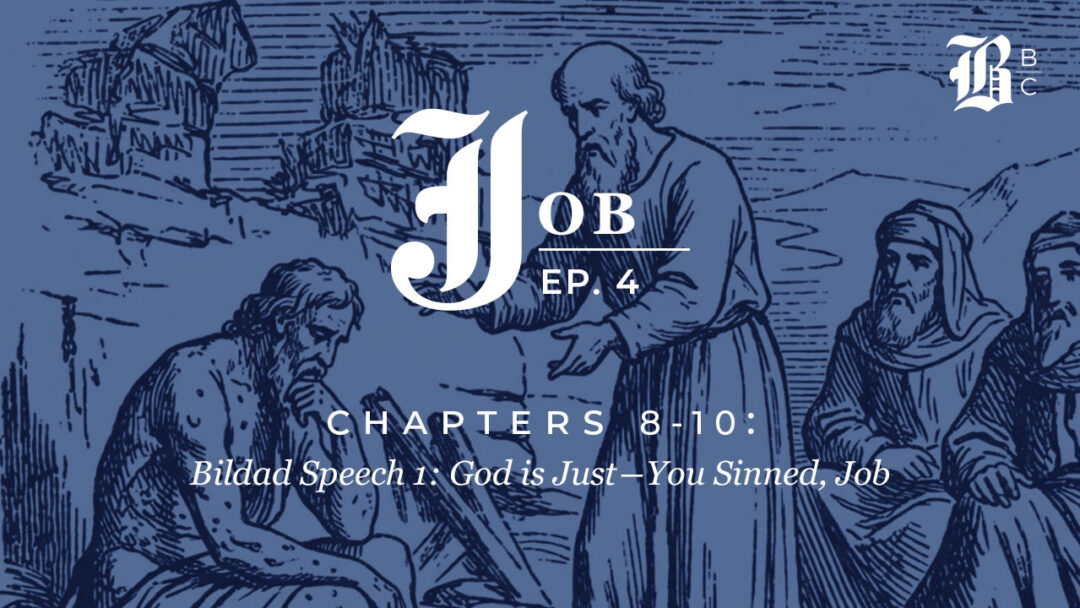
In this Job 8 commentary, Bildad the Shuhite opens his attack by accusing Job’s dead children of sin. Job responds by asking three haunting questions: How can a mortal be righteous before God? How can I argue my case before God? Why was I even born? Behind this earthly trial, a heavenly courtroom holds the secret purpose of Job’s suffering.
Previously on Bible Book Club
In our last chapters, after seven days of silence Job’s three friends finally spoke, and it made everything worse. Eliphaz, the one we call the pious preacher, opened with a compliment but quickly pivoted to accusing Job. Despite Eliphaz’s unkindness, Job didn’t respond by denying or defending. He took his pain straight to God raw, honest, and angry. He is our example that anguished prayer is still prayer.
Subscribe to BBC on Apple, Spotify, Amazon, or YouTube.
Why do Job’s friends believe he is guilty of sin?
All three of Job’s friends believe if you do something wrong God will punish you, and if you do something right God will reward you. It is fair. It is just. And because God is just, that must be the way He rules. It is a mathematical equation to them that should always work.
- Sin = Suffering
- Rightness = blessing
- Job is suffering. Therefore, Job has sinned.
However, all three friends are completely wrong because Job did not sin in this case. But they will persist in an attempt to prove that he did. The friends have no idea that the suffering they’re pointing to as evidence against Job in this earthly courtroom is proof of his righteousness in the courtroom of heaven.
As chapter 8 opens Eliphaz has finished and at this point we have to wonder if the crowd has thinned. Because the dominant understanding is that the dialogues in Job chapters 4-31 are not private conversations. They are most likely public debates.
Where did the public debates between Job and his friends take place?
The public debates between Job and his friends most likely take place at the city gate which, in the ancient Near East, functions as the hub of legal and civic life like a town square. Job is described as the greatest man of the East, a community elder who “sat at the city gate.”
Job’s fall is public. His friends coming to him is a public event. The whole community is likely watching and listening. If the crowd thinned because of Eliphaz’s wordy sermon, they will all be back for the cruel conformist Bildad’s speech now. Bildad relies on the tradition of the ancestors to make his case against Job, and he takes the stand intent on forcing Job to see reason. In our last chapters, Eliphaz opened with compliments that slowly revealed condemnation. Bildad opens by firing off questions that are condemning.
Scene 1: Bildad the Cruel Conformist Speaks of Justice
Job 8:1-4
1 Then Bildad the Shuhite replied: 2 “How long will you say such things? Your words are a blustering wind. 3 Does God pervert justice? Does the Almighty pervert what is right? 4 When your children sinned against him, he gave them over to the penalty of their sin.
Did Bildad hear Job’s cry for compassion?
My guess is that Bildad did not hear one word of Job’s cry for compassion. He must have been too busy formulating his own words. Otherwise, he would have never been so cruel in the face of Job’s abject suffering.
Lesson for Us
When someone is suffering, whether it is their fault or not is not the point. The point is compassion. We must listen rather than craft our corrections.
Bildad accuses Job of even more sin. He states that God is just. And if Job says his punishment is not just, he is accusing God of perverting justice, which is blasphemy and another sin. Bildad is correct. God is just. But Bildad is forgetting that God is also merciful. God’s reconciliation of justice and mercy is the cross. God, in love and mercy, provided a savior to justify our sin. But Job and the patriarchs didn’t have Christ. Before Christ, believers in God looked forward to a future Savior. They were justified for their faith as the Apostle Paul tells us in Hebrews 11.
Job believes in God. Therefore, if he sinned, God would deal with His child with mercy. We know Job is justified for his faith, because God offered him up to Satan as blameless and upright. There is mercy, but there still are consequences to sin. Certainly Abraham, Moses, and David all suffered consequences. Some of these consequences seemed unfair. I still can’t understand how it was fair that Moses was not allowed to enter the Promised Land just because of one mistake.
What is fair?
The idea of unfairness or injustice is an important point that is evolving in this story. Who determines what is fair? How can we assume we know what is fair? Is being fair even the goal? Or can we accept that suffering can serve a higher purpose?
Accept is the keyword. When God created man, he created us to be immortal. We are created for another world, the Garden, where there was no death. So while our minds intellectually expect death our hearts subconsciously cannot accept death. It is foreign to us. We long to live, because we are created for life. Our intuition tells us that death is abnormal, wrong, and an enemy. So how can we accept that suffering and even death can serve a higher purpose? Again, the Apostle Paul, a man who suffered for his faith, has the answers:
Philippians 1:12-14 12 Now I want you to know, brothers and sisters, that what has happened to me has actually served to advance the gospel. 13 As a result, it has become clear throughout the whole palace guard and to everyone else that I am in chains for Christ. 14 And because of my chains, most of the brothers and sisters have become confident in the Lord and dare all the more to proclaim the gospel without fear.
According to Paul, suffering has a higher purpose; it can advance the gospel. Praising God in the joy of life is easy. Praising God in the trials of life is noteworthy. And when people take notes on your faith, they may learn something that builds their own faith.
Next, in our story, Bildad will make the most cold-hearted statement of all.
How does Bildad the Shuhite explain the death of Job’s children?
Bildad wrongly states, as fact, that Job’s children died as a penalty for their sin. Basically, he is accusing Job and all 10 of his children of evil so great they all deserve to die. Imagine how this scene crushes Job.
If we assume this informal trial takes place at the city gate, then there must be a city wall. And the people on the wall have prime seats with a great view of the trial below. I imagine the crowd thinned out because of Eliphaz’s long, drawn-out piety. I, for one, would have called to my friend sitting on the wall and said, “I’ve got to go. Call me if it gets exciting.” And it does, without a doubt. Bildad’s opening words would create a stir. He is harsh and hot. And I imagine those heralds on the wall send out the word, “Get back here and check out this guy. He is crushing Job.”
The Crowd’s Reaction
What do Job’s former neighbors and friends think of Bildad’s audacity? How does Job react? Does he sink in grief over his children, cringe at his growing humiliation, cry at the injustice of friends who are cruel rather than kind? It is too much! I could not have listened to one more word.
I give Job credit. His punishment is more, so much more, than anyone deserves. Not to mention he is innocent! Bildad publicly attacks Job’s integrity and that of all his children. A personal attack is difficult enough, but attacking the children?
And Bildad is wrong! What he states as fact is a lie. Job knows this and yet he stays, listens, and suffers more. I am not sure what I would have done, but I wouldn’t have been sitting on ashes. I most likely would have been throwing them or hiding in them.
Have you ever been crushed in spirit by a friend? Have you ever crushed anyone’s spirit with harsh words? It is something to ponder. Bildad continues with instruction.
Scene 2: Bildad’s Appeal to Ancestral Wisdom
Job 8:5-22
5 But if you will seek God earnestly and plead with the Almighty, 6 if you are pure and upright, even now he will rouse himself on your behalf and restore you to your prosperous state.
7 Your beginnings will seem humble, so prosperous will your future be. 8 “Ask the former generation and find out what their ancestors learned, 9 for we were born only yesterday and know nothing, and our days on earth are but a shadow. 10 Will they not instruct you and tell you? Will they not bring forth words from their understanding? 11 Can papyrus grow tall where there is no marsh? Can reeds thrive without water? 12 While still growing and uncut, they wither more quickly than grass. 13 Such is the destiny of all who forget God; so perishes the hope of the godless. 14 What they trust in is fragile; what they rely on is a spider’s web. 15 They lean on the web, but it gives way; they cling to it, but it does not hold. 16 They are like a well-watered plant in the sunshine, spreading its shoots over the garden; 17 it entwines its roots around a pile of rocks and looks for a place among the stones. 18 But when it is torn from its spot, that place disowns it and says, ‘I never saw you.’ 19 Surely its life withers away, and from the soil other plants grow.
20 “Surely God does not reject one who is blameless or strengthen the hands of evildoers. 21 He will yet fill your mouth with laughter and your lips with shouts of joy. 22 Your enemies will be clothed in shame, and the tents of the wicked will be no more.”
What does Bildad say Job must do?
Bildad advises Job on what he must do to correct the situation, and it is the same advice as Eliphaz: Job needs to confess to God. And what will God do then, in Bildad’s opinion? God will make him prosperous again. Satan couldn’t have said it any better.
If Job confesses to sin he didn’t commit just to prosper, Satan wins the case against God, because Job proves that people are only faithful for what they get from God. They don’t really love God. It is a transactional relationship.
Lastly, Bildad tries to prove why Job should confess his sin by reviewing history, which is the tradition he rests his case on. In our last chapters, Eliphaz rested his case on his experience. But now Bildad rests his case on the wisdom of the ancients. And they believed suffering was due to sin.
What nature analogies does Bildad use to describe the godless?
Bildad uses evidence in nature from a papyrus plant, a spider, and a garden.
- Papyrus plant: Just as the papyrus dies without water, the godless person withers the moment they forget God.
- Spider’s web: The trust of the godless is as weak and flimsy as a spider’s web.
- Garden: It may look like it’s flourishing but when uprooted it withers away.
Bildad finally ends with a reminder to Job that, hey you can get out of this mess if you just admit your sin and get right with God. Bildad’s focus in this round is justice, so Job responds to Bildad, “I know God is just, but how can I be justified?”
Scene 3: Job Responds to Bildad
Job 9:1-35
1 Then Job replied: 2 “Indeed, I know that this is true. But how can mere mortals prove their innocence before God? 3 Though they wished to dispute with him, they could not answer him one time out of a thousand. 4 His wisdom is profound, his power is vast. Who has resisted him and come out unscathed? 5 He moves mountains without their knowing it and overturns them in his anger. 6 He shakes the earth from its place and makes its pillars tremble. 7 He speaks to the sun and it does not shine; he seals off the light of the stars. 8 He alone stretches out the heavens and treads on the waves of the sea. 9 He is the Maker of the Bear and Orion, the Pleiades and the constellations of the south. 10 He performs wonders that cannot be fathomed, miracles that cannot be counted. 11 When he passes me, I cannot see him; when he goes by, I cannot perceive him. 12 If he snatches away, who can stop him? Who can say to him, ‘What are you doing?’ 13 God does not restrain his anger; even the cohorts of Rahab cowered at his feet.
14 “How then can I dispute with him? How can I find words to argue with him? 15 Though I were innocent, I could not answer him; I could only plead with my Judge for mercy. 16 Even if I summoned him and he responded, I do not believe he would give me a hearing. 17 He would crush me with a storm and multiply my wounds for no reason. 18 He would not let me catch my breath but would overwhelm me with misery. 19 If it is a matter of strength, he is mighty! And if it is a matter of justice, who can challenge him? 20 Even if I were innocent, my mouth would condemn me; if I were blameless, it would pronounce me guilty.
21 “Although I am blameless, I have no concern for myself; I despise my own life. 22It is all the same; that is why I say, ‘He destroys both the blameless and the wicked.’ 23 When a scourge brings sudden death, he mocks the despair of the innocent. 24 When a land falls into the hands of the wicked, he blindfolds its judges. If it is not he, then who is it?
25 “My days are swifter than a runner; they fly away without a glimpse of joy. 26 They skim past like boats of papyrus, like eagles swooping down on their prey. 27 If I say, ‘I will forget my complaint, I will change my expression, and smile,’ 28 I still dread all my sufferings, for I know you will not hold me innocent. 29 Since I am already found guilty, why should I struggle in vain? 30 Even if I washed myself with soap and my hands with cleansing powder, 31 you would plunge me into a slime pit so that even my clothes would detest me.
32 “He is not a mere mortal like me that I might answer him, that we might confront each other in court. 33 If only there were someone to mediate between us, someone to bring us together, 34 someone to remove God’s rod from me, so that his terror would frighten me no more. 35 Then I would speak up without fear of him, but as it now stands with me, I cannot.
What are the three main questions Job asks in chapters 9 and 10?
In chapters 9 and 10, Job will ask three main questions.
- How can a mortal be righteous before God?
- How can I argue my case before God?
- Why was I born?
Job totally skips addressing all of Bildad’s insults and agrees with much of what Bildad is saying. God is just. But Job cannot fathom why he is being punished. He has been faithful. And if God causes man to suffer without sin, then how can anyone ever hope to be acceptable before God?
Why does Job believe he cannot win a legal case against God?
Job asks: How can a mortal be righteous before God? He wants a heavenly trial of his own. He is innocent. Yet, everyone seems to have proven him guilty. Surely God knows he is not guilty. But how can he prove it? God is wiser and more powerful. He controls the heavens and the earth. No one would dare approach such an opponent.
So Job asked: How can I argue my case before God? This is where Job begins to want to fight for a hearing before God. He needs a mediator. How can he prove the injustice of his suffering and be acquitted? God is too powerful; Job would be crushed.
Why did Job cry out for a mediator between himself and God?
Job needed a mediator because God is too fearsome to question. There is no way out for Job. God is just; he cannot argue with God. But neither can he reconcile what has happened to him. Because it is not just. So who, but God, can explain it to him? Who will mediate for him?
Job is begging, pining for what we have, a mediator in Jesus Christ. What Bildad was advocating made sense to him because he presumed Job guilty. Bildad’s whole framework rests on justice. What Bildad needed was a lesson from another great speaker.
How does the Apostle Paul’s teaching in Galatians 3 refute Bildad’s framework?
In Galatians 3, the Apostle Paul dismantles Bildad’s framework and explains how God does indeed provide the mediator Job so desperately needed.
Galatians 3:11-14
11 Clearly no one who relies on the law is justified before God, because “the righteous will live by faith.” 12 The law is not based on faith; on the contrary, it says, “The person who does these things will live by them.” 13 Christ redeemed us from the curse of the law by becoming a curse for us, for it is written: “Cursed is everyone who is hung on a pole.” 14 He redeemed us in order that the blessing given to Abraham might come to the Gentiles through Christ Jesus, so that by faith we might receive the promise of the Spirit.
15 Brothers and sisters, let me take an example from everyday life. Just as no one can set aside or add to a human covenant that has been duly established, so it is in this case. 16 The promises were spoken to Abraham and to his seed. Scripture does not say “and to seeds,” meaning many people, but “and to your seed,” meaning one person, who is Christ. 17 What I mean is this: The law, introduced 430 years later, does not set aside the covenant previously established by God and thus do away with the promise. 18 For if the inheritance depends on the law, then it no longer depends on the promise; but God in his grace gave it to Abraham through a promise.
19 Why, then, was the law given at all? It was added because of transgressions until the Seed to whom the promise referred had come. The law was given through angels and entrusted to a mediator. 20 A mediator, however, implies more than one party; but God is one.
21 Is the law, therefore, opposed to the promises of God? Absolutely not! For if a law had been given that could impart life, then righteousness would certainly have come by the law. 22 But Scripture has locked up everything under the control of sin, so that what was promised, being given through faith in Jesus Christ, might be given to those who believe.
23 Before the coming of this faith,we were held in custody under the law, locked up until the faith that was to come would be revealed. 24 So the law was our guardian until Christ came that we might be justified by faith. 25 Now that this faith has come, we are no longer under a guardian.
What is Bildad’s core argument built on?
Bildad’s core argument is built on the retribution principle just like Eliphaz’s was. If you’re suffering, you sinned. If you sinned, you deserve it. He assumes that a person’s standing before God depends entirely on their track record of righteous behavior. Keep the law, earn the blessing. Break the law, earn the curse. It’s transactional faith dressed up as ancient wisdom.
Paul overturns Bildad’s entire framework. His argument is that no one is justified before God by law-keeping. Not Job, Bildad, or anyone. Paul makes the case that the law was never designed to be the mechanism of right-standing with God. It was a guardian, a temporary custodian, pointing toward something better.
The irony is that Job already seems to sense this. He keeps insisting his relationship with God is real, even when his behavior can’t explain his suffering. He is living by faith when his circumstances demanded he perform for approval. Bildad couldn’t understand that because he is still operating inside the vending machine: put in righteousness, get out blessing.
Paul’s answer, centuries later, is essentially…Job was right, Bildad was wrong. Righteousness was never about a ledger. It was always about faith. The Mosaic law came 430 years after Abraham’s covenant. It couldn’t retroactively change how God relates to His people. And Abraham and the patriarchs were all declared faithful without the law. Bildad has the tradition. Paul has the truth. And Job, suffering in the ash heap, is living it before either of them could fully explain it.
Job is asking honestly, I know God is just, but how can I be justified? Job needs the mediator we have in Jesus. Unfortunately, with understanding out of his reach, Job becomes frustrated, and he turns in frustration to question his reason for being.
Scene 4: Job’s Lament Before God
Job 10:1-22
1 “I loathe my very life; therefore I will give free rein to my complaint and speak out in the bitterness of my soul. 2 I say to God: Do not declare me guilty, but tell me what charges you have against me. 3 Does it please you to oppress me, to spurn the work of your hands, while you smile on the plans of the wicked? 4 Do you have eyes of flesh? Do you see as a mortal sees? 5 Are your days like those of a mortal or your years like those of a strong man, 6 that you must search out my faults and probe after my sin— 7 though you know that I am not guilty and that no one can rescue me from your hand?
8 “Your hands shaped me and made me. Will you now turn and destroy me? 9 Remember that you molded me like clay. Will you now turn me to dust again? 10 Did you not pour me out like milk and curdle me like cheese, 11 clothe me with skin and flesh and knit me together with bones and sinews? 12 You gave me life and showed me kindness, and in your providence watched over my spirit.
13 “But this is what you concealed in your heart, and I know that this was in your mind: 14 If I sinned, you would be watching me and would not let my offense go unpunished. 15 If I am guilty—woe to me! Even if I am innocent, I cannot lift my head, for I am full of shame and drowned in my affliction. 16 If I hold my head high, you stalk me like a lion and again display your awesome power against me. 17 You bring new witnesses against me and increase your anger toward me; your forces come against me wave upon wave.
18 “Why then did you bring me out of the womb? I wish I had died before any eye saw me. 19 If only I had never come into being, or had been carried straight from the womb to the grave! 20 Are not my few days almost over? Turn away from me so I can have a moment’s joy 21 before I go to the place of no return to the land of gloom and utter darkness, 22 to the land of deepest night, of utter darkness and disorder, where even the light is like darkness.”
Why does Job wish he had died at birth in Chapter 10?
Job’s life makes no sense to him, so why was he even born? Job cannot understand how he has been declared guilty with no explanation. He is begging God to explain, and his words are heartbreaking. Even if I am innocent, I cannot lift my head, for I am full of shame and drowned in my affliction.
One senses that questions plague his mind obsessively. He cannot escape from:
- Mental pain.
- Physical pain.
- Emotional pain.
- Spiritual pain that God has abandoned him for no reason at all.
So Job is back to wishing he had never been born. Poor Job. If he only knew what is really going on. But that is the point of the test. He can’t know. God isn’t withhold information to be cruel. Job is part of a bigger court case, and it is of the utmost importance that he does not understand.
What is the secret purpose of Job’s suffering in the heavenly courtroom?
Job is God’s chosen weapon to defeat Satan. There is a reason Job has been born. Job’s existence has a purpose he can’t see from inside his pain. He will become a testament to man’s faith in God.
Like Job, there is a reason we were born. Could it be the same as Job? We also don’t have access to the heavenly courtroom. And perhaps our suffering may be something we will never fully understand this side of eternity. But our faithfulness in the midst of that suffering most definitely has a purpose. We, too, can become a testament to faith in God. Like Job.
Continue with us into the next chapters of Job’s story.
Group Discussion Questions for Job 8-10
- Bildad is so busy “crafting his correction” that he doesn’t hear a word of Job’s cry for help. When a friend is suffering, do you ever find it difficult to simply sit with them in their pain rather than discussing the reason behind it?
- Job insists his relationship with God is real even when his circumstances make no sense. When has God felt distant or silent in your own life, and what kept you holding on?
- Job’s suffering has a purpose he can’t see from inside his pain. Looking back, have you ever experienced a season of suffering that later revealed a purpose you couldn’t have understood in the middle of it?
Listen to this episode of the Bible Book Club Podcast:
Apple Podcast
Spotify
Amazon
YouTube
