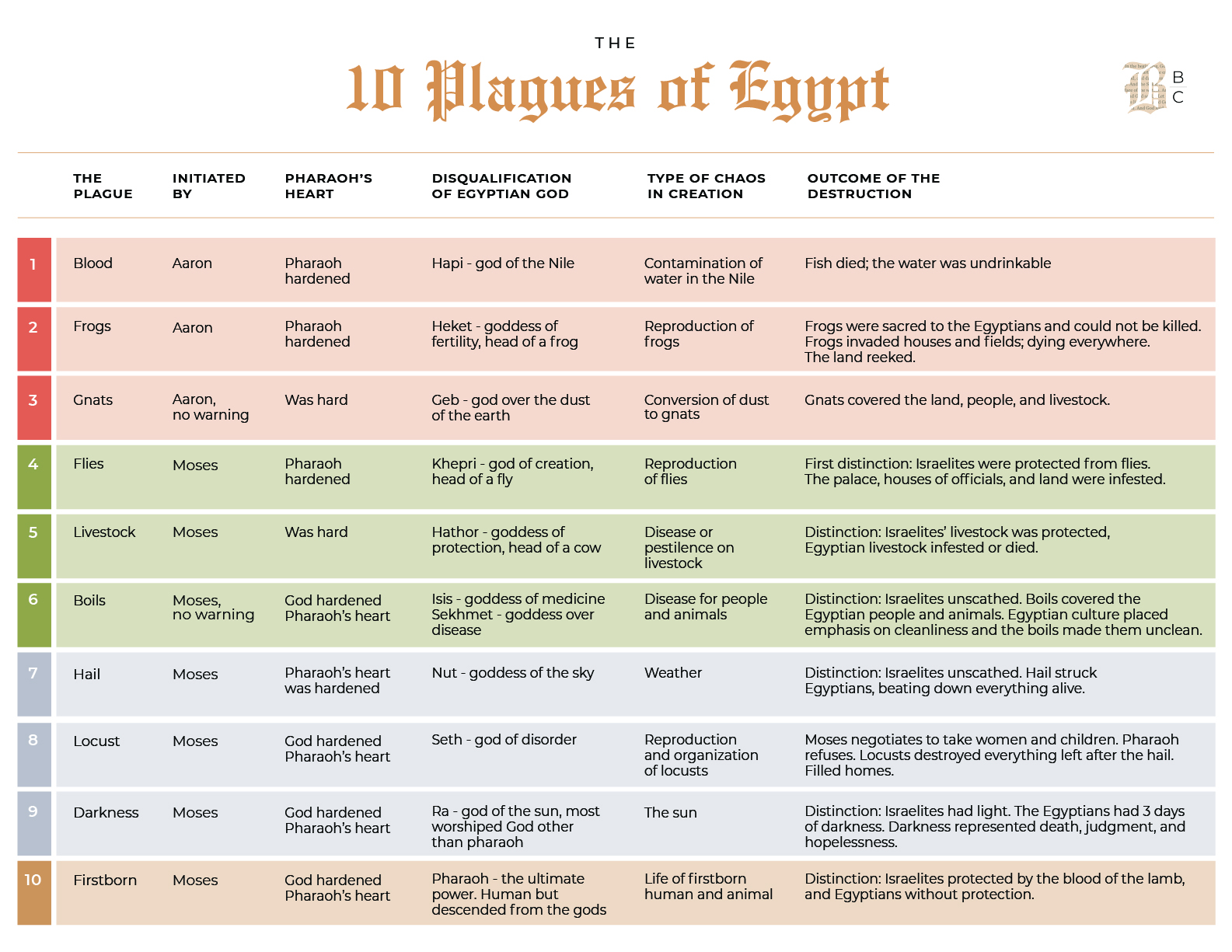
In Exodus 10-11, God completes the plagues and Moses sees his passion developed into his purpose. All because Moses was obedient to God, we see the transformation of Moses into a leader.
Round # 9 – The Plague of Darkness
The destruction of the plague of darkness:
- Was not physical. No creature died, no plant destroyed.
- And yet it would have been mentally tormenting.
- This plague forced isolation
- Which forces stillness and a time of reckoning with life and God.
- This plague would have produced a consuming fear of death and what awaited them in the afterlife.
The significance of the message:
- The significance of this plague is the message it sent to the
- First, there was no warning so there was no information on how long it would last. If it lasted forever they would die.
- Second, the only light around was in Goshen
- Third, it says it was darkness they could feel.
- The other significance of this plague is the message it sent to the pharaoh about his gods
- The attack was on Ra, the god of the sun, the sun that shone 99% of the time in Egypt who was considered one of the most powerful gods.
- In addition, Egyptian Pharaohs were often considered sons of the god Ra.
- The significance of the symbolism of the plague of darkness
- This plague completes the theme of creation reversal. All that is good in creation Egypt, the plants, trees, animals have completely been destroyed
- Then as if reversing the first day of creation Egypt is thrown into darkness.
- Genesis 1:2 says: 2 Now the earth was formless and empty, darkness was over the surface of the deep, and the Spirit of God was hovering over the waters.3 And God said, “Let there be light,” and there was light.
The message from God was terrifying, and without a doubt, panic would have ensued.
-
- Would the sun come back? Was this the end of their world? Were they all going to die? How could they undo what they had done to the Israelites?
- It would have been chaos you could feel.
Pharaoh has a fit
- Pharaoh is whipped.
- Like a child playing a game. It’s only fun if he is winning.
- For maybe the first time in his life he can’t win.
- so Pharaoh doesn’t want to play the game anymore.
- He melts down like a child and screams…get out, don’t come back, or I’m going to kill you!
- There is no opportunity to redeem himself in humility.
- God hardens his heart.
We are all susceptible to behaving like a child. As adults, we just know how to hide our thoughts rather than venting them for the world to see. But God sees the heart. Are internally pouting about a situation or a relationship? How hard is your heart about the matter? How would the game change if you humbled yourself?
The Final Round # 10 – The Plague on the Firstborn
The significance of the message
- God predicted it. This plague brings us back full circle to Exodus 4:21.
- The god that pharaoh thought he was, is no more. Egyptian Pharaoh’s believed themselves to be gods. Specifically, they were sons of the most visible god in Egypt the ever-shining god of the sun – Ra. The plague of the firstborn is an attack on Pharaoh himself as a god. If the son of the powerful sun god cannot even protect his own son, who will be a god after he dies.
- The painful shattering of a pharaoh’s hardened heart. Pharaoh’s heart is hard as granite by now, but surely this plague crushed it – this was his What anguish to realize too late that his child was dead because of his pride. The future pharaoh was dead.
- The judgment was just. How many Hebrew sons had been killed at the hands of the Egyptians we do not know, but this consequence was clearly a ruling against the Egyptians for killing God’s people.
- The use of the word cry or loud wailing describing Egypt’s suffering in verse 6 is an echo of verse 3:6 which uses the same word cry to describe Israel’s suffering.
- Each plague has brought a symbolic consequence for what was done to Israel
- and with each consequence, there has been a shift in power.
- Pharaoh is out, down, done.
- The exchange of power is complete.
- Moses doesn’t even give Pharaoh a chance to respond – he just leaves.
- It’s time for the exodus.
But before we get ready to go let’s talk about…
M O S E S
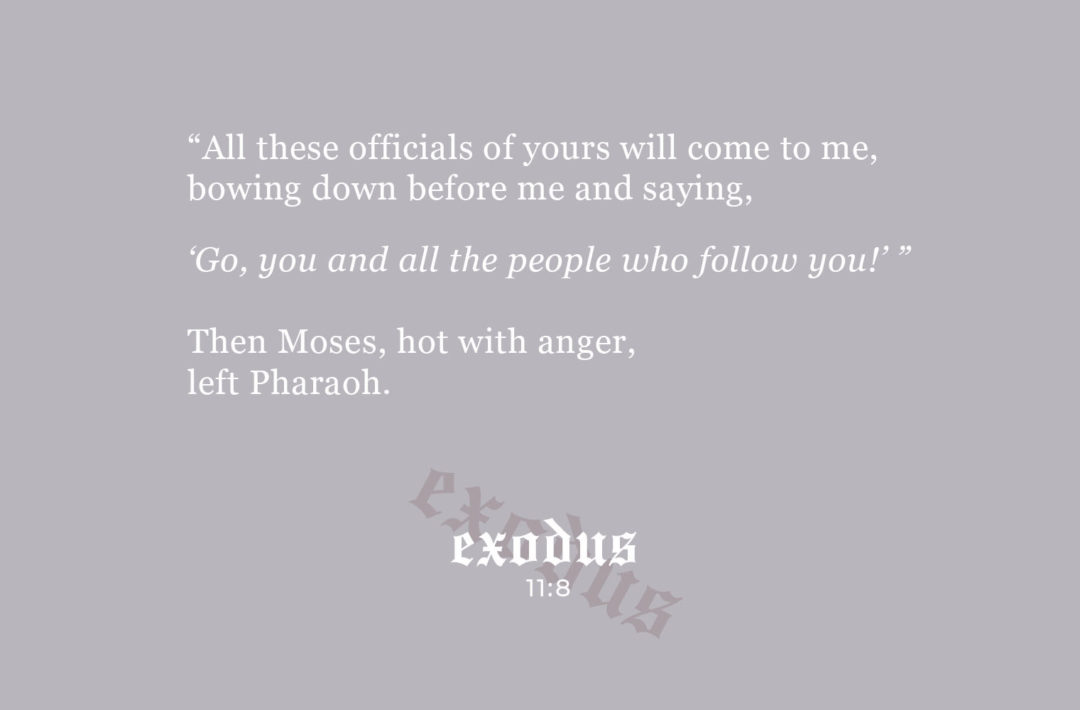
And, in particular, this one little phrase at the end of verse 8: “Then Moses, hot with anger, left Pharaoh.”
Moses is angry.
Because we know that Moses is passionate.
- the last time we saw him display his passion was way back chapter 2.
- He saw an Egyptian beating a Hebrew and “looking this way and that and seeing no one, he killed him and hid him.
- This time Hot with anger, Moses walked out
- Anger about what? Same thing: the Egyptians has been beating the Israelites.
- Moses has one passion – God’s people, his people, the Israelites.
But Moses has changed.
- he is not impulsive, he does not care who is looking
- he is not afraid of who he is talking to
- Gone is the need to lean on Aaron, the doubt about his ability, the fear of failure
- 40 years in the desert hiding and 10 rounds in the ring with Pharaoh have finally paid off.
- The impulsive passion that got Moses in trouble, has been controlled and cultivated.
- It has become a powerful passion for a great purpose.
Then Note this: there is another insight into Moses’ new identity in the second part of verse 3: “and Moses himself was highly regarded in Egypt by Pharaoh’s officials and by the people.”
Moses has become a great leader.
- Moses is now highly regarded in Egypt! In Egypt! The son of Israelite slaves!
- Moses and his God have proven they have more power than pharaoh ever had.
- All the people and Pharaoh’s officials respect him, fear him.
- Compare that to when Moses doubted himself and doubted God and said:
- chapter 3:11 “Who am Ithat I should go to Pharaoh and bring the Israelites out of Egypt?”
- Or verse 4:1 “What if they do not believe me or listen to me?”
- Or verse 4:10 “Pardon Lord, I have never been eloquent…I am slow of speech.”
- Or again in verse 4:13 “Pardon your servant, Lord. Please send someone else.”
- How did this insecure doubter become highly regarded by his enemy – the nation he just destroyed?
- How does one become a great leader? A purpose so great that even enemies recognize its truth?
Moses turned his passion into purpose by obeying God.
- In the beginning, he doubted
- He argued
- He begged
- But step by little step, he obeyed.
- He left Midian for Egypt
- He met with Aaron
- Moses showed signs to the Israelite leaders
- He went to the pharaoh and let Aaron do the talking
- He went to Pharaoh and he started doing the talking
- Moses kept going back every time God told him
- He executed God’s instructions just as God asked.
- Moses began to believe God
- that his passion for the Israelites release could happen.
- And that God could use him to do it.
- Moses’ passion is being used for a great purpose – to further God’s plan for his people
Moses became a great leader by obeying God.
It was just that simple.
- With each act of obedience
- Moses’ confidence grew
- The Israelites confidence in him grew
- The Egyptians regard for him grew
- The strength of Moses’ leadership is obedience to God
- Moses learned that God will bring about his plan we just have to obey.
- Obedience is the secret sauce to a life lived for the Lord.
- Obedience is Mentioned over 240 times in the Bible.
- For forever the Lord’s love is with those who fear him and obey him
- Is it possible that it can be that simple for us?
Moses has turned his passion into purpose and Moses has become a great leader with the simple act of trust and obedience.
VERSES MENTIONED:
SHOW NOTES:
The 10 Plagues of Egypt