
Subscribe to BBC on Apple, Spotify, or Amazon
How to Repair a Relationship
In 2 Chronicles 24-28, we see how God uses consequences as a way to repair relationship. When we face consequences in our own lives because we failed to love our neighbor as ourselves, God provides opportunities for us to repair the relationship too. If we respond in humility and repentance, He can move in incredible ways.
Learning from Leadership Fails
In these five chapters, the Chronicler recounts the story of the next five kings who serve as a warning to the exiles rather than an encouragement. These kings all begin well, but ultimately fail to remain true to God.
This pattern is familiar. It can be found all throughout the Old Testament in the books of Exodus, Numbers, Deuteronomy, Judges, and Kings.
This pattern is a lesson the Israelites must learn from, or they will repeat it. Unfaithfulness leads to divine discipline, and the purpose of divine discipline is relational restoration.
In our journey through the books of Kings and Chronicles, we see this pattern in many of the kings.
- When a king leads the nation into sin, there is divine discipline.
- When the king repents and leads that nation back to a relationship with God, there is restoration.
- If the nation fails to repent time and again, there is exile, and that is exactly what the returned exiles are trying to rebound from now.
What we must always remember when reading the Old Testament is that God’s discipline is tied to his desire for relationship. He uses discipline as a tool to confront sin, teach accountability, and create opportunities for repentance and renewal.
The ultimate goal is restoration or a restored relationship with God. Relationship was the goal in the Garden of Eden, and it will be the end result in the new heaven and earth.
The Ultimate Betrayal: 2 Chronicles 24
With the next three kings, each will begin with faith but ultimately fail to seek relational restoration when confronted with divine discipline. It’s a pattern on repeat with faith followed by failure.
King Joash is first. We already know from back in 2 Chronicles 24:1-2 he did what was right all the years his faithful advisor Jehoiada was alive.
However, as we pick up in 2 Chronicles 24:17-19, after the death of Jehoiada, King Joash begins listening to other officials. Then he abandons the Lord completely and worships idols.
God’s anger falls on Judah. But because the Lord wants restoration, He sends prophets to the people to bring them back to him. They don’t listen.
God doesn’t give up. He’s still seeking restoration, so He sends word through someone who has a direct relationship with Joash. It’s not a prophet this time but a priest. And it’s not just any priest, it’s Zachariah, the son of Jehoiada, Joash’s faithful advisor.
Surely Joash will listen to Zachariah. After all, he would have known him like a brother. This is the son of the couple who saved King Joash and raised him. The son of the the priest who advised Joash his entire life.
Zachariah will surely warrant Joash’s attention as the Spirit of God speaks through him to warn Joash. Can they see the Spirit in him as he talks? His passion? We don’t know.
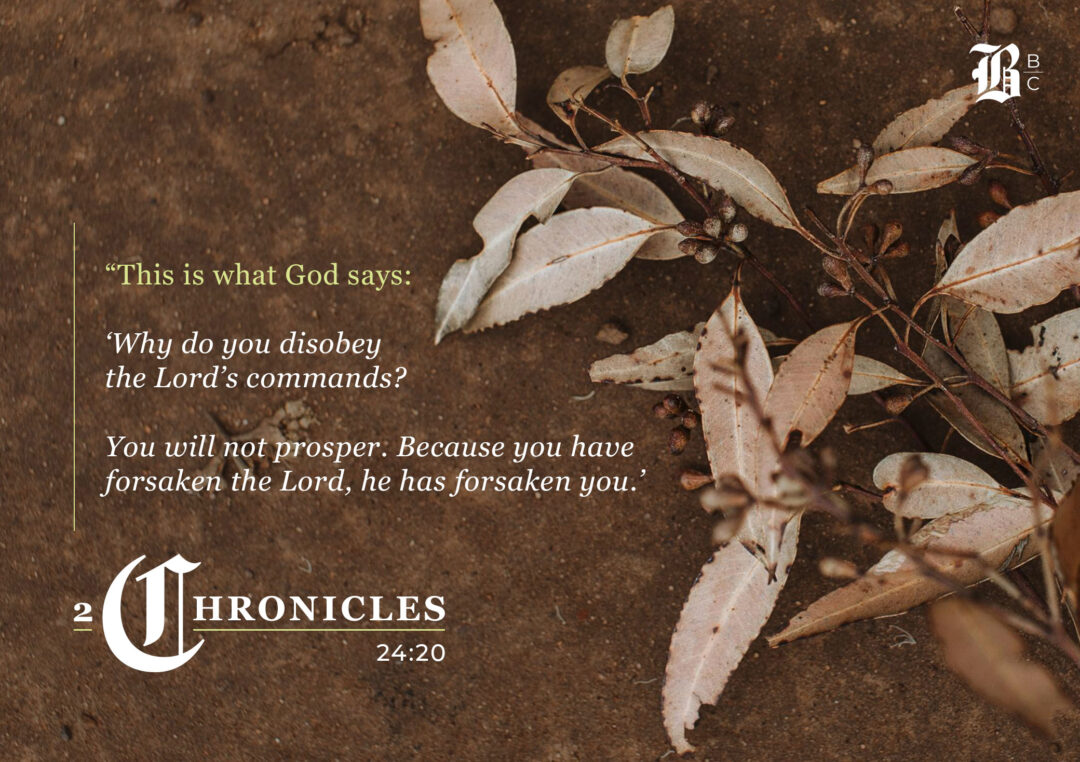
The Chronicler places great emphasis on the tragedy that happens next in 2 Chronicles 24:20-22. Joash has forgotten his wise friends and his faith. He’s changed. His heart is so evil he orders them to kill Zechariah.
Rejected Restoration
Despite God’s repeated attempts to bring them back and offer opportunities for restoration, Joash and Israel reject Him. The people have the Mosaic Covenant with God, and the king has the Davidic Covenant with God. Both have broken their promise.
Therefore, God uses divine discipline as a tool to confront sin, teach accountability, and create opportunities for repentance and renewal. That discipline comes in the familiar form of an attack from Aram in 2 Chronicles 24:23-27. Judah suffers and Joash dies.
Joash’s death is ironic. For decades Jehoiada taught him to trust God. Yet, within months of Jehoiada’s death, Joash turns from trusting God to trusting random officials.
In the end, although severely wounded in the battle, the enemy does not kill him. It is the foolish officials he trusted above God who kill him. Misplaced trust can be fatal.
When Success Becomes Idolatry: 2 Chronicles 25
Our next king, Amaziah, has a mother from Jerusalem. This is a detail we can assume carries weight with our Chronicler when compared to other kings who had idolatrous, foreign mothers.
Amaziah is off to a great start in 2 Chronicles 25:1-13 except for the hint we have in verse two that his desire to do right is not wholehearted. It’s no surprise. We know the pattern. He will start off as a good king then rebel and fail to listen when God seeks restoration.
He does eliminate his father’s traitorous officials and mercifully spare their children according to the law of Moses. Then he mistakenly hires troops from Israel but obeys the prophet who says he must dismiss them.
He is victorious in his battle against Edom but fails to see the victory as God’s. Then, in 2 Chronicles 25:14-16, Amaziah brings back momentos from Edom in the form of idols. Not good.
Pride Goes Before the Fall
Once again, God is angry. He wants restoration though, so He sends a prophet to challenge King Amaziah.
Like so many kings before him, Amaziah does not listen. Instead, he silences the prophet with a threat, but not before the prophet warns the king of his upcoming demise.
God provided Amaziah with the opportunity for restoration, but he rejected it. So now God uses divine discipline as a tool to confront sin, teach accountability, and create opportunities for repentance and renewal.
The divine discipline comes in the familiar form of a military defeat. This time it’s against Israel, and King Amaziah definitely brings it upon himself.
In 2 Chronicles 25:17-24 he is full of himself after “his” recent victory, and he gets greedy . He wants to conquer more. He wants Israel. So he brazenly issues a challenge to Jehoash, king of Israel.
Jehoash sends back a message in the form of a fable. It implies Judah is going to get trampled. King Jehoash blatantly points out King Amaziah’s arrogance and tells him to stay home.
Amaziah’s pride interferes with his ears and again he does not listen. In 2 Chronicles 25:25-28, the results are tragic for Judah.
Amaziah is captured by Israel and eventually killed by his own people. The Temple, the place of God’s presence, is decimated. It’s a visible warning that Judah’s relationship with God is at serious risk.
When Prosperity Corrupts the Heart: 2 Chronicles 26
Next up is King Uzziah. He starts off well in 2 Chronicles 26:1-15 doing what is right in the eyes of the Lord.
Uzziah has a faithful instructor named Zecharaiah, and he seeks the Lord all the days of Zechariah’s life. God blesses Uzziah’s faithfulness, helping him defeat the Philistines and giving him fame and fortune.
Unfortunately, all that fame and fortune go to his head leading to sin and a sense of self-importance. In 2 Chronicles 26:16-23, King Uzziah breaks all the laws regarding the Temple and does whatever he wants.
Pride is a difficult sin to combat. Sometimes we just can’t see past ourselves. Everything we believe seems so right, despite the Word of God saying it isn’t.
Even with the warning of 80 courageous priests, Uzziah doesn’t listen. He rejects the chance for restoration God gives him.
So God uses divine discipline as a tool to confront sin, teach accountability, and create opportunities for repentance and renewal. This time, that discipline comes in the form of disease.
A King’s Incomplete Legacy: 2 Chronicles 27
In 2 Chronicles 27:1-9, Uzziah’s son Jotham takes the throne. He is different from the other kings.
He does what is right in the eyes of the Lord personally. However, he fails to impose what is right on the people by removing the high places and idolatry.
God blesses him for his faith, and he grows powerful. However, Jotham is a lukewarm king. He is not on the list of the four faithful kings who followed David.
No Hope for Ahaz: 2 Chronicles 28
In 2 Chronicles 28:1-4, Ahaz takes the throne and follows the ways of the kings of Israel and the Canaanites. He even goes as far as sacrificing his own children by fire.
God doesn’t even provide the opportunity for restoration. He knows the heart, and there is no hope for Ahaz.
Therefore, God uses divine discipline as a tool to confront sin. That discipline comes in the familiar form of a military defeat, this time by Aram, Israel, and Edom in 2 Chronicles 28:5-8.
Judah is taken captive by the men of Israel, who are their former brothers. This is so far from God’s plans for His people. He redeemed them from captivity and now the divided kingdom of Israel, the 12 tribes from the 12 sons of Jacob, are taking each other captive.
God steps in. He is not having this. It is too much.
He sends a prophet not to the people of Judah but to the people of Israel, and weirdly they listen. In 2 Chronicles 28:9-15, Israel obeys the prophet and releases Judah’s men, women, children, and plunder.
However, King Ahaz and Judah’s divine discipline are not over. More attacks come from Edom and the Philistines in 2 Chronicles 28:16-21.
A Hardened Heart Leads to Destruction
Judah is being decimated and humbled because of King Ahaz. However, Ahaz is not humbled.
His heart is so hardened he refuses to see the divine discipline as a message from God. Instead, he pursues even greater evil in 2 Chronicles 28:22-27, destroying the Temple furnishings and locking the Temple doors.
Fortunately for Judah, someone is watching and learning from the lessons King Ahaz so stubbornly ignores. His son Hezekiah has a front row seat to Judah’s destruction, and he is no fool. He is reading the Lord loud and clear.
Divine discipline is an opportunity for relational restoration. Hezekiah is going to make it happen.
🎧 Ready to dive deeper? Listen to episodes of the Bible Book Club Podcast here.
