
Subscribe to BBC on Apple, Spotify , or Amazon
The Road to Ruin
Judah will fall from God’s presence, but they won’t go down without a fight. It takes not one but three invasions to ultimately wipe them out. In 2 Kings 24, we begin with King Jehoiakim’s rebellion. King Jehoiachin is up next and quickly surrenders. In 2 Kings 25 Zedekiah’s bad choices seal Judah’s fate. But God is faithful, even in our disobedience, and there’s a twist to this story at the end.
Invasion #1: King Jehoiakim’s Doomed Rebellion in 2 Kings 24
As we begin, King Jehoiakim is in charge…kind of. Really, he’s just a puppet king, first for the Pharaoh Necho who invaded Jerusalem and now for the Babylonian King Nebuchadnezzar as he overtakes the land.
But King Jehoiakim must not have liked being subject to King Nebuchadnezzer as much as he had the Pharaoh, because he rises up against him. Maybe he hopes Pharoah will rescue him.
If that’s the case, he’s sadly mistaken. Egypt does not come to King Jehoiakim’s rescue. Babylon strips Israel of the best of their royal family and noblemen including Shadrack, Meshack, and Abednego whom we learn more about in Daniel 1:3-7.
We have entered the process of God removing Judah from His presence. In response to King Jehoiakim’s rebellion, He allows not just Babylon to shut him down but a list of other nations God previously delivered into Israel’s hands as well.
This victory over Judah is the beginning of their march to captivity. But only for a time because God is faithful, even if Israel is not.
Invasion #2: The Visible Symbol of God’s Presence Removed
Jehoiachin takes the throne at 18-years-old and reigns in Judah just three months doing evil in the eyes of the Lord. King Nebuchadnezzar must have still been angry about the disobedience of King Jehoiachin’s father, because he moves to seize Jerusalem.
King Jehoiachin gives up without a fight and becomes a prisoner of Babylonian. In his place, the King of Babylon sets Jehoiachin’s uncle Zedekiah on the throne.
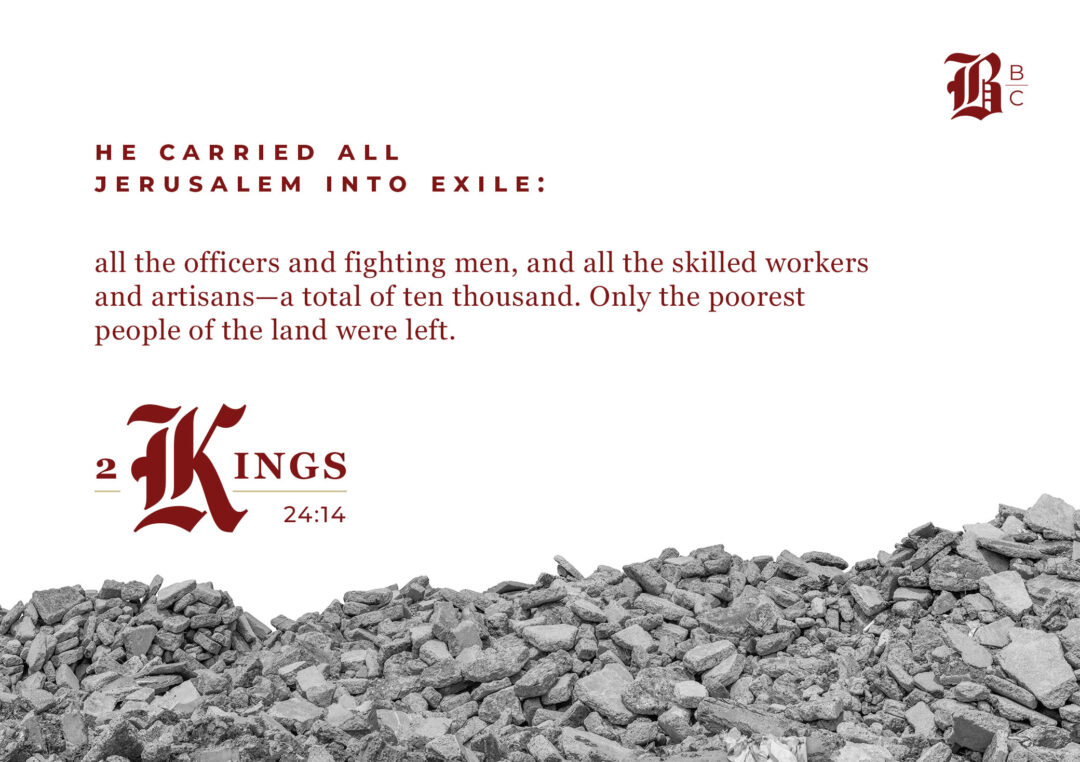
With free access to Jerusalem, King Nebuchadnezzer ravages the city and carries away King Jehoiachin and his family along with 10,000 people including all the officers, military men, and skilled workers and artisans. Nothing is left except the poorest of people.
Jerusalem and Judah disobeyed God, choosing the path of evil over good, just like Israel to the north. As a result, God will remove them from his presence. And where is God’s presence? In the temple.
This is the temple David so badly wanted to build. It’s the temple Solomon reverently designed to honor God. Yet the Lord allows King Nebuchadnezzar to destroy this place of His presence.
In 2 Kings 24 when the temple falls into rubble, it’s a visible symbol of Judah’s fall from God’s presence.
Invasion #3: Zedekiah’s Hopeless Rebellion in 2 Kings 25
Judah is a hurting nation and their population is down to only the poorest of the poor. Nevertheless, King Zedekiah launches a misguided attack on Babylon.
Perhaps he was blind to the true state of Judah, or maybe he is delusional enough to think God will still rescue them. But they don’t stand a chance against Babylon.
Sometimes the leaders God gives nations are part of His judgment on the nation. This is a note for us. As our nation bounces back and forth between presidents of different parties and we see policies ping pong, it might be wise to ask ourselves what is the state of our nation in God’s eyes?
How would the author of the Book of Kings describe our presidents, governors, senators, representatives and mayors over the last several decades? Have they done what’s right in the eyes of the Lord? Or have they done evil in the eyes of the Lord?
While we can’t control our rulers’ choices, we do have the collective opportunity to vote for leaders who will do right in the eyes of the Lord. We can raise support for future leaders who will do right in the eyes of the Lord. And some of us may even be called to become leaders who will do right in the eyes of the Lord.
Prophecy Fulfilled: Starvation, Surrender, and the Fall of Judah
At this point, Judah is nothing more than an annoying gnat to Babylon and King Nebuchadnezzar is tired of messing around with them. So, in response to King Zedekiah’s attack, he marches his entire army to Jerusalem and surrounds the city.
The city is seized for a year and a half, and the people stuck inside are starving. Just when they’re at their weakest, the Babylonians attack.
Judah’s army flees out the back gate, but King Nebuchadnezzar pursues and overtakes them. King Zedekiah’s troops scatters and he is captured.
King Nebuchadnezzar kills Zedekiah’s sons right in front of him and blinds him so the last thing he sees is this atrocity. Then he takes Zedekiah to Babylon where he dies.
This fulfills the prophecy in Ezekiel 12:13-14: “I will bring him to Babylonia, the land of the Chaldeans, but he will not see it, and there he will die. I will scatter to the winds all those around him—his staff and all his troops—and I will pursue them with drawn sword.”
The kingdom of Judah is no more.
A Kingdom in Ashes: Judah is Destroyed
King Nebuchadnezzar sets fire to the temple, the palace, and all the houses and important buildings. He breaks down the walls around the city and carries the rest of the people into exile. Anyone of importance he sends to Riblah to be executed. He leaves only a few of the poorest people to tend the vineyards and fields.
The city David built is burned. The temple Solomon built is burned. All the temple artifacts Solomon so lovingly designed to honor God are destroyed.
The bronze pillars and Sea are broken up and carried to Babylon. The elaborate gold and silver censers and bowls so carefully designed to reflect the Garden of Eden are carried off to be used by people who don’t worship God.
And Israel is back where it began…in captivity, this time in Babylon rather than Egypt. They are deprived of the Promised Land and the presence of the Lord.
It’s a haunting echo of the story of Adam and Even who were deprived of the Garden of Eden and the presence of God.
When Kingdoms Crumble
The temple gives us bookends around 1 Kings and 2 Kings. In 1 Kings, we began with the building of the temple. We ended 2 Kings approximately 300 years later with the destruction of that same temple.
In between, we covered all the drama of the kings and their kingdoms. First, the kingdoms split into Israel in the north and Judah in the south. Then, most of the kings in both kingdoms did evil in the eyes of the Lord, despite the prophets God sent to guide them.
As a result, both kingdoms were destroyed and forced back into slavery.
The author is making a point. The purpose of a king is to lead the nation in God’s ways. This mission began with the Mosaic covenant God had with the people and continued with the Davidic covenant God had with the kings. The whole point was…God would dwell among them if they were faithful.
God gave them the temple as the place of His presence among them. He removed the temple and His presence when neither the kings nor the people were faithful.
Pride Scatters the People
Upon his departure, King Nebuchadnezzar appointed Gedaliah over the few people left in Judah. Then several of King Zedekiah’s officers who had fled from Nebuchadnezzar, including Ishmael, returned to meet with Gedaliah.
Gedaliah assured them they didn’t need to fear the Babylonian officials and encouraged them to settle in the land and serve the king of Babylon. However, Ishmael was royal and believed he had more of a right to lead than Gedaliah.
So Ishmael and his men murdered Gedaliah. This was a bold but bad move against Babylon. The people knew it and fled in fear to Egypt.
A Remnant Remains: King Jehoiachin Survives
Still, after all this turmoil, one king in the line of David survives in captivity, King Jehoiachin. He was 18 when he surrendered in the second invasion of Judah. After 37 years in prison, now he’s 55.
Somehow, by the grace of God, Jehoiachin finds favor with the new King of Babylon. The king is kind to him, gives him a high place of honor, and provides for him as long as he lives.
Jehoiachin is not the last king of Judah, but he is the only king whose line survives even in captivity. So the Davidic line will continue through him, not Zedekiah.
Fast forward to Matthew 1:11-12 and we see this play out. Matthew lists the genealogy of Christ with Jehoiachin, also called Jeconiah, at the time of exile. Then he picks up the genealogy after the exile with Jehoiachin’s son, Shealtiel.
There is another remnant God is working through as well. Somewhere nearby, Daniel is preserving the faith. There is always a remnant. There is always hope for the faithful.
A Legacy of Faithfulness and Failure
Since 1 Samuel 10, we have journeyed together through 42 different kings. Of those, only five were good kings and five were lukewarm.
The good kings were David, Asa, Jehoshaphat, Hezekiah, and Josiah. The lukewarm kings who had spiritual lapses and/or neglected to remove idolatry were: Solomon, Joash, Amaziah, Azariah/Uzziah, and Jotham.
Kudos to you for surviving 32 evil kings!
By now, the author of these books has made his intended point. The covenant with God was about relationship, but Israel rejected a relationship with God. This rebellion and unfaithfulness led to their removal from God’s presence.
The Rise and Fall of Kings: A Story Pointing to the Savior
The story of the kings of Israel is part of a much larger narrative. It begins in Genesis with Abraham when God chose a family. The story continues in Exodus with Moses when God makes Abraham’s family into a nation called Israel.
Then in Joshua God gives Israel the Promised Land. In a perfect world, they should have been set for life. However, in Judges 21:25 we hear Israel had no king, and everyone did what was right in their own eyes.
In 1 Samuel and 2 Samuel, God gave Israel two kings. First was Saul who was a bad example for us to follow. Then we met David, from the tribe of Judah, who was a king with a heart for the Lord.
This led to the two books we just completed, 1 Kings and 2 Kings. These two books are the history of all the kings who came after David. It lays out the story of their failure to be faithful to a relationship with God.
In this, we can see the obvious–the people need a king who can save them from their sins and no human king will suffice. Humanity needs a savior king who must come from the family of Abraham, the nation of Israel, the tribe of Judah, the kingly line of David–and born of God who was with God in the beginning.
From here on out, there will be no more kings until Jesus–the Word, Life, and Light who can shine through the darkness of our sin and overcome it.
🎧 Listen now to see how God’s faithfulness shines through even in judgment.
Join us!
Season 13 is up next where we’ll study the book of 1 Chronicles. We look forward to continuing our journey through God’s Word with you.
Show Notes:
- Kings of Israel
- The Path to Good or Evil
- Scene 1: The 1st Babylonian Invasion AGainst King Jehoiakim (2 Kings 24:1-7) (Daniel 1:3-6)
- Scene 2: The 2nd Babylonian Invasion Against King Jehoiachin (2 Kings 24:8-17)
- Scene 3: The 3rd Babylonian Invasion against King Zedekiah (2 Kings 24:18-20) (2 Kings 25:1-7)
- Scene 4: The Temple Destroyed (2 Kings 25:8-21)
- Scene 5: Gedaliah Fails and the Peole Flee (2 Kings 25:22-26)
- Scene 6: Jehoiachin Remains the Only Glimmer of Hope (2 Kings 25:27-30)


Themes of this podcast episode:
The dangers of ignoring God’s Word. Judah’s downfall was rooted in their failure to obey and honor God. When they neglected His presence, destruction followed. In our own lives, when we drift from God’s Word and guidance, we risk spiritual decline. Staying rooted in His truth protects and strengthens us.
Our choices have consequences, but God’s mercy endures. Judah’s downfall didn’t start with King Jehoiakim in 2 Kings 24. It was the result of repeated rebellion and bad leadership over centuries. Yet, even as the nation collapses in 2 Kings 25, God still preserves a remnant. While our choices carry real consequences, God’s mercy is always available, offering us a way back to Him.
God’s sovereign plan prevails. Even in exile, God ensures the Davidic line continues through King Jehoiachin, leading to Jesus—the true King. His plan cannot be thwarted, no matter how bleak the circumstances. God is always working, even in our darkest moments, to bring about His perfect will.
