
Subscribe to BBC on Apple, Spotify , or Amazon
Would God save Jerusalem from Assyria?
Our last episode was a cliffhanger as Hezekiah prays God will rescue Jerusalem. We read a lot about King Hezekiah in the Bible because he is among the top three best kings of the old testament. His reign is filled with goodness. However, his son Manasseh takes the throne next, and he is basically the exact opposite of his father. King Manasseh’s profoundly evil acts push Judah to the edge of existence in 2 Kings 19, 2 Kings 20, and 2 Kings 21.
But first, we begin with some happy news. The Prophet Isaiah sends word that God has indeed heard King Hezekiah’s prayer to save Jerusalem. His answer is two-fold and both parts are pretty great for Judah.
First of all, because Assyria arrogantly boasted against God, a time is coming when Judah will mock them as they run away. Assyria has no room to boast, because they haven’t done anything that God Himself did not predict and allow to happen.
God does not hold back on describing Assyria’s troubling fate and declares he will put a hook in their nose. This imagery could mean God is treating the Assyrians as they treated others, putting a hook in the nose of their captives and attaching a rope to lead them. Or it could imply Assyria is a rebellious beast who needs a bit and bridle to be put into submission.
2 Kings 19 – Rooted in Faith: Judah’s Future Secured by God
The second part of God’s answer assures Judah He will provide for their needs, including food. This is really great news because Judah has been under siege for a while. Their crops from the spring were destroyed or eaten, maybe by the Assyrians, and now it’s fall. Provisions are low and the people are afraid.
God assures Judah the first year they’ll have enough to eat from just the vegetation growing around them. The second year they’ll have the food from those same plants. By the third year, they will plant their own crops and eat them. Then everything will be as it was before.
Like the remnant of vegetation that will feed them, Judah itself is a remnant that will take root and bear fruit. The people of Judah will survive. The King of Assyria will not enter the city or even attempt to attack. God will save them, and he’ll do it for David.
No Army Needed: God Saves King Hezekiah in the Bible
To fulfill his promise, that night God sends an angel of the Lord into the Assyrian camp to put 185,000 people to death. When the others in camp wake and find all the dead bodies, they break camp and leave immediately.
God does not need a single human soldier to accomplish His plan. The angel of the Lord does all the work, and God delivers on His promise from 2 Kings 19:33-34. The Assyrians do not enter Jerusalem. Instead, they return the way they came.
But God is not done. He delivers on what he said would happen in 2 Kings 19:6-7 as well, and the king of Assyria is murdered by his own son.
2 Kings 20 – When Hezekiah Prays, His Tears Move the Heart of God
At this point, our story does a little time travel, going back a few years. Maybe the author had a “whoops, forgot to tell you this” moment. More likely, in 2 Kings 20 he wanted to put together two stories–one about Hezekiah focusing on God and one about him focusing on the world.
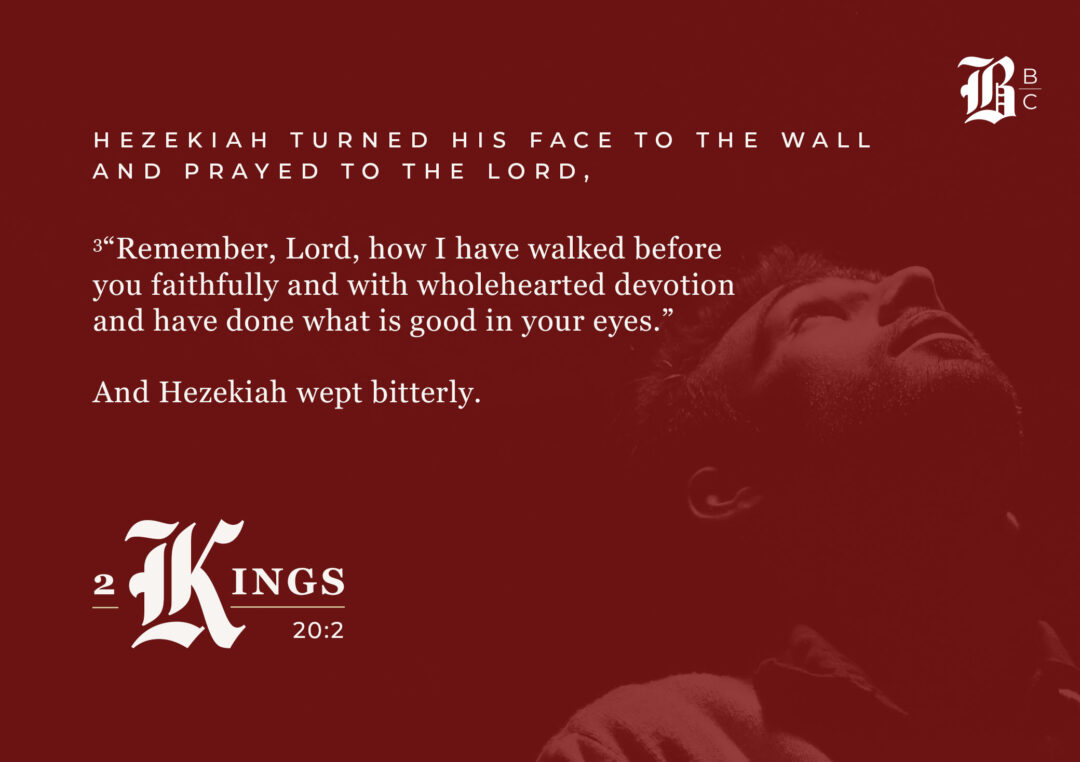
In any case, King Hezekiah gets some bad news. He’s sick and God tells him to put his house in order, he’s going to die. In response, Hezekiah prays asking God to remember all the good things he’s done. He doesn’t ask to live. He simply asks the Lord to remember.
The Prophet Isaiah delivers God’s response. God heard Hezekiah pray and saw his tears. He will give Hezekiah 15 more years of life.
Was this entire experience a test? A faith builder for King Hezekiah? Or was our compassionate God delighting in answering prayers? Only God knows.
Shifting Shadows Announce a Miracle
King Hezekiah asks the Prophet Isaiah for a sign the Lord will heal him. Isaiah gives him a couple options. Either the shadow can go forward or backward. Knowing it naturally moves forward, King Hezekiah chooses the impossible—he asks for it to go backward. And it does!
This whole shadow thing is a bit of a mystery. Some think it was a sundial. Others believe it was a set of stairs on which the shadows indicated the time of day. Maybe King Hezekiah could see them from his sick bed.
Regardless, this is the story where King Hezekiah focuses on God and enjoys a rapid recovery and 15 more years of life. He is a good king, but he’s not perfect. Like David, he makes mistakes, and we’re about to see a devastating one.
From Triumph to Tragedy: Hezekiah’s Fatal Misstep
King Hezekiah has a new lease on life. He’s healed, strong, and filled with joy when the King of Babylon comes to visit and celebrate his recovery. Hezekiah shows the king around and puts Judah’s riches on full display.
This is not unusual when trying to impress a potential ally. However, fueled by the other king’s flattery, King Hezekiah drops his guard and it backfires. When the King of Babylon sees just how rich Judah is, instead of allies, he starts to think Judah would make a better enemy.
Poor Hezekiah has no idea the fatal mistake he has just made when the Prophet Isaiah shows up and starts asking questions. Who is that? What did you show him? King Hezekiah’s answer–I showed the king everything–feels like a gavel falling to seal the prophecy.
By the hand of Babylon, not Assyria, Judah will fall. God’s people will be taken into captivity.
King Hezekiah’s momentary lapse in judgement will cost them everything. Although, interestingly, it will not happen during Hezekiah’s life. Instead, this prophecy will set the stage for the rest of 2 Kings.
King Hezekiah’s response to Isaiah’s prophecy is interesting. At first, he accepts it with humble resignation saying, “God’s word is good.” Then he basically sounds like he’s saying, at least there will be peace and security in my lifetime.
It comes off as selfish. However, most commentaries think King Hezekiah is actually coming from a place of humility, acceptance, and thankfulness. Perhaps he was hopeful God would change his mind like he had with Hezekiah’s illness.
The chapter ends with a mention of King Hezekiah’s brilliant water tunnel, called the Siloam Tunnel. This very tunnel was discovered in 1880 and today you can walk through it. The tunnel runs beneath the City of David connecting the Gihon Spring to the Pool of Siloam. It is considered one of the greatest engineering accomplishments of the period.
2 Kings 21 – King Manasseh’s Legacy: The Undoing of Judah
After 15 years, King Hezekiah dies, and his son Manasseh takes the throne. We quickly go from the best king ever to the worst. King Manasseh rebuilds the high places his father tore down and the list of evils he commits is breathtakingly awful.
It was exactly this kind of evil that led God to take the land away from the Caananites and give it to the Israelites hundreds of years ago. Now Judah is acting even more evil than the Caananites ever did. It’s not surprising they are about to lose the land as well.
Moses made it clear to the Israelites before they took possession of the Promised Land they were not receiving this land out of their own righteousness. It was because of the wickedness of the Canaanites. (Deuteronomy 9:4)
Then God declared the land would remain with the Israelites as long as they kept His commands. (Deuteronomy 11:22) Clearly, due to the sins of Judah and their failure to repent, that covenant with Abraham’s descendants is broken.
God gives us all ample time for repentance, but there is a point when sin reaches its full measure. (Genesis 15:16) That time already came in the Northern Kingdom of Israel. Now it is approaching for Judah.
Betrayal, Bloodshed, and the Rise of the Last Good King
King Manasseh pushes Judah over the edge, but not quite to the point of no return. Unlike Israel, for Judah there will be a return. However, not before the nation endures an incredible amount of suffering.
Babylon is headed their way. The once vibrant Judah with a population of well over 100,000 will be reduced to a remnant of just 4,200 people.
But first, King Manasseh dies, and his son Amon takes the throne. Amon follows in his father’s footsteps, committing atrocities against the Lord. After just two years, his officials conspire against him and kill him in his palace.
But the people of the land rise up against these officials and kill them. Then they set King Amon’s son Josiah on the throne. With King Josiah, we get the last good king of Israel.
🎧 Ready to dive deeper? Click here to listen to the Bible Book Club Podcast now!
Show Notes:
- Kings of Israel
- The Path to Good or Evil
- Scene 1: God Hears and Isaiah Speaks (2 Kings 19:20-34)
- Scene 2: God Alone Saves Jerusalem, So the World May Know (2 Kings 19:35-37) (2 Kings 19:5-7)
- Scene 3: Hezekiah Prays for His Life (2 Kings 20:1-11)
- Scene 4: A Visit from Babylon Casts a Dark Shadow (2 Kings 20:12-21)
- Scene 5: Manasseh Is Crowned King of Judah (2 Kings 21:1-18) (Genesis 15:16) (Deuteronomy 9:4-6) (Deuteronomy 11:22-25)
- Scene 6: Amon Is Crowned King of Judah (2 Kings 21:19-26)


Main themes of this podcast episode: Reading about King Hezekiah in the Bible gives us an amazing example of how to have a relationship with God. When Hezekiah prays, we see how we can pray too. Then King Manasseh gives us the perfect example what not to do when it comes to faith in 2 Kings 19, 2 Kings 20, and 2 Kings 21.
- God’s power is greater than any challenge. When King Hezekiah faced the Assyrian threat, he turned to God instead of relying on human strength. His story reminds us that no obstacle—whether an army, crisis, or personal struggle—is bigger than God’s ability to save and provide.
- Pride can turn blessings into burdens. King Hezekiah’s faith brought about his miraculous healing, but later his pride led Babylon to Judah’s riches. His mistake teaches us to turn to the Lord rather than pride in our blessings. Success should deepen our dependence on God, not inflate our ego.
- One Generation’s Faith Doesn’t Guarantee the Next’s Despite having a righteous father, King Manasseh led Judah into idolatry and evil. His reign proves that spiritual heritage isn’t enough—we must choose to follow God ourselves. Faith isn’t inherited; it’s lived.
