Subscribe to BBC on Apple, Spotify , or Amazon.
The Temple as a Path Back to God’s Presence: 2 Chronicles 4
In 2 Chronicles 4, the Chronicler continues his mission to share stories of the past to give the returning exiles hope for their future. Everything rests on their faith and rebuilding their relationship with God, so he gives them a vision of what the Temple was…and can be in the future.
The Temple is crucial to their covenant relationship with God. It’s not just a building, it’s the intersection of Heaven and Earth. It’s where God will choose to dwell among His people, and the Chronicler longs for God’s presence to reside among the returning exiles once again.
The Temple Solomon builds is stationary, replacing the traveling Tabernacle. It’s a symbol of permanency and promise. God gave them the land, and now they can dwell with Him in peace just as Adam and Eve did in the Garden of Eden.
But not quite.
They have to do the work to maintain their relationship with God through sacrifices and worship. That’s something Adam and Eve never had to do in the Garden. Everything in the temple is decorated with a Garden of Eden motif of flowers, fruit, and trees to remind God’s people of their goal to return to a relationship with God.
Same Blueprint, Bigger Scale
Just as Moses furnished the Tabernacle, Solomon furnishes the Temple. Both the Tabernacle and Temple contained:
- The Altar of Burnt Offering.
- The Altar of Incense.
- A Laver or Basin for washing.
- The Table of Showbread.
- A Menorah.
- Bronze artifacts in the courtyard and gold artifacts in the temple.
The difference between the Tabernacle and the Temple was the size, materials, and quantity. Solomon kept the same scale but everything in the Temple was bigger and there was a lot more gold.
The Furniture Is Not for Sitting
The furnishings in the Temple weren’t exactly furniture. They were items for worship and sacrificial ceremonies. Nobody was hanging out in the Temple. There were no chairs or pews.
The lay people were not allowed inside the building at all. Only priests could enter the building, and even they could only go in the first ⅔ of the building, which was called the Holy Place.
The High Priest was the only one who could enter the last room called the Most Holy Place. That’s where the Ark of the Covenant was.
The Altar Remains the Heart of Worship
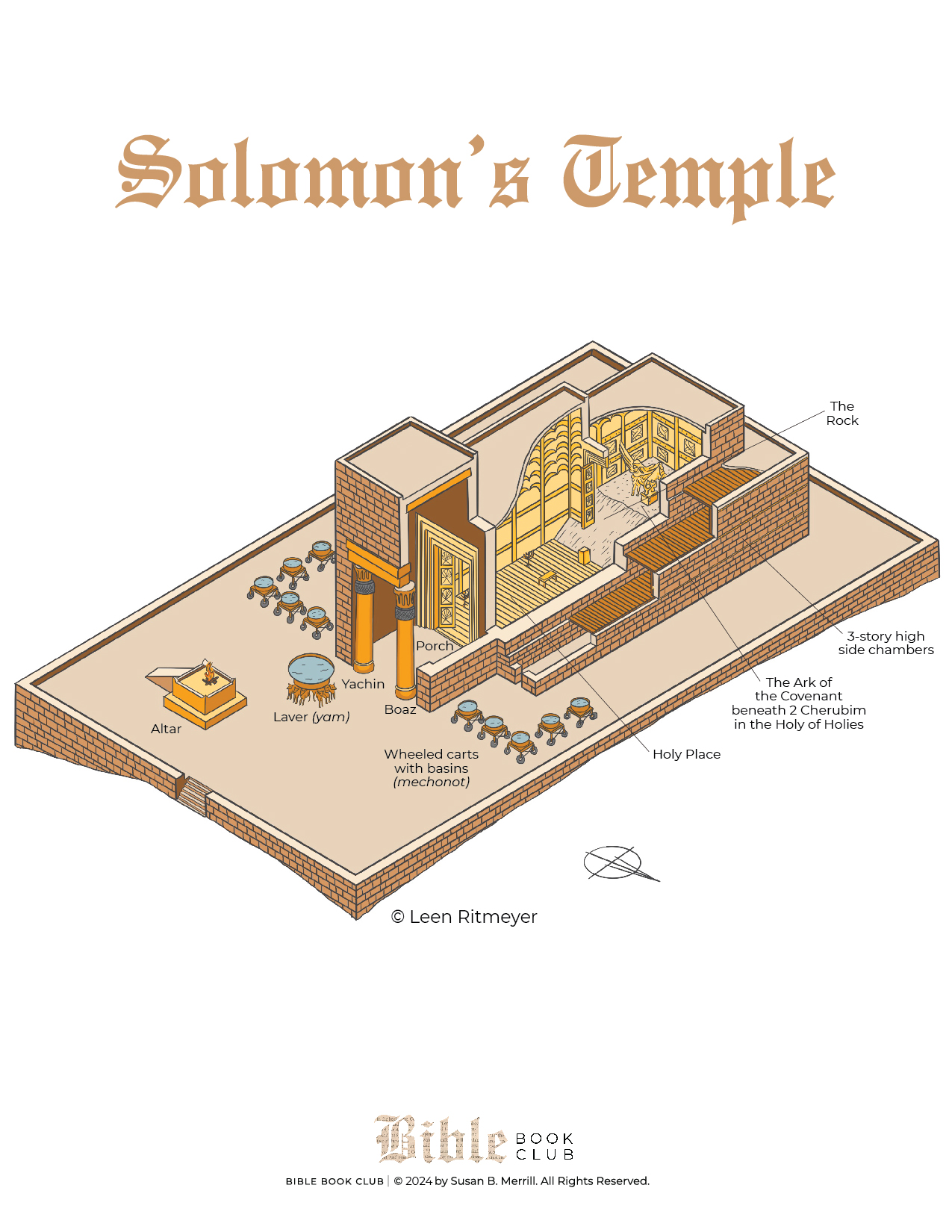
There was a courtyard around the Temple where the Israelite men were allowed to go so they could offer sacrifices. The daily sacrifices all happened in this outside courtyard on a massive altar you can find in the picture on our Temple Show Note.
Solomon provided two sets of Temple Furnishings. One for this outer courtyard, which was all made of bronze, and another set for the Temple, which was all made of gold.
The altar mentioned in 2 Chronicles 4:1 was about 30 feet by 30 feet and placed 15 feet high on a platform with steps up to it. This Temple altar was about five times the size of Moses’s Tabernacle version in Exodus 27, but the purpose of the altar was the same. It was used for burnt offerings to atone for sins.
If you were with us in Season 3 of the Bible Book Club podcast for our study of Leviticus, you might recall there were a lot of daily animal sacrifice on that altar. Solomon enlarged the water basins and altar of burnt offerings, suggesting he was planning to expand the kingdom.
The Bronze Sea and Basins
The bronze Sea in the courtyard mentioned in 2 Chronicles 4:2-5 replaces the smaller Laver of the Tabernacle in Exodus 30. It has a 15-feet diameter and 7.5-feet high elevated water basin supported by 12 bronze bulls, three on each side. It holds up to 17,000 gallons of water and is considered a great feat of ancient metalwork because of its size. The water is used for the priests to ritually wash, and there are many priests and many daily rituals.
The ten water basins on carts in the courtyard mentioned in 2 Chronicles 4:6 were unique to the Temple and not mentioned in the Tabernacle. They were used for washing the utensils for burnt offerings.
Each of these ten basins was six feet wide and held about 220 gallons. The stands or carts that held the water basins were elaborately decorated and had wheels, but they wouldn’t be easy to move. Get a glimpse of them in our Temple Show Note.
Lampstands Light the Way
In 2 Chronicles 4:7-8 the Chronicler describes the ten lampstands and tables in the Temple. Like the water basins, the lamps get an upgrade. The Tabernacle had just one lampstand and the Temple has ten, which makes sense since the Temple is so much larger.
The purpose of the lampstands is to light the main area or Holy Place. The lampstands look like a candelabra, but they don’t have candles. Instead, the Israelites use oil with a wick. The ten tables are only mentioned here, so perhaps the Chronicler assumed the ten lampstands sat on ten tables.
A Gifted Outsider with Israelite Roots
In 2 Chronicles 4:9-10, the Chronicler takes us back outside to the large courtyard which has bronze doors.
In our last post, we read in 2 Chronicles 2:13-14 that Hiram, King of Tyre, was sending Huram, a man of great skill, to Solomon. Now, in 2 Chronicles 4:9-18, we get the details of what Huram created for Solomon’s Temple.
Back in 1 Kings 7:13 we learned Huram is from the tribe of Naphtali, but our Chronicler writes he is from Dan. It’s possible “from Dan” doesn’t mean from the tribe of Dan. The city of Dan was located in the territory of the tribe of Naphtali.
The Chronicler is likely pointing out that the gifted Huram was actually half Israelite and half Phoenician. It’s another example of Phoenician intermarriage which began way before Solomon during the time of the book of Judges.
The tribe of Asher failed to drive out the inhabitants of the cities on the Phoenician coast. The tribe of Naphtali lived right next door to the tribe of Asher. The result was that both tribes intermarried with the Phoenicians.
Inside the Temple
In 2 Chronicles 4:19-22, Solomon provides more furnishings for the inside of the Temple. The golden altar is mentioned first. The Chronicler doesn’t give details about the size of the altar.
However, we know from Exodus 30 that the gold altar was the altar of Incense. It was smaller and more beautiful than the bronze altar of Burnt Offerings in the courtyard.
This altar was placed in the Holy Place, or main room of the Temple, in front of the curtain that led to the Most Holy Place. Its purpose was to burn incense, which symbolized the prayers of God’s people.
Then the author mentions the Bread of the Presence and the table, but he doesn’t give any other details. He probably assumes we are good Hebrews who have read Exodus and Leviticus, so we know the Bread of the Presence is 12 loaves of bread replaced every Sabbath representing the 12 tribes who are under the constant provision and care of God.
The table, lampstands, and golden incense altar are all positioned in the Holy Place. The Chronicler wraps up with another mention of the lampstands along with some tools and dishes.
Holy Doors and Curtains
Last of all, we get a note about the doors to the Temple. They are partly gold. The translation of 1 Kings 7:50 suggests the hinges, eaves, or side posts were gold. But in 1 Kings 6:31-35 it states that the doors were made of olive wood overlaid with gold.
The confusion is that a curtain or veil also separated the Holy Place from the Most Holy Place. But it makes sense to have both doors and a curtain, because when the door opened the Ark would still need to be protected from the regular priests view. So there may also have been a curtain the high priest would walk around after he opened the door.
We can assume every door on the Temple, whether to the Holy Place or Most Holy Place, was overlaid in gold. The posts or eaves around those doors would have been gold too.
From Chaos to Sacred Order: Chapter 5
In 2 Chronicles 5:1 all the work is done. Every detail of the Temple is carefully and elaborately created. The Tabernacle design represents creation in miniature. Its splendor mimics the splendor of the world God created.
It was a sacred space and the precise and perfect dimensions give a sense of order amid chaos just as God created the world out of chaos. Then God dwelt with Adam and Eve in the Garden of Eden. Israel created the Temple, a sacred place of worship and order, in the hope God would dwell among them.
There was one furnishing Solomon did not have to make. It was the only original piece of furniture created under Mose’s instruction over 400 years earlier…the Ark. And, once again, it’s time to move the Ark.
Celebrating God’s Promise and Presence
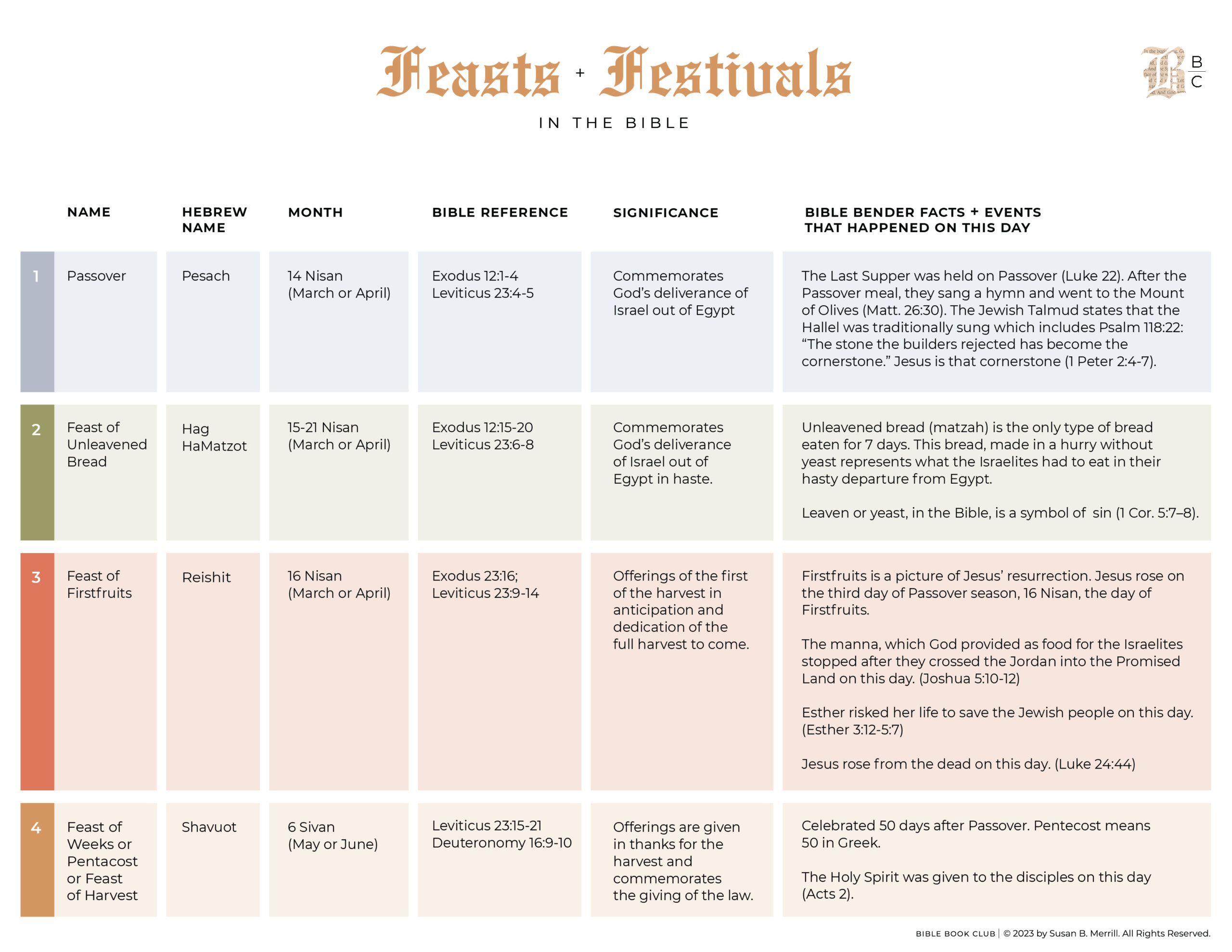
The Feast of Tabernacles is the festival celebrated in 2 Chronicles 5:2-3 in conjunction with the Temple dedication. This is one of the nine feasts and festivals we covered in Leviticus 23-24: Holy Days vs Holidays + Sabbath vs Sunday. See our chart of all the Feasts and Festivals here.
The Feast of the Tabernacles, also known as the Feast of Booths, commemorated the 40 years the Israelites spent in the wilderness. The people of Israel would gather and set up booths or temporary shelters for a week to remember how the Israelites lived for 40 years.
It made sense that Solomon waited unit this festival to dedicate the Temple, because the Temple is a visible sign Israel has found rest and permanence in the Promised Land. Plus, all the people would already be gathered in Jerusalem to celebrate the feast.
The Ark’s Journey Home
The reign of Solomon was the golden age of Israelite history, and this installation of the Ark in the Temple was the high point. The Ark, the Temple, and the promise of the Davidic line leading to the future Messiah were the essential building blocks in the theology of hope the Chronicler was trying to instill in the returned exiles.
The Ark was the single most sacred object from the Tabernacle, and its movement was carefully dictated. We read in 1 Chronicles 13-15 about the fatal trip the Ark took under David’s reign when it was improperly handled and killed a man. After that failed attempt, David was eventually successful in transferring the Ark from Obed-Edom’s house to Jerusalem where he housed it in a tent.
Solomon and the Levites learned from David’s mistakes and successfully installed the Ark in the Most Holy Place of the Temple beneath those 15-foot cherubim without incident. It sounds as if the poles were longer than the veil and stuck out somehow. No one is quite sure how.
In 2 Chronicles 5:4-10, the Arks’ inventory included only the stone tablets. Aaron’s staff and the pot of manna aren’t mentioned here, but they are in Hebrews 9:3-4. Based on Numbers 17, Aaron’s staff was likely placed before the Ark in the Temple.
With the Ark and all the items installed in the Temple, worship would no longer be split between Jerusalem and Gibeon. All worship would be centralized in Jerusalem.
The Cloud Returns
Sacrifices were taking place in the courtyard as they placed the Ark in the Temple. As the priests withdrew, we can imagine they took a collective sigh of relief that everyone survived the Ark transport. Then the Levite musicians began to play and sing in 2 Chronicles 5:11-13.
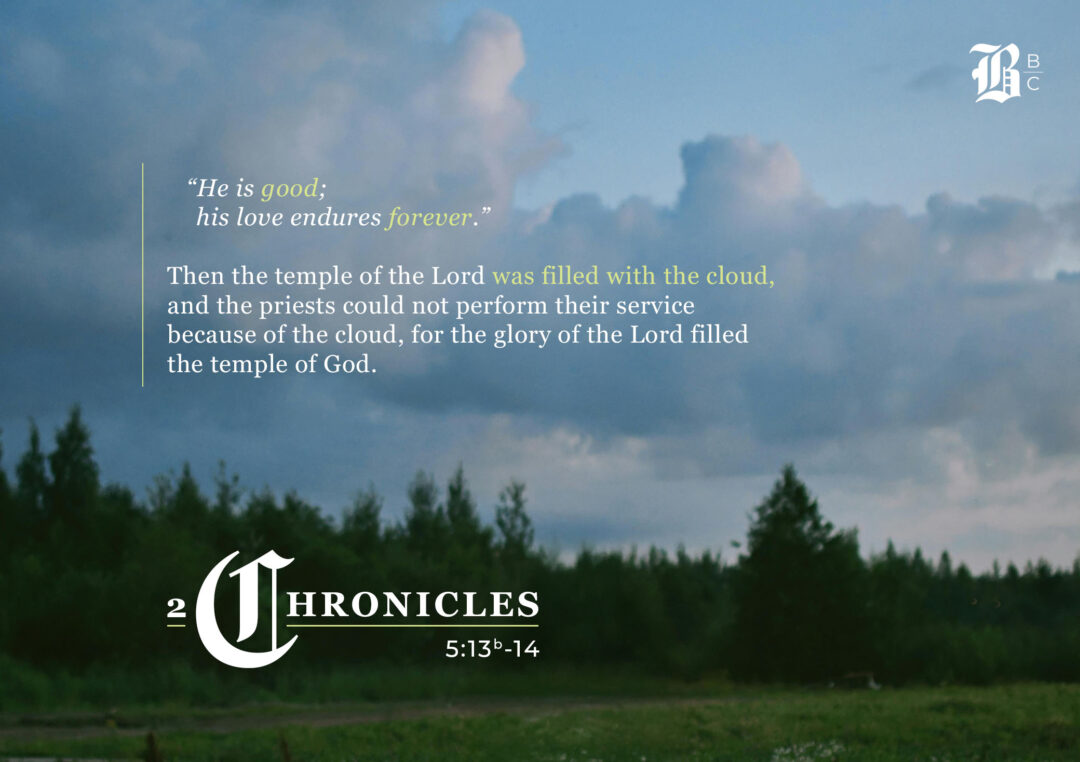
When the Ark was in and the priests were out, the cloud filled the temple in 2 Chronicles 5:14. This cloud is the glory of the Lord and embodies His presence, power, and protection.
The Cloud is a visible representation of the Lord’s glory while at the same time covering God’s glory. It reveals and conceals. No one in this world can look upon the full glory of God.
In our journey, we have met the Cloud often throughout the Old Testament. The first mention was in Exodus 13 when the Cloud guided the Israelites through the wilderness.
The Cloud is still a bit of a mystery to us. We know from Exodus 13:21 that the Lord is in the Cloud. In Exodus 14, when the Egyptians tried to attack at the Red Sea, the Cloud protected them.
We also know the Cloud appeared at Mount Sinai in Exodus 9 before God gave them the Ten Commandments. In Exodus 40, the Cloud of the Lord filled Moses’s Tabernacle just as it did Solomon’s Temple.
The Israelites followed the Cloud for 40 years in the desert, but then the Cloud disappeared. Or, at least as far as we know, it did. For 500 years there was no Cloud until this moment of the Temple’s completion.
Solomon’s Temple and the Promise Yet to Come
Now the cloud has returned! Did the Israelites have any idea this would happen? They must have thought about it because they knew when Moses completed the Tabernacle the Cloud filled it.
Surely Solomon cried. He had to be thinking of his father, David, and how he would have loved to see this manifestation of God. Just as Moses would have loved to see the Promised Land.
Never before had two men worked so hard to fulfill God’s desire. Moses to give the Israelites a home in the Promised Land. David to give God a home in the Promised Land.
Moses saw the Cloud of the Lord but never the Land. David saw the Land but missed the Cloud of the Lord. The irony is a little heartbreaking.
But God chose to dwell among them in the Temple, and Solomon surely felt His pleasure. The Temple was as close as they could get to Heaven on Earth.
From Solomon to the Second Coming
God’s presence, power, and protection meant peace in Israel. This is the climax of Israel’s spiritual journey, but we know it won’t last. On the other side of every peak is a valley. The cloud will once again disappear until over 900 years later when the Cloud will reappear again at Jesus’ transfiguration in Mark 9, Luke 9, and Matthew 17.
The Cloud appears again at Jesus’ Ascension in Acts 1:9-11. The King James version for this passage says it beautifully…”a cloud received him.” The Cloud received Him, and the Cloud will deliver Him again at the second coming of Christ.
On that day, we will most likely weep with joy as we witness the fulfillment of God’s promise to us, just as we can imagine Solomon did at the sight of the Cloud.
🎧 Ready to dive deeper? Listen to episodes of the Bible Book Club Podcast here.
Themes of this podcast:
God’s presence is the ultimate promise. From the Tabernacle to the Temple to the cloud descending, God’s people long for Him to dwell among them. The Temple isn’t just architecture. It’s hope made visible. That same hope stretches forward to Christ and the Cloud that will one day bring Him back.
Worship requires both precision and surrender. From massive bronze basins to golden lampstands, every detail of the Temple shows that sacred space must be handled with reverence. Worship was orderly, intentional, and often costly. But when God’s people followed His design, His glory came down and the Temple became the intersection of Heaven and Earth.
God creates order out of chaos and restores hope for the future. The Chronicler paints a picture of return and renewal—pointing exiles (and us) toward a God who brings order from chaos. The Temple stood as a reminder that even after failure, God invites His people back into relationship, back into His presence.
Show Notes: