Subscribe to BBC on Apple, Spotify , or Amazon
What are the books of the Bible?
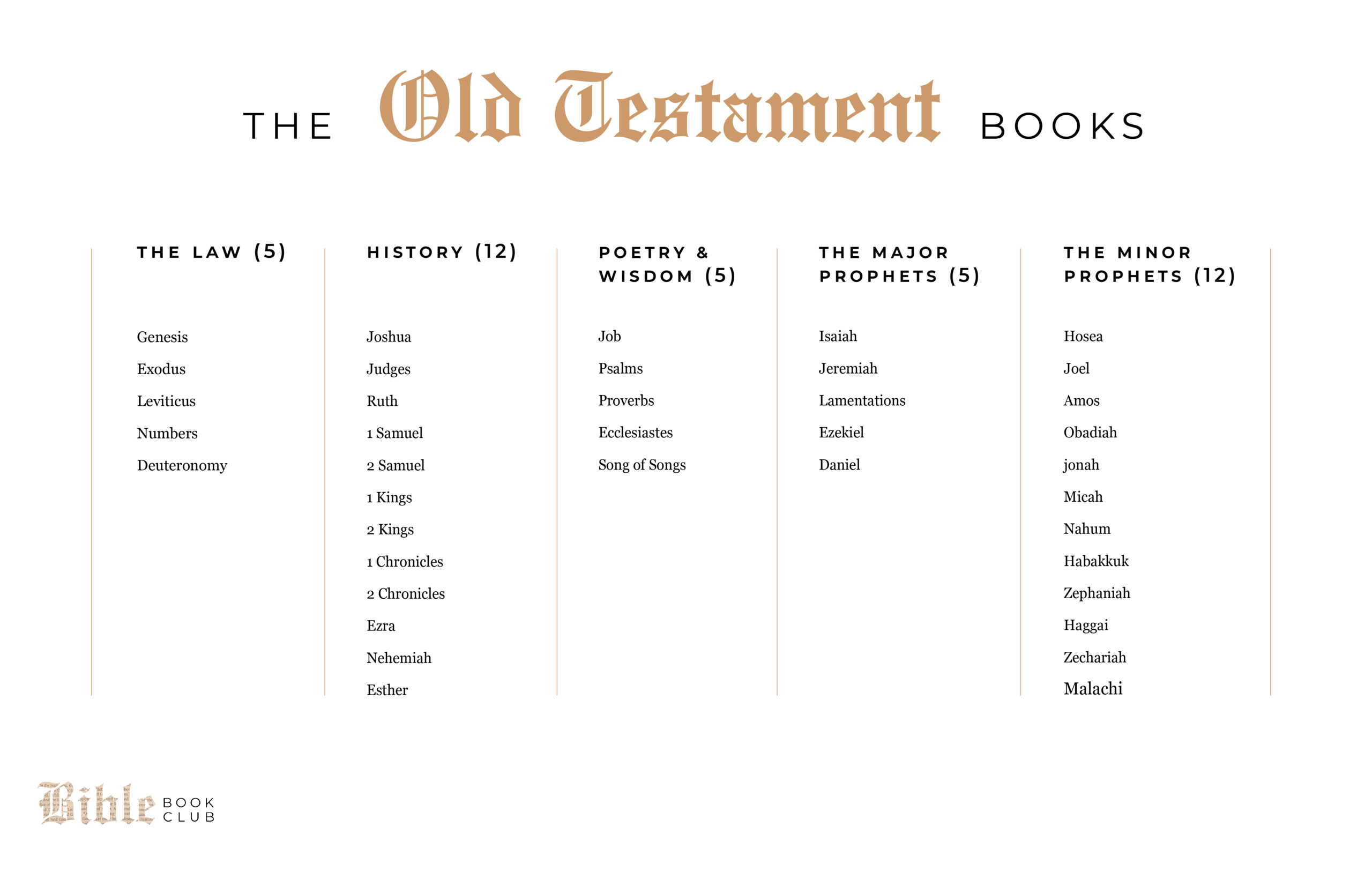
The Bible is a collection of books that together tell a much larger story of the entire history of our redemption with Jesus as the ultimate hero. Get a clear visual of all the books of the Bible and how they are divided with our Old Testament and New Testament show notes.
How is the Old Testament divided?
It’s helpful to know how the Old Testament is divided for a better understanding of how the whole story of our redemption fits together. The Old Testament has five divisions:
- Books of the Law
- History Books
- Poetry and Wisdom
- Major Prophets
- Minor Prophets
The First Five Books of the Bible
The first five books of the Bible are called the Pentateuch. These are the Books of the Law and include: Genesis, Exodus, Leviticus, Numbers, and Deuteronomy. We discussed this first division in seasons 1-5 of the Bible Book Club Podcast.
The History Books of the Bible
The next division is called the History books. This division is aptly named because these books describe Israel’s history in Canaan. The 12 History books of the Bible start with Joshua and end with Esther. They are a retrospective analysis that explains what caused the Israelites to go from the prosperity of the Promised Land during Joshua’s era to exile.
We discussed the first five History books in seasons 6-10 of the Bible Book Club Podcast. The story begins in Joshua with Israel’s opportunity to live well after being enslaved in Egypt for hundreds of years. The people enter the Promised Land and conquered most of the Canaanites.
Joshua dies and Israel begins their journey down the wrong path. Instead of being a light for the world, they become like the world. Like the people of Canaan.
Who was the first king of Israel?
The books of Samuel tell the story of Israel’s leadership transition from Judges to the first two Kings of Israel. The story starts with Saul, the first king of Israel, who disobeyed and failed to follow God. Then we learn about David, a man after God’s heart.
Because of David’s heart for the Lord, God made a covenant with him promising his descendants would reign as king forever. So the books of Kings we’re about to dive into tell the story of all of Israel’s kings from David until the Israelites are carried off into captivity due to their disobedience and idolatry.
With each king, the question is answered…who are they like, Saul or David? Disobedient or obedient? With a heart of pride or a heart for the Lord?
A 400-Year Journey from Glory to Exile
We are on a journey through God’s plan to save us, and the books of Kings sit right in the middle of the History Books. They are the 11th and 12th books of the Old Testament and cover a period of over 400 years.
Kings is a continuation of the story in 2 Samuel. As with 1 and 2 Samuel, 1 and 2 Kings were originally one book that followed one storyline. The author is unknown, but the commentaries agree Kings was written by someone in exile who was pondering what happened and how their nation went from bountiful prosperity to destitution and exile.
The author’s goal is to show the people how their rebellion and unfaithfulness led to exile. He wants them to see how things went so wrong and how their stubborn persistence in breaking the Mosaic Covenant led to their exile.
The Mosaic Covenant is the covenant God made with the people when He brought them out of Egypt under the leadership of Moses. It is laid out with painstaking detail in Deuteronomy.
God wants to move us closer to Him, so relationship is at the core of all the covenants He made with his people. However, Israel rebelled against God and rejected His covenants. This moved them further and further away from God until eventually they were in exile.
For an overview of all five covenants God made with His people including the New Covenant that follows the Davidic Covenant and how they build on each other, listen to Season 10, Episode 7 of Samuel on the Bible Book Club Podcast.
David’s Decline: 1 Kings 1
We are on a journey through God’s plan to save us, and as we begin 1 Kings 1:1-4, David is dying. He is old and cold, and his inability to stay warm, even with multiple covers, is a sign that death is near. He appears to be withdrawing from life and no longer has the energy to lead.
His attendants provide a beautiful woman named Abishag to care for him and keep him warm. The use of a young person to restore warmth was a known medical practice at that time. She is considered David’s personal heater, nurse, and possibly even considered a concubine although David did not have sexual relations with her.
But she is beautiful. Maybe the advisors are hopeful David’s health will take a turn, because David likes women. Lots of them. As a result, he has many sons, which becomes a source of contention and heartbreak for both him and for them.
Adonijah the Heir Apparent
Although David is dying, he hasn’t named his successor. We get a glimpse into the birth order for David’s sons in 1 Chronicles 3:1-9, and it’s not out of line for Adonijah to think he’s the heir apparent.
After all, in 2 Samuel, Absalom kills his half brother, the firstborn son Amnon. The second son, Daniel, who is also called Kileab, is never mentioned and is assumed dead, perhaps at a young age. Joab kills Absalom, the third born son of David. So it appears Adonijah is next in line.
However, 2 Samuel 12, informed us that when Solomon was born the Lord loved him. Nathan the prophet named Solomon Jedidiah, which means loved by the Lord. Certainly, this was our first hint Solomon was the next king even though he is actually number 10 in the line of sons.
The politics of who will reign are complicated. The surrounding culture has a succession precedent for the firstborn or primogeniture, but Israel does not. David wasn’t even Saul’s son. God promised David someone from his line would reign, but He didn’t say it had to be the oldest son.
The problem is, David is being remiss in his parental duties again as he was in 2 Samuel 14-15. He is dying, and his failure to declare a successor creates a chance for discord. He should have made God’s choice very clear and anointed Solomon.
Adonijah Makes His Move for the Throne
David appears to be weak and unwilling to confront his children. Adonijah takes advantage of the silence and makes a move in 1 Kings 1:5-10.
He is aggressive. He gathers a military arm and wins the favor of Joab, the military commander. Then he acquires a willing priest, Abiathar, and invites all his brothers, minus Solomon, to the celebration. He makes sacrifices to God and every box is checked.
It’s important to note Joab supports Adonijah. He is a hot mix of good deeds and bad, and he has a long-standing history of wanting to have a say in the running of Israel.
Good old Abiathar escaped the slaughter of the priests in 1 Samuel 22, and he has been with David ever since. He supports Adonijah, but as a priest he should have been more in tune with God’s desire.
The fact that Adonijah did not invite Nathan, Benaiah, or Solomon implies he knew Solomon was David’s choice. Adonijah is much like his older brother Absalom in 2 Samuel Season 10 of the Bible Book Club Podcast.
David avoided disciplining Absalom for bad behavior, which led to rebellion. Like Absalom, Adonijah has political aspirations and the confidence to take what he wants. He has the handsome look of a king, which the Israelites favor, and because he looks the part and is next in line he has no trouble gathering support.
Nathan and Bathsheba’s Urgent Intervention
In 1 Kings 1:11-14, the situation is urgent. Adonijah is a usurper and the protocol to protect his claim to the throne is to eliminate all rivals to his position and their families. That means no more Solomon or Bathsheba. They will most definitely be executed.
Nathan informs Bathsheba of Adonijah’s coup, and they make a plan. Bathsheba will inform the king, and Nathan will step in and confirm her accusations against Adonijah.
It’s as if they know David will not want to deal with a tattletale wife unless she has backup. Nathan is the backup. He is Bathsheba’s stamp of legitimacy from God in 1 Kings 1:15-27.
In 2 Samuel 12, Nathan is the one who held David accountable for his affair with Bathsheba. Now he is going to make sure David follows through with God’s plan for Solomon as David proclaimed it in 1 Chronicles 22.
The fact that Abishag was present when Bathsheba and Nathan talked to King David will be important in the next chapter, because she witnessed David’s orders. She knows the king ordained Solomon to be king.
David’s Final Act of Faith
For one last time, David’s heart for the Lord beats again. He remembers his duty and takes control, determining once again to do what is right before the Lord.
In 1 Kings 1:28-31, he supernaturally rallies from his deathbed. They call Bathsheba back in. Apparently she had gone out when Nathan came in. Now when Bathsheba comes in, Nathan goes out.
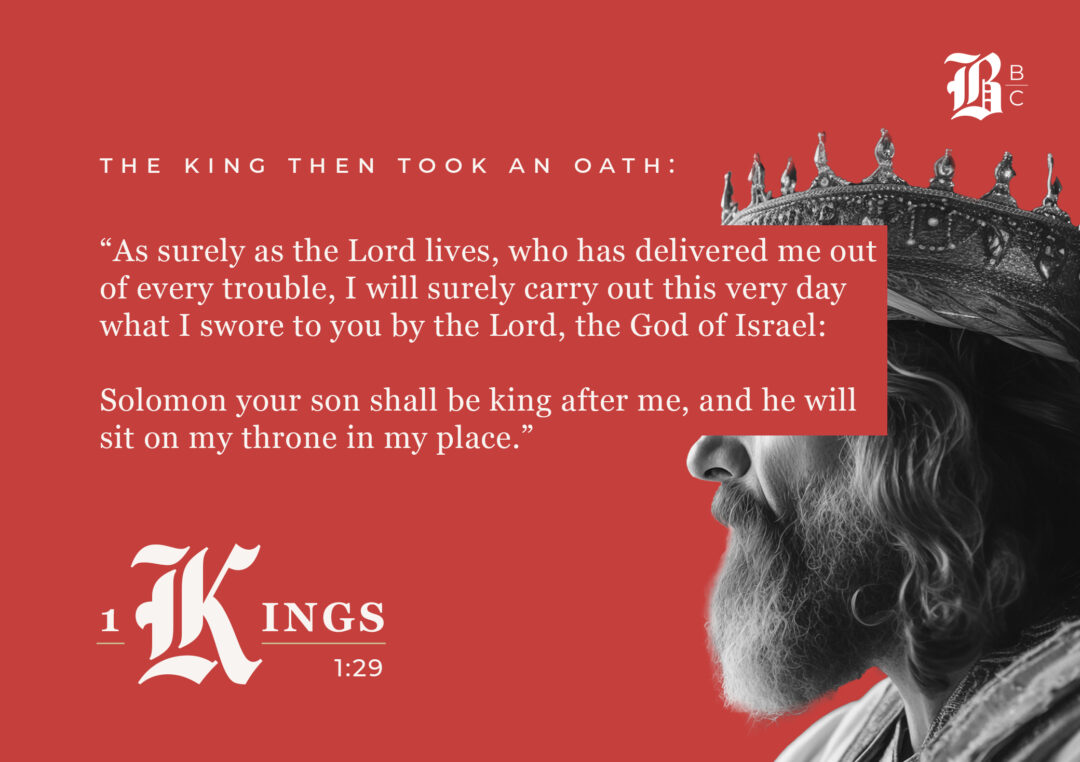
The first thing David does is renew his promise to Bathsheba that Solomon will be king. She bows down in thanks.
The formality with which Bathsheba approaches David makes you wonder what became of their relationship. We know David continued having many children with concubines and slaves. It is likely David’s wives and children did not all live in one palace. They probably resided in separate houses on the palace grounds.
Had David and Bathsheba grown distant? Were they strangers by this time?
It’s sad that David, so in love with her that he murdered to cover up his affair, could become so distracted by other women. And that at the end of his life he is cared for by a woman who is a stranger rather than his own wife.
Solomon Becomes King
In 1 Kings 1:32-40, David calls in his team. Nathan the prophet, Zadok the priest, and Benaiah the general.
We already know who Nathan is. Zadok is David’s leading priest and a descendent of Eli. He first appears after David occupied Jerusalem in 2 Samuel 8.
Benaiah is the commander of David’s royal guard and one of the leaders of David’s Mighty Men. He is in David’s inner circle of most trusted men, and it has always been his job to act as David’s secret service. Learn more about him in 2 Samuel 23, Season 10, Episode 15 of the Bible Book Club Podcast.
Benaiah leads the royal guards of Kerethites and the Pelethites in surrounding Solomon. They are his bodyguards, and they place him on David’s royal mule as is customary for kings as a status symbol.
Zadok anoints Solomon as king under Nathan’s authority, and the baton is publicly passed from David to Solomon for all Israel to see and celebrate. The jubilation is so great the ground noticeably shakes.
Adonijah Is Abandoned
In 1 Kings 1:41-48, as commander of the army, Joab is the first to be concerned by the trumpet, as well he should be. He knows he is going against David, but this is not the first time he’s done what he wanted instead of what David wanted.
Adonijah arrogantly, a little drunk on his own success and celebration, thinks Jonathan bears good news. Jonathan does indeed bear good news, it’s just not good news for Adonijah.
David has made Solomon co-regent over Israel. The party is over for Adonijah.
In 1 Kings 1:49-53, everyone scatters in fear. Adonijah goes straight to the altar and grabs hold of the horns in a desperate move to save his life.
The altar was a place of refuge, and it was most likely in the Tabernacle. By grasping the horns, Adonijah is claiming the protection of God until judged.
The custom of safe haven in the sanctuary is a way of stopping innocent bloodshed in revenge before a trial can be held. The concept seems similar to the cities of refuge Moses commanded Israel to create in the books of Numbers and Deuteronomy.
In this case, Adonijah is not innocent, but he probably hoped David would save him as he had done on behalf of his children so many times before. But it is not David who pardons Adonijah.
Solomon takes control and pardons Adonijah with the stipulation that he behave with honor and not evil. He appears contrite and recognizes Solomon as king by bowing down in submission to the new king’s authority.
If only Adonijah had learned his lesson and left it alone. But he can’t. He is a born leader, and the need for power runs in his veins.
🎧 Ready to dive deeper? Listen to episodes of the Bible Book Club Podcast here.
Show Notes: