

Subscribe to BBC on Apple, Spotify , or Amazon
A Nation in Crisis: 1 Chronicles and the Search for Identity
The Bible is a collection of small stories that together tell a much larger story of our redemption, with Jesus as the ultimate hero. At first glance, 1 Chronicles and even 2 Chronicles may seem like a repeat of stories from Samuel and Kings. If we dive deeper, the true purpose of Chronicles rises to the surface.
Kings was written during the people’s time in the Promised Land, and Chronicles is written after the exile in a time when Israel is lost. Not geographically—many of them have returned from their scattered exile—but spiritually.
A People Without a Nation
When the Israelites lived in Egypt, they lived in a place called Goshen, separate from the Egyptians who had a cultural aversion to shepherds and livestock conditions. So when the Israelites left Egypt, they had all grown up together learning and practicing the same faith. God gave them a plan, leaders, and paved the way to get it done. They left Egypt to become their own nation, united and all on the same page.
Fast forward to the time when Chronicles is written. The people of the Northern Kingdom were exiled to Assyria in 722 BC. They were so scattered and absorbed into other cultures they are called the ten lost tribes of Israel.
After just 100 years, around 626 BC, the Babylonians overtook Assyria causing the Israelites who were born into Assyrian captivity to lose their identity even more. Twenty years later, Babylon went after Judah, and all the Israelites were scattered into captivity.
Now it’s two hundred years of exile later, and the captives have finally been released. But it’s nothing like their dramatic exile from Egypt. This time, they slowly trickle back to Israel.
Setting the Stage for 1 Chronicles
As the Israelites slowly return, they no longer have a nation to call their own. The ten tribes of the Northern Kingdom of Israel are lost forever, and Judah is reduced to just another province under Persian rule. They don’t have a king, and the line of David, once the symbol of God’s covenant, seems to have ended.
Their once-grand temple where God’s presence dwelled is reduced to a pile of rubble. After generations of captivity, all the people who are returning have been born into foreign cultures surrounded by pagan gods. They no longer have unity.
It’s no wonder they faced an identity crisis. Who are they now? Are they still God’s chosen people? Do His promises still hold true?
The Chronicler steps in with an urgent message: Yes. They are still God’s people. His covenant still stands. His promises are still good. But they needed to remember their roots, rebuild their faith, and recommit to their calling.
There’s a sense of urgency in the Chronicler’s writings. He wants this poor, small, weak remnant to believe that God will work all things together for good even when it seems impossible at this point. They must choose to believe God’s promises and make a covenant of faith with Him.
The Chronicler is careful not to dwell on Israel’s failures like the book of Kings does. Instead, his is a message of hope, restoration, and the unbreakable covenant between God and His people. The message is clear: God is still faithful, and His people still have a purpose.
Who Wrote Chronicles?
The author of Chronicles is unknown, but Jewish tradition and early Christian scholars attribute it to Ezra.
There’s a strong case for this:
- Ezra was both a scribe and a priest, and Chronicles places a heavy focus on the importance of the temple and priesthood, which would be vital to a priest serving in a post-exiled culture without a temple.
- The book of Ezra picks up right where Chronicles leaves off, even using almost identical wording at the end of 2 Chronicles 36 and the beginning of Ezra 1.
- The author of Chronicles is reminding the people not to forget what Ezra and Nehemiah taught.
The Theme of Chronicles
While Kings emphasizes why Israel was judged, Chronicles emphasizes hope and restoration.
- Kings was a warning—turn back to God or face judgment. It was written before the exile.
- Chronicles was an encouragement—turn back to God and be restored. It was written after the exile.
Instead of dwelling on the failures of Israel’s past, Chronicles highlights God’s faithfulness—especially through:
- David’s reign (portrayed in an overwhelmingly positive light).
- The construction of the temple (a reminder of God’s presence among His people).
- The continuity of God’s covenant (proving that He never abandoned them).
This is why some of the more negative events—like David’s affair with Bathsheba—are left out. The Chronicler assumes the people already know those stories from Kings and instead focuses on the goodness of God’s promises.
Why 1 Chronicles and 2 Chronicles Still Matter Today
Just like 1 and 2 Samuel and 1 and 2 Kings, 1 and 2 Chronicles was written as one book. The Christian Bible has Chronicles nestled in the Old Testament. However, Chronicles is the last book in the Hebrew Bible or Tanakh, because it’s meant to remind the Israelites of their heritage and point forward to the fulfillment of God’s promises.
The Chronicler was writing to the Israelite people whose faith was weak. Their understanding was cloudy, and their purpose seemed impossible. Like so many of us today, they simply did not know their heritage and calling as God’s chosen people.
Similar to the Israelites, we often do not understand our rich heritage in God. But the Old Testament story is our heritage too. It is the answer to our identity crisis. Like Paul says in Romans 15:4, everything that was written in the past was written to teach us endurance and give us encouragement and hope.
Maintaining our identity in Christ requires a lot of endurance, especially in our current culture. Like the returned exiles, we face opposition, worldly temptations, spiritual drift, trials, and suffering. Just like the Israelites, it will take a deep and abiding knowledge of God’s word, and that is what we hope we’re all gaining from the Bible Book Club Podcast.
Chronicles will open our mind to all the other Scriptures. When you submerge yourself in the Word, your faith will grow stronger, your understanding will become clearer, and your purpose will move from impossible to possible.
The Purpose of Chronicles
The continuity between the remnant’s past and present was gone. They were confused how to move forward as a nation and people of God. It was a state of national confusion. Chronicles had a big task. The people who returned after the exile needed to understand their past (just as we do).
Before the exile, Judah had been a theocracy–church and state were one. God ruled through the leaders of Israel. All that changed after the exile as the people returned from Babylon. The Persians were the ruling power over Israel, so there was a lot of foreign influence over the remnant to the point it must have felt like they were still in bondage.
The people were discouraged. Even though they were living in the site of the Promised Land again, to them it was the Persian’s land. The task of rebuilding the temple and city seemed impossible.
The author of Chronicles wants the remnant to remember their God, their covenant with God, and his promises to them if they’ll finally be faithful. They may no longer be allowed to have a physical king in Israel, but God is still on the throne.
Break Down of 1 Chronicles and 2 Chronicles
Chronicles 1 and 2 are really one book divided into three parts.
- Part 1: 1 Chronicles 1-9 – God’s people from Adam to the return from Exile
- Part 2: 1 Chronicles 10 to 2 Chronicles 9 – the ideal, united David/Solomon Kingdom
- Part 3: 2 Chronicles 10-36 – Judah during the divided kingdom
Notice anything strange about this order? Chronicles is not chronological, it’s thematic and meant to encourage the remnant.
Kicking Off 1 Chronicle 1
Chronicles starts with something surprising: a long genealogy covering 2,000 years from Adam to Jacob. Why? Because the Chronicler wants to prove that God’s chosen people still have a place in His plan—starting all the way back with Adam.
The author speeds through the genealogy of Adam through Noah for a good reason, he doesn’t want to waste any time with this portion of history because it ceases to exist when God floods the earth. If you’re curious to learn more about this time period, listen to Season 1 of the Bible Book Club Podcast, and you’ll get all kinds of intel on the other sons like Cain and all his wicked descendants.
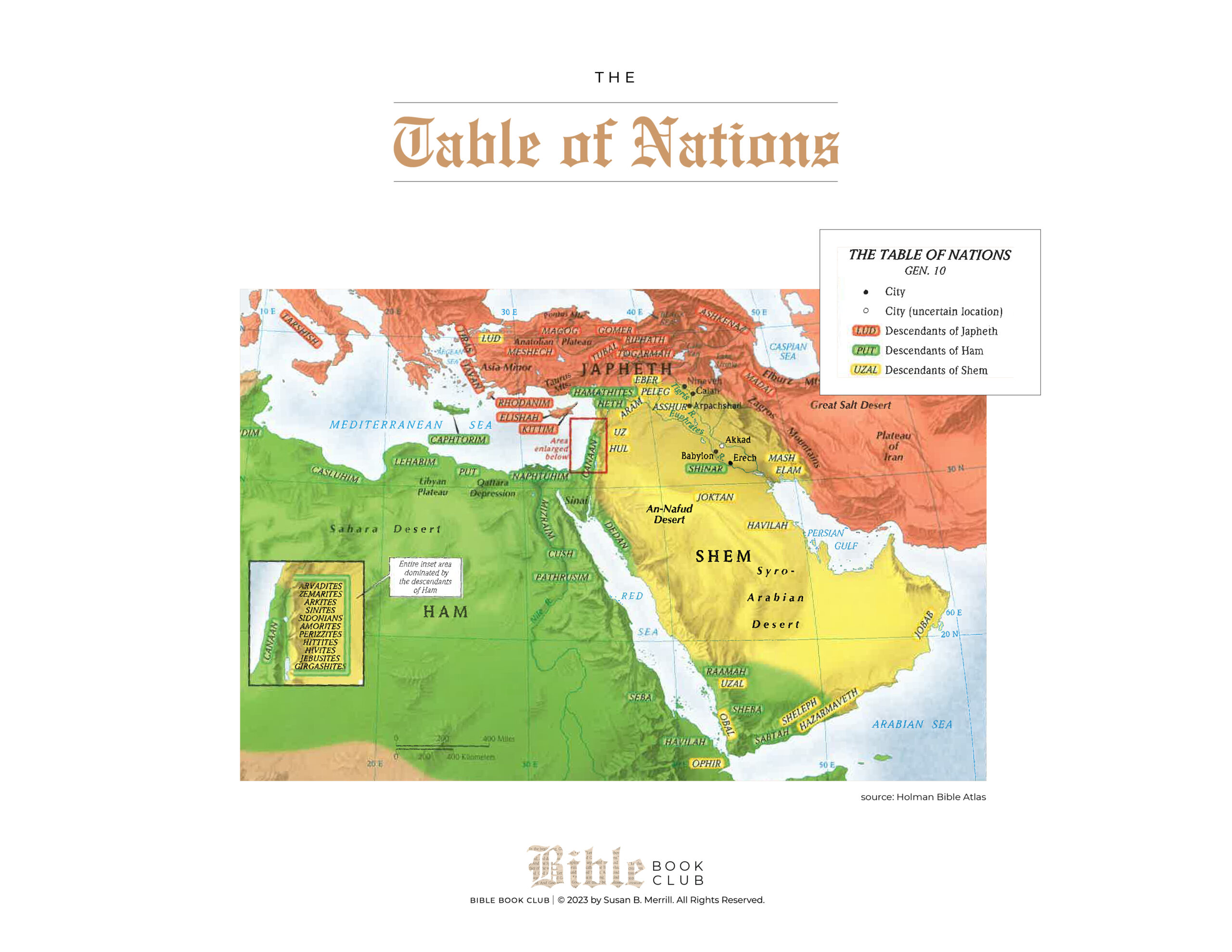
Chronicles goes into detail about Noah’s three sons because they are the beginning of the Table of Nations, which was the beginning of 70 different nations. The Table of Nations is found in Genesis 10. It is a listing of the various people and nations that descended from Noah’s three sons. By listing the nations again, the Chronicler wants the people of Israel (and us) to remember all the nations of the world belong to God and all will be used to fulfill His purpose.
Noah’s Lineage
Noah had three sons Shem, Ham, and Japheth. The only people to survive the flood were Noah, his wife, their sons, and their wives. The Chronicler starts with the third son and works back to the most important son, Shem, the firstborn.
Japheth
Noah’s third son Japheth had seven sons that became 14 nations, and if your ancestors immigrated from Europe you may be one of their descendants. The Japhethites became the nations to the north and west of Israel. They populated the regions around the Mediterranean, including Turkey, Greece, and Spain. Many of these people grafted into God’s people in the New Testament through Paul and the other apostles. This fulfilled Noah’s prophecy in Genesis 9:24-27.
Ham
Noah’s second son Ham led to the Hamites who became 30 nations. The sons of Ham were Cush, Egypt, Put, and Canaan. Only three of the four are listed as having sons.
Cush was the father of: Seba, Havilah, Sabta, Raamah, Sabteka, and Nimrod. (The sons of Raamah were Sheba and Dedan.) He settled south of Egypt in Africa and parts of Arabia. From Nimrod came the great nations of Assyria and Babylon. These were the nations that carried Israel and Judah into captivity.
Egypt was the father of the Ludites, Anamites, Lehabites, Naphtuhites, Pathrusites, Kasluhites (from whom the Philistines came), and Caphtorites. The Pharoah and the Philistines arose from Egypt’s line. This was a line that caused problems for both Moses and David.
Canaan was the father of Sidon his firstborn, and of the Hittites, Jebusites, Amorites, Girgashites, Hivites, Arkites, Sinites, Arvadites, Zemarites, and Hamathites. Of Ham’s three sons, Canaan was the worst. He was cursed because he was somehow involved in the wine scandal with Noah, so Noah decreed that Canaan was to be a slave to his brothers.
This came true in several interesting ways. The Semites, sons of Shem who became the Israelites, conquered Canaan under Joshua and David. The Japhethites, sons of Japeth, became the Greeks and Romans and conquered Canaan and the Persian Empire under Alexander the Great.
If you’ve been with the Bible Book Club since the beginning, you’re probably cringing over a lot of the names of the sons of Ham. Many of them became the enemies of Israel and lived in Canaan as the occupants of the Promised Land whose sins became so great God couldn’t ignore it and they lost their land to the Israelites.
Shem
Noah’s third son, Shem, was the chosen one who became the Semites and ultimately the Israelites along with about 26 different nations. Five sons of Shem are listed, but only two are listed as having sons of their own.
Shem’s son Aram had four sons but that’s all we know of his line other than that they became the Arameans. Laban, the father of Leah and Rachel, was Aramean. Leah and Rachel married Jacob and produced eight of the tribes of Israel, including the three most important tribes: Judah, Levi, and Benjamin.
The only son of Arphaxad that the Chronicler cares to follow is Shelah who has a son named Eber. He has two sons, Peleg and Joktan. Joktan’s people populated the Arabian peninsula. Peleg is the other son, and it is through him we get to Abraham.
From Shem to Abraham
This genealogical breakdown is so important the Chronicler starts from Shem again. It’s as if he wants us to mentally break away from all the other sons and grandsons of Noah and focus on this one special, elect line that will eventually lead to Israel.
There are ten generations from Adam to Noah and ten more generations from Shem (Noah’s son) to Abraham. The Chronicler also makes sure to note Abram became Abraham, which is a shout out to God’s covenant promise in Genesis 17:3-5 to make Abraham a father of many nations.
Bible Bender
Think about all the nations that came from this one man Abraham. Not just the nations but three of the major religions of the world–Judaism, Christianity, and Islam–were all descendants of Abraham. Coming up, we will discover more about Abraham’s descendants when we get into the Patriarchs of Israel.
Buckle up, Bible Book Club! This season will be a journey of rediscovery, faith, and hope as we explore how God’s promises never fail—even when everything else seems lost.
🎧 Ready to dive deeper? Click here to listen to the Bible Book Club Podcast now!
Shownotes:

Themes of this podcast:
God’s Faithfulness in Uncertain Times. After 200 years of exile, Israel’s identity seems lost, but 1 Chronicles reassures them (and us) that God’s covenant never fails. Even when they had no nation, no king, and no temple, He was still working to fulfill His promises.
Identity Rooted in God, Not Circumstances. The Israelites had been shaped by foreign cultures and influences, leading to confusion about their purpose and calling. 1 Chronicles and 2 Chronicles was written to remind them (and us) that true identity isn’t found in political power or national status but in being God’s chosen people.
Hope and Restoration Through Obedience. While 1 & 2 Kings focused on Israel’s failures, Chronicles emphasizes restoration. The Chronicler calls the remnant to remember their heritage, recommit to God, and trust that the Lord is still on the throne, even when life seems uncertain.
