
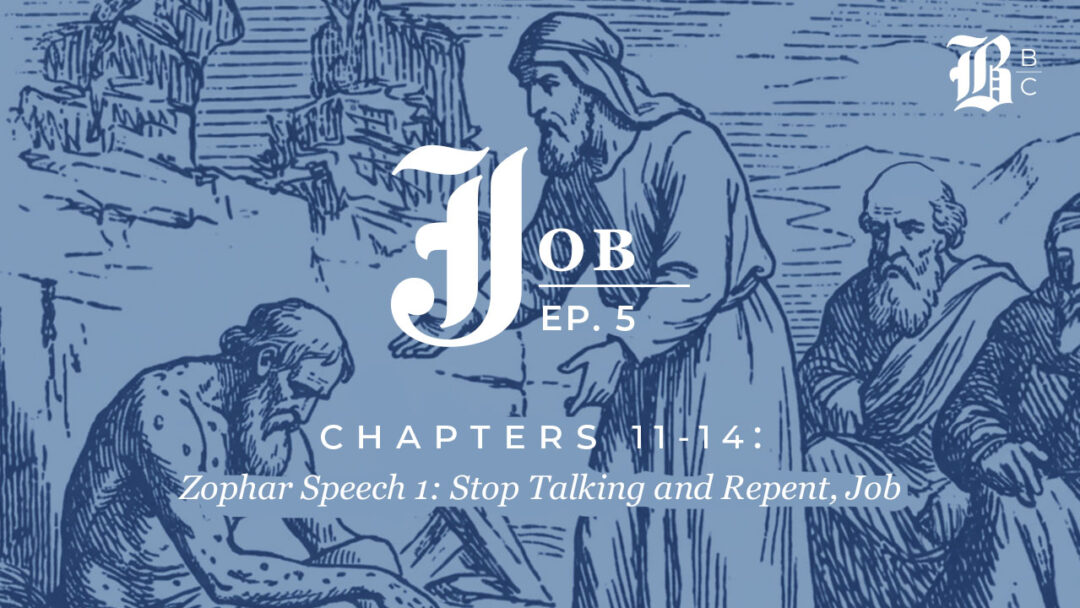
In Job 11–14, Zophar the zero-mercy zealot delivers the shortest and most aggressive speech of Round 1, pronouncing Job guilty without evidence and demanding repentance. Job fires back with his longest and most emotional response yet, moving from sarcasm to argument to a declaration of faith that answers Satan’s original challenge. By chapter 14, even in despair, Job asks the question that points toward resurrection hope.
Previously on Bible Book Club
In our last chapters, Bildad, the Cruel Conformist, stepped up and accused Job of blasphemy for questioning God’s justice. Then he delivered the most cold-hearted blow of all, stating Job’s children died because of their own sin. Job agreed that God is just, but that agreement led him straight into a crisis, crying out for a mediator, and unknowingly crying out for Jesus.
Subscribe to BBC on Apple, Spotify, Amazon, or YouTube.
Scene 1: Zophar, the Zero-Mercy Zealot Says Stop Talking and Repent
Job 11:1-20
1 Then Zophar the Naamathite replied: 2 “Are all these words to go unanswered? Is this talker to be vindicated? 3 Will your idle talk reduce others to silence? Will no one rebuke you when you mock? 4 You say to God, ‘My beliefs are flawless and I am pure in your sight.’ 5 Oh, how I wish that God would speak, that he would open his lips against you 6 and disclose to you the secrets of wisdom, for true wisdom has two sides. Know this: God has even forgotten some of your sin.
7 “Can you fathom the mysteries of God? Can you probe the limits of the Almighty? 8 They are higher than the heavens above—what can you do? They are deeper than the depths below—what can you know? 9 Their measure is longer than the earth and wider than the sea.
10 “If he comes along and confines you in prison and convenes a court, who can oppose him? 11 Surely he recognizes deceivers; and when he sees evil, does he not take note? 12 But the witless can no more become wise than a wild donkey’s colt can be born human.
13 “Yet if you devote your heart to him and stretch out your hands to him, 14 if you put away the sin that is in your hand and allow no evil to dwell in your tent, 15 then, free of fault, you will lift up your face; you will stand firm and without fear. 16 You will surely forget your trouble, recalling it only as waters gone by. 17 Life will be brighter than noonday, and darkness will become like morning. 18 You will be secure, because there is hope; you will look about you and take your rest in safety. 19 You will lie down, with no one to make you afraid, and many will court your favor. 20 But the eyes of the wicked will fail, and escape will elude them; their hope will become a dying gasp.”
What is Zophar’s main argument against Job in Chapter 11?
Zophar opens by shutting Job down. He mocks Job calling him a “talker” and one who claims to be “pure” in God’s sight. In other words, Job is all talk, wrong, and frankly, embarrassing himself. Remember Zophar most likely has an audience. In this brief opening, he has totally discredited Job without any proof.
Then he insinuates Job is guilty of more: Know this: God has even forgotten some of your sin. Zophar tells Job that his current suffering is less than he deserves. In Zophar’s view, Job should be grateful it isn’t worse. This is the zero-mercy zealot in full form. He is not content to say “you sinned.” He doubles down to say “you got off easy.”
Zophar, the zero-mercy zealot, is the third and final frenemy to speak in Round 1, and he wastes no time getting to the point. He shares Eliphaz and Bildad’s assumption that the retribution principle is God’s MO.
Notice what Zophar is doing here. He is not engaging in Job’s arguments. He is attacking Job’s right to make arguments. This is a classic silencing tactic. If you can’t win the debate, invalidate the debater. Zophar isn’t interested in dialogue. He has decided Job is guilty. He wants submission. Job needs to just repent and get on with it.
How does Zophar’s approach differ from Eliphaz and Bildad?
Eliphaz leaned on his experience. Bildad leaned on tradition. Now it is Zophar’s turn, and he doesn’t lean on anything. Zophar does not need to rest his case on experience or tradition. Dogma is his MO. No need to back it up with evidence or history. He just knows he is right.
Eliphaz and Bildad at least attempted to convince. Zophar just pronounces. He is judge, jury, and executioner with zero grace and zero doubt. His speech is the shortest, but also the most aggressive of the three friends, which makes him particularly difficult to argue with.
God is a vending machine. You put in obedience, you get out blessings. You put in sin, you get out suffering. The problem is that Job has been obedient. He has nothing to repent of. He is stuck. And that is something we should never feel. We are never “stuck” with God.
What do we have that Job didn’t?
Job is sitting on the ash heap with no defense attorney and no “not guilty” verdict to stand on. Job does not have what we have, the mediator who defends us and liberates us so that we have no condemnation:
Romans 8:1-4 1 Therefore, there is now no condemnation for those who are in Christ Jesus, 2 because through Christ Jesus the law of the Spirit who gives life has set you free from the law of sin and death. 3 For what the law was powerless to do because it was weakened by the flesh, God did by sending his own Son in the likeness of sinful flesh to be a sin offering. And so he condemned sin in the flesh, 4 in order that the righteous requirement of the law might be fully met in us, who do not live according to the flesh but according to the Spirit.
The question is no longer, “Have you sinned?” The answer to that is obviously yes. The question is, “Has the penalty been paid?” And the answer to that is also yes. Completely. This is what Job is searching for in the dark without knowing it. Remember, he kept crying out for a mediator. Someone to stand between him and God to make this right, whether he was wrong or not.
Jesus Is Our Mediator
He says in chapter 9:33, “If only there were someone to mediate between us, someone to bring us together.” He is describing Jesus centuries before Jesus arrives. And Romans 8:1 is the answer to that cry. The mediator comes. And the condemnation that Zophar tries to heap on Job, and that the Zophars in our lives try to heap on us, has nowhere left to land.
So when you feel stuck in that place Job is, buried under guilt, convinced your suffering is punishment, paralyzed by the sense that God is against you, Romans 8:1 is your court record. And it says: case dismissed.
Zophar Calls Job a Deceiver
Zophar continues with a speech about God, and his description of God is spot on. However, he takes God’s incomprehensibility and weaponizes it. He is saying: You know nothing. God knows everything. He knows a deceiver and evil when he sees it. Meaning you, Job. That is why you are suffering.
He follows his accusation that Job is a deceiver with a stinging insult. 12 But the witless can no more become wise than a wild donkey’s colt can be born human.
Why does Zophar compare Job to a “wild donkey’s colt”?
In the ancient world, the donkey was a symbol of stupidity and stubbornness, untamable, unteachable, and unfit for civilized company. Zophar is saying: Job, you will never understand, because you are incapable of wisdom. Then, as if he realizes how cruel he is being, Zophar changes his tone.
Zophar finishes quickly and gets to his solution. He offers Job the same retribution deal as Eliphaz and Bildad. If Job will turn to God, repent, and stop sinning, then he will have that beautiful life that he lost. In Zophar’s mind, it is a simple transaction that Job just needs to execute.
Zophar is short. Job is not. Coming up is the longest and most emotional speech Job has delivered so far. Now that all three of his “friends” have spoken, he is feeling a rollercoaster of emotion. In his response, he moves from sarcasm to arguing to courageously accusing them back to grief.
Scene 2: Job Responds to Zophar — Still, I Will Hope in God
Job 12:1-25
1 Then Job replied: 2 “Doubtless you are the only people who matter, and wisdom will die with you! 3 But I have a mind as well as you;I am not inferior to you.Who does not know all these things?
4 “I have become a laughingstock to my friends, though I called on God and he answered—a mere laughingstock, though righteous and blameless! 5 Those who are at ease have contempt for misfortune as the fate of those whose feet are slipping. 6 The tents of marauders are undisturbed,and those who provoke God are secure—those God has in his hand.
7 “But ask the animals, and they will teach you,or the birds in the sky, and they will tell you; 8 or speak to the earth, and it will teach you,or let the fish in the sea inform you. 9 Which of all these does not knowthat the hand of theLord has done this? 10 In his hand is the life of every creature and the breath of all mankind. 11 Does not the ear test words as the tongue tastes food? 12 Is not wisdom found among the aged? Does not long life bring understanding?
13 “To God belong wisdom and power; counsel and understanding are his. 14 What he tears down cannot be rebuilt; those he imprisons cannot be released. 15 If he holds back the waters, there is drought; if he lets them loose, they devastate the land. 16 To him belong strength and insight; both deceived and deceiver are his. 17 He leads rulers away stripped and makes fools of judges. 18 He takes off the shackles put on by kings and ties a loincloth around their waist. 19 He leads priests away stripped and overthrows officials long established. 20 He silences the lips of trusted advisers and takes away the discernment of elders. 21 He pours contempt on nobles and disarms the mighty. 22 He reveals the deep things of darkness and brings utter darkness into the light. 23 He makes nations great, and destroys them; he enlarges nations, and disperses them. 24 He deprives the leaders of the earth of their reason; he makes them wander in a trackless waste. 25 They grope in darkness with no light; he makes them stagger like drunkards.
How does Job respond to his friends’ claims in Chapter 12?
Job opens with sarcasm and who can blame him? Job is done being lectured. He has listened to three rounds of speeches from friends who think they are so much smarter than him, and he has had enough. Job is angry, and he lets them have it.
Job says: “Those who are at ease have contempt for misfortune.” He accuses his friends of being too comfortable to see that it is easy to believe the retribution principle when life is going well. It is easy to look at someone suffering and assume they earned it when you are sitting in your beautiful house with your healthy children. Comfort breeds contempt for the suffering of others.
Then he makes a brilliant point: “The tents of marauders are undisturbed.” In other words, if the retribution principle is true, why do evil people like marauders prosper?
Then Job begins his next argument by turning Zophar’s sermon about God back on him. Zophar gave a mini-lecture on God’s incomprehensible wisdom. Job basically says: ya, I know that. All creation knows that.
Zophar has used God’s greatness to silence Job. Job takes that same greatness and uses it to argue the opposite point.
What evidence does Job provide that the retribution principle is flawed?
Job agrees God is sovereign and all-powerful, but that sovereignty means God is not bound by a neat little system created by man. His ways are bigger than man’s faulty theology.
The amazing point in this argument is not what Job says. It is that he is saying it. Job is suffering. He is being falsely accused by his closest friends. Yet he continues to affirm God’s sovereign wisdom. He is not cursing God or rejecting God. He is wrestling with God. Wrestling requires a relationship. You only fight with someone you refuse to walk away from. And Job is not walking away from God. With that point, Satan must have been really squirming. Then Job, with remarkable strength and clarity, makes a declaration in the face of their accusations.
Scene 3: Job’s Declaration
Job 13:1-28
1 “My eyes have seen all this, my ears have heard and understood it. 2 What you know, I also know; I am not inferior to you. 3 But I desire to speak to the Almighty and to argue my case with God. 4 You, however, smear me with lies; you are worthless physicians, all of you! 5 If only you would be altogether silent! For you, that would be wisdom. 6 Hear now my argument; listen to the pleas of my lips. 7 Will you speak wickedly on God’s behalf? Will you speak deceitfully for him? 8 Will you show him partiality? Will you argue the case for God? 9 Would it turn out well if he examined you?Could you deceive him as you might deceive a mortal? 10 He would surely call you to account if you secretly showed partiality. 11 Would not his splendor terrify you? Would not the dread of him fall on you? 12 Your maxims are proverbs of ashes; your defenses are defenses of clay.
13 “Keep silent and let me speak; then let come to me what may. 14 Why do I put myself in jeopardy and take my life in my hands? 15 Though he slay me, yet will I hope in him; I will surely defend my ways to his face. 16 Indeed, this will turn out for my deliverance, for no godless person would dare come before him! 17 Listen carefully to what I say; let my words ring in your ears. 18 Now that I have prepared my case, I know I will be vindicated. 19 Can anyone bring charges against me? If so, I will be silent and die.
20“Only grant me these two things, God, and then I will not hide from you: 21 Withdraw your hand far from me, and stop frightening me with your terrors. 22 Then summon me and I will answer, or let me speak, and you reply to me. 23 How many wrongs and sins have I committed? Show me my offense and my sin. 24 Why do you hide your face and consider me your enemy? 25 Will you torment a windblown leaf? Will you chase after dry chaff? 26 For you write down bitter things against me and make me reap the sins of my youth. 27 You fasten my feet in shackles; you keep close watch on all my paths by putting marks on the soles of my feet.
28“So man wastes away like something rotten, like a garment eaten by moths.
What does Job mean by calling his friends “worthless physicians”?
First Job declares that he knows all that they know. Then he proceeds to put them in their place. They are worthless physicians. And if they want to be wise, they should be silent. By speaking wickedly on God’s behalf, they should be terrified. How would they fare in God’s eyes if He examined them?
Job declares his faith in God. He will take his case to God and prove his integrity. To approach God is to take his life in his hands, for God can slay him. But if God doesn’t, wouldn’t that prove his innocence?
But Job says, “Though he slay me, yet will I hope in him; I will surely defend my ways to his face.” Job is saying: even if this kills me, I am not letting go of God. Even if God Himself is the one bringing this suffering, I will not stop trusting Him. And I will not stop demanding to be heard.
This is the answer to the accuser’s question from chapter 1. Satan asked, “Does Job fear God for nothing?” Here is the answer. Yes. He does. Even with nothing left, Job clings to God. Not for what God gives him, but for who God is. The case that began in the heavenly courtroom is being answered here on the ash heap. And again the point goes to God. I think we are at God three, Satan zero!
After these bold statements, Job’s emotional rollercoaster ride spirals downward. His emotions seem to be spent, and he returns to despair once more.
Scene 4: Job’s Lament in Chapter 14
Job 14:1-22
1 Mortals, born of woman, are of few days and full of trouble. 2 They spring up like flowers and wither away; like fleeting shadows, they do not endure. 3 Do you fix your eye on them? Will you bring them before you for judgment? 4 Who can bring what is pure from the impure? No one! 5 A person’s days are determined; you have decreed the number of his months and have set limits he cannot exceed. 6 So look away from him and let him alone, till he has put in his time like a hired laborer.
7 “At least there is hope for a tree: If it is cut down, it will sprout again, and its new shoots will not fail. 8 Its roots may grow old in the ground and its stump die in the soil, 9 yet at the scent of water it will bud and put forth shoots like a plant. 10 But a man dies and is laid low; he breathes his last and is no more. 11 As the water of a lake dries up or a riverbed becomes parched and dry, 12 so he lies down and does not rise; till the heavens are no more, people will not awake or be roused from their sleep.
13 “If only you would hide me in the grave and conceal me till your anger has passed! If only you would set me a time and then remember me! 14 If someone dies, will they live again? All the days of my hard service I will wait for my renewal to come. 15 You will call and I will answer you; you will long for the creature your hands have made. 16 Surely then you will count my steps but not keep track of my sin. 17 My offenses will be sealed up in a bag; you will cover over my sin.
18 “But as a mountain erodes and crumbles and as a rock is moved from its place, 19 as water wears away stones and torrents wash away the soil, so you destroy a person’s hope. 20 You overpower them once for all, and they are gone; you change their countenance and send them away. 21 If their children are honored, they do not know it; if their offspring are brought low, they do not see it. 22 They feel but the pain of their own bodies and mourn only for themselves.”
How does Job compare the hope of a tree to a human life?
Job sadly compares his life to a tree and says a tree has more hope than a man. Cut down a tree, and it will sprout again. But a man dies, and what then? Nothing. Job is talking to God. He believes in God, but his words are those of despair.
Job has lost all hope that life has purpose. He does not know what we know, that all of our suffering does have a purpose.
What question does Job ask about life after death in Chapter 14?
Job asks: “If someone dies, will they live again?” Job is searching in the dark toward something he can feel but cannot fully see: the possibility that death is not the final word. Paul provides the answer 1,500 years later.
1 Corinthians 15:51-57 Listen, I tell you a mystery: We will not all sleep, but we will all be changed— 52 in a flash, in the twinkling of an eye, at the last trumpet. For the trumpet will sound, the dead will be raised imperishable, and we will be changed. 53 For the perishable must clothe itself with the imperishable, and the mortal with immortality. 54 When the perishable has been clothed with the imperishable, and the mortal with immortality, then the saying that is written will come true: “Death has been swallowed up in victory.”
55 “Where, O death, is your victory?
Where, O death, is your sting?”
56 The sting of death is sin, and the power of sin is the law. 57 But thanks be to God! He gives us the victory through our Lord Jesus Christ.
The Answer to Job’s Question
The answer to Job’s question: If someone dies, will they live again? is yes. Jesus makes that possible for us. But Job would never know it. This is one of those aha moments in the Old Testament. Job is voicing the intuitive need for resurrection hope without any inkling of God’s plan for humanity to have a Savior. He is living in the patriarchal era:
- No covenants yet
- No laws
- No promised king
- No talk of redemption.
And yet he is wrestling with what his soul is telling him: I was created for life. A life with God. This cannot be it. God surely created me for more.
Job is groping in the dark toward something he can’t fully see. And despite all of his friends’ judgment, Job believes God will call his name, and he will answer. That the relationship is not over even when everything else is. He is right. He just doesn’t know yet how right he is.
The lesson in suffering for us is this: wrestle with it. Don’t walk away. Job brought every emotion to God: anger, confusion, frustration, exhaustion, despair. And even when he couldn’t make any sense of it, he refused to let go. He still hoped. He still believed.
And with that, Round 1 is over. Eliphaz, Bildad, and Zophar have all spoken. Job holds firm and refuses to confess to a sin he didn’t commit. He will not give up on what he knows to be true. And neither will his friends. What more can they say? Stay tuned.
Group Discussion Questions for Job 11–14
- Zophar uses a classic silencing tactic — rather than engaging with Job’s arguments, he attacks Job’s right to make them. Have you ever encountered a Zophar in your own life, someone who responded to your pain with pronouncements instead of presence? How did you respond?
- Job declares in 13:15, “Though he slay me, yet will I hope in him” — from the ash heap, not from a place of blessing. What does it look like in your own life to wrestle with God rather than walk away when circumstances give you every reason to?
- Job asks “If someone dies, will they live again?” from a place of raw despair, without access to the answer. How does the resurrection hope we have in Christ change the way you face grief, loss, or your own mortality?
Listen to this episode of the Bible Book Club Podcast:
Apple Podcast
Spotify
Amazon
YouTube
