
In this Esther 8 commentary, Haman is dead but his murderous edict is still very much alive. King Xerxes gives Esther all of Haman’s vast wealth and presents Mordecai with his signet ring making Mordecai the most powerful man in the court. Esther pleads for her people with masterful diplomacy, and Mordecai’s counter-decree gives the Jews the right to defend themselves. The world of Mordecai and the Jews was completely reversed.
Previously on Bible Book Club
In our last chapter, it was the beginning of the great reversal triggered by the king’s insomnia. Haman was revealed as the villain, Esther revealed her identity as a Jew, and the king realized he had been a fool. Haman was executed on the very gallows he built for Mordecai. It was a victory of divine justice, but while we can all cheer the villain’s demise, his murderous edict is still very much alive. And the king is in a predicament.
Subscribe to BBC on Apple, Spotify , Amazon, or YouTube.
Scene 1: The Reversal of Fortune and Power
Esther 8:1-2
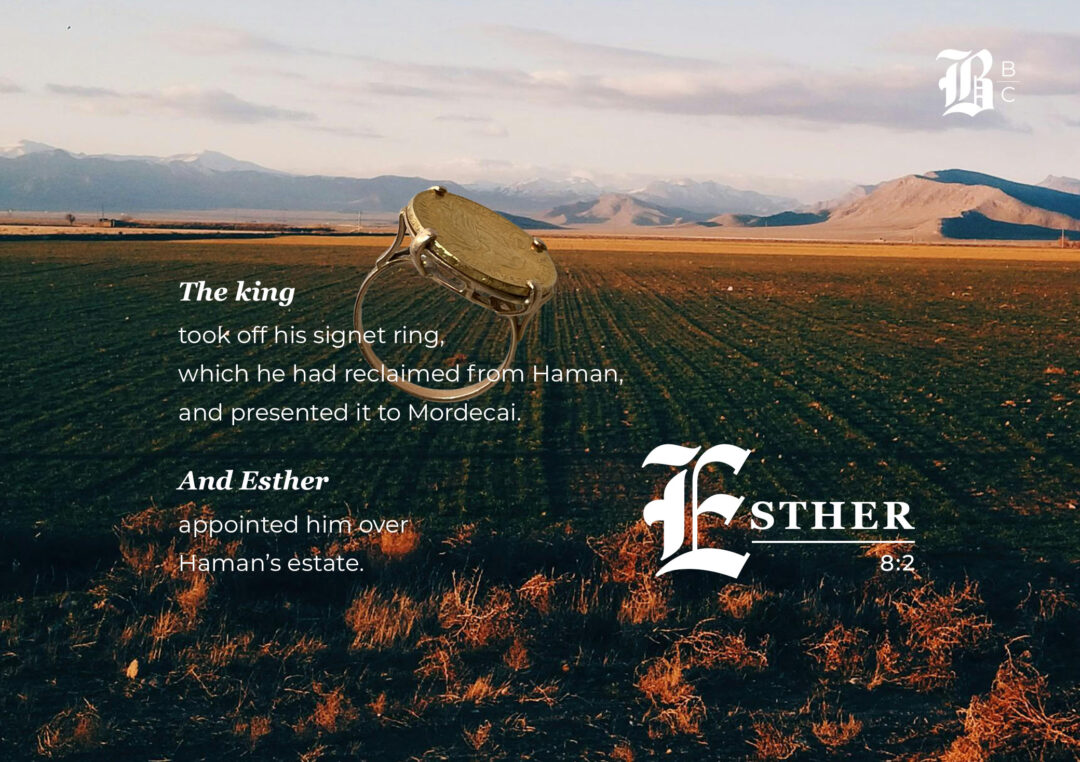
1 That same day King Xerxes gave Queen Esther the estate of Haman, the enemy of the Jews. And Mordecai came into the presence of the king, for Esther had told how he was related to her. 2 The king took off his signet ring, which he had reclaimed from Haman, and presented it to Mordecai. And Esther appointed him over Haman’s estate.
What happened to Haman’s estate and wealth after his death?
That very same day Haman was executed, the king gave Esther all of Haman’s vast wealth. According to historians, this was the way of kings in many ancient cultures. When a traitor was executed, his property was appropriated by the throne.
The king could have kept the money, but Esther is a woman of favor, and she has been wronged. So King Xerxes, for the first time displaying some wisdom, gives her all of Haman’s wealth.
How did Mordecai rise to power in Esther Chapter 8?
Esther was the instrument of his path to power and fortune. Esther immediately seized the opportunity to present Mordecai as her cousin and to recall Mordecai’s loyalty to the king. Then, in perhaps the greatest reversal or irony in the entire story, Xerxes gives Mordecai Haman’s job. Mordecai goes from wearing sackcloth outside the palace to wearing the king’s signet ring inside the palace.
Mordecai has all the authority of the man still hanging on the gallows. The gallows that, but for the providence of God, he would be hanging on. With the ring and the title, Mordecai the Jew has become the most powerful man in the court. On top of that Esther puts Mordecai in charge of her estate, the former estate of Haman.
And with that, Mordecai has all of Haman’s power and fortune. This reversal of power and fortune is a great victory for the Jews. But what was it worth if in nine months they were as dead as Haman? More than position and money, Esther, Mordecai, and the Jews need the king to grant them life.
Scene 2: Esther Seeks the Scepter Again to Save Her People
Esther 8:3-8
3 Esther again pleaded with the king, falling at his feet and weeping. She begged him to put an end to the evil plan of Haman the Agagite, which he had devised against the Jews. 4 Then the king extended the gold scepter to Esther and she arose and stood before him.
5 “If it pleases the king,” she said, “and if he regards me with favor and thinks it the right thing to do, and if he is pleased with me, let an order be written overruling the dispatches that Haman son of Hammedatha, the Agagite, devised and wrote to destroy the Jews in all the king’s provinces. 6 For how can I bear to see disaster fall on my people? How can I bear to see the destruction of my family?”
7 King Xerxes replied to Queen Esther and to Mordecai the Jew, “Because Haman attacked the Jews, I have given his estate to Esther, and they have impaled him on the pole he set up. 8 Now write another decree in the king’s name in behalf of the Jews as seems best to you, and seal it with the king’s signet ring—for no document written in the king’s name and sealed with his ring can be revoked.”
Why could King Xerxes not reverse the decree against the Jews?
In Persia and other ancient cultures, an edict from the king could not be reversed because kings were like gods and could do no wrong. To reverse an edict would have meant the king had made a mistake.
Therefore, the death warrant decree Haman wrote ordering the annihilation of every Jewish man, woman, and child across 127 provinces is still in effect. It’s sealed with the king’s signet ring and according to Persian law not even the king himself can reverse it. There are nine months left before the Jews will legally be attacked and plundered. But all is not lost because there are always options, and King Xerxes made a way for the option of life.
Even with all her new wealth and Mordecai’s political power, Esther still needs the king to save the Jewish people. She cannot do what needs to be done, but she can do something, and what she can do, she does. She bravely approaches the throne again hoping the king will again extend the golden scepter to her. Recall that any approach to the king without an invitation is a breach in protocol and comes with risk, depending on the king’s mood and favor. The king could just as easily decide he has done enough for Esther by giving her Haman’s estate.
This time, Esther’s approach is totally different. She skips the dinner invitation and mystery and gets right to the point. She falls on the king’s feet just as Haman had fallen on her feet and begs for mercy. Not for her own life as Haman had begged, but for the lives of her people. Her plea is passionate, but even in her passion, she is wisely diplomatic.
How did Esther use diplomacy to plead for her people?
Esther is yet again a master of diplomacy and begins with the king, because she knows it is and always will be all about him. She asks:
- If it pleases him
- If he regards her with favor
- If he thinks it is the right thing to do
- And if he is pleased with her
Note that she ends with the most obvious and works logically backward. She ends with the simplest “if” question for him to answer — if the king is pleased with her. Of course he is pleased with her. Her cousin saved his life. She saved him from committing genocide. Therefore, if he is pleased with her and now trusts that she and Mordecai have his best interest at heart, then he regards them with favor. And if he regards her with favor, then what she is asking is the right thing to do. And if it is the right thing to do, then it must please him.
Then she brilliantly removes the king of any responsibility and blames the entire plan on Haman, “who devised and wrote” the evil decree. It is all so logical! The king didn’t stand a chance. Esther’s wisdom, humility, and diplomacy save the people of Israel from certain death. She does what she can do, and it is enough.
The irony of Esther’s request is that the king has previously told her she could ask for whatever she wanted up to half the kingdom. Certainly, the retraction of an edict was a lesser request than half the kingdom but apparently not. A king can not deliver a retraction. However, there is an out. Mordecai, the new prime minister, can write another decree to counteract — but not cancel — Haman’s decree.
Scene 3: The Decree That Legalized a War
Esther 8:9-14
9 At once the royal secretaries were summoned — on the twenty-third day of the third month, the month of Sivan. They wrote out all Mordecai’s orders to the Jews, and to the satraps, governors and nobles of the 127 provinces stretching from India to Cush. These orders were written in the script of each province and the language of each people and also to the Jews in their own script and language. 10 Mordecai wrote in the name of King Xerxes, sealed the dispatches with the king’s signet ring, and sent them by mounted couriers, who rode fast horses especially bred for the king.
11 The king’s edict granted the Jews in every city the right to assemble and protect themselves; to destroy, kill and annihilate the armed men of any nationality or province who might attack them and their women and children, and to plunder the property of their enemies. 12 The day appointed for the Jews to do this in all the provinces of King Xerxes was the thirteenth day of the twelfth month, the month of Adar. 13 A copy of the text of the edict was to be issued as law in every province and made known to the people of every nationality so that the Jews would be ready on that day to avenge themselves on their enemies.
14 The couriers, riding the royal horses, went out, spurred on by the king’s command, and the edict was issued in the citadel of Susa.
How did Mordecai’s counter-decree differ from Haman’s original order?
The difference is the new order is addressed to the Jews and other rulers, and the Jews are listed first. The inclusion of and the order in which they are listed puts the Jews of Persia on the same level as the rulers of Persia. The people who were victims with no recourse are now empowered by the king himself.
- The First Edict: Commanded people to attack the Jews.
- The Second Edict: Commanded the Jews to strike back.
- The Result: Anyone who chose to follow Haman’s original order was now legally entering a “war” in which the state sanctioned both sides to fight.
The royal secretaries are summoned just as they had been for Haman. The new orders are recorded and sealed with the king’s ring by Mordecai. The old order from Haman was addressed:
Esther 3:12 an edict, according to all that Haman commanded, was written to the king’s satraps and to the governors over all the provinces and to the officials of all the peoples, to every province in its own script and every people in its own language.
The new order is addressed:
Esther 8:9 They wrote out all Mordecai’s orders to the Jews, and to the satraps, governors and nobles of the 127 provinces stretching from India to Cush
What rights did the second decree grant to the Jewish people?
The Jews were given permission to defend themselves against any nationality in the Persian Empire that might attack them. Recall from past episodes that the Babylonians were the people who originally conquered, exiled, and dispersed the Israelites throughout Babylon.
When Persia took over Babylon, they inherited a “melting pot” of displaced people from many nations. Unlike the Babylonians who tried to erase national identities through exile, the Persians under Cyrus and later Xerxes generally encouraged people to return to their lands and rebuild their temples. This created a high level of ethnic tension. Many of these nationalities harbored ancient grudges. Haman’s decree gave these groups a legal excuse to act on those grudges. Mordecai’s counter-decree changed the game. The Jews were not “sitting ducks” but a protected, sovereign group within the empire.
God’s presence in the battle
Something for us to consider in this solution is that God doesn’t always, or often, remove the opposition. We still have to walk through the trial and fight in the battle. He does, however, promise his presence.
Isaiah 43:1-2 “Fear not, for I have redeemed you; I have called you by name, you are mine. 2 When you pass through the waters, I will be with you; and through the rivers, they shall not overwhelm you; when you walk through fire you shall not be burned, and the flame shall not consume you.
He promises his presence. To be with us. And He promises to prepare us for the battle.
Psalm 18:31-39 For who is God, but the Lord? And who is a rock, except our God?— 32 the God who equipped me with strength and made my way blameless. 33 He made my feet like the feet of a deer and set me secure on the heights. 34 He trains my hands for war, so that my arms can bend a bow of bronze. 35 You have given me the shield of your salvation, and your right hand supported me, and your gentleness made me great. 36 You gave a wide place for my steps under me, and my feet did not slip. 37 I pursued my enemies and overtook them, and did not turn back till they were consumed. 38 I thrust them through, so that they were not able to rise; they fell under my feet. 39 For you equipped me with strength for the battle.
Even today, God is not a lawnmower parent. He is not going to go before you and mow everything down to make it smooth and easy for you. Instead, God will equip you and walk with you so you can learn to plow through the weeds yourself, each and every day growing in wisdom and strength.
Scene 4: The Day the World Turned Upside Down
Esther 8:15-17
15 When Mordecai left the king’s presence, he was wearing royal garments of blue and white, a large crown of gold and a purple robe of fine linen. And the city of Susa held a joyous celebration. 16 For the Jews it was a time of happiness and joy, gladness and honor. 17 In every province and in every city to which the edict of the king came, there was joy and gladness among the Jews, with feasting and celebrating. And many people of other nationalities became Jews because fear of the Jews had seized them.
What is the literary chiasm structure in the story of Mordecai?
Mordecai’s world has been completely turned upside down, and the reversal of incidents is a perfect chiasm. Recall we discussed the literary structure called a chiasm in Episode 5 of the Bible Book Club Podcast. It’s a structure in which the second half of a story mirrors the first with a pivotal story point in the middle. In this case:
- Haman’s edict caused great mourning and weeping.
- Mordecai clothed himself in ashes and sackcloth.
- Because of his mourning, Mordecai could not enter the king’s gate.
- Then the great reversal of roles occurs: Mordecai replaces Haman and good overcomes evil.
- Now Mordecai is welcomed into the palace instead of banned.
- Mordecai is clothed in royal garments to replace his sackcloth.
- And Mordecai’s edict causes great celebration and joy.
Why do many Persians choose to identify as Jews?
Many people of other nationalities become Jews because fear of the Jews has seized them. The Hebrew word mityahadim translated “became Jews” occurs only here and is debated by scholars. Does it mean a religious conversion or an alignment with the Jewish people for political protection? We don’t know.
Perhaps some Persians recognize the hand of God and become believers in the God of Israel. Or maybe they just stand by their Jewish neighbors in support of their right to life. I like to think of it as perhaps a combination. Because of Esther, Mordecai, and divine providence, there is a Jewish revival among the Jews, and being a Jew becomes a more honorable thing in Persia.
How does Esther’s intercession compare to Moses and David?
Like Moses and David, Esther had a willingness to give up her life to save her people. This kind of intercession is a biblical lesson we have learned over and over in our journey, starting in Genesis. Abraham, Joseph, Samuel, Nehemiah, Elijah, Ezra all interceded for the people. But there are three who stand out because of their willingness to give up their life, and Esther is one of them.
1. Moses
In Exodus 32, Moses interceded with his life when Israel faced annihilation after the golden calf incident.
Exodus 32:30-34 The next day Moses said to the people, “You have committed a great sin. But now I will go up to the Lord; perhaps I can make atonement for your sin.”
31 So Moses went back to the Lord and said, “Oh, what a great sin these people have committed! They have made themselves gods of gold. 32 But now, please forgive their sin—but if not, then blot me out of the book you have written.”
33 The Lord replied to Moses, “Whoever has sinned against me I will blot out of my book. 34 Now go, lead the people to the place I spoke of, and my angel will go before you. However, when the time comes for me to punish, I will punish them for their sin.”
Moses loved this new nation of Israel so much that he was willing for God to blot him out of the Book of Life to deliver the people from the sin they had committed. So he interceded on their behalf and saved a nation.
2. David
In 2 Samuel 24 David interceded on behalf of the people in the plague that ended on Mount Moriah. In this case it was David who had sinned after he took an unauthorized census of the people.
2 Samuel 24:15-17 So the Lord sent a plague on Israel from that morning until the end of the time designated, and seventy thousand of the people from Dan to Beersheba died. 16 When the angel stretched out his hand to destroy Jerusalem, the Lord; relented concerning the disaster and said to the angel who was afflicting the people, “Enough! Withdraw your hand.” The angel of the Lord was then at the threshing floor of Araunah the Jebusite.
17 When David saw the angel who was striking down the people, he said to the Lord, “I have sinned; I, the shepherd, have done wrong. These are but sheep. What have they done? Let your hand fall on me and my family.”
David was so struck by the death caused by his own sin that he begged God to take him and his family instead. God did not. David is an example of how God’s will does not always make sense to us. David was a man who did great things for the Lord and also sinned deeply.
3. Esther
Unlike Moses, Esther is rather detached from her people in the palace, and she was certainly not the leader of the Israelites as Moses was. Unlike David, she is not at fault for the genocide, and again certainly not the Israelite leader, as David was. Esther is just a young woman, alone in a sea of women, isolated in a harem. Yet, when challenged by Mordecai:
Esther 4:14 And who knows but that you have come to your royal position for such a time as this?
Esther, like Moses and David, answered with a willingness to give up her life to save her people.
Esther 4:16 I will go to the king, even though it is against the law. And if I perish, I perish.”
Esther chose to identify with her people and take responsibility. Moses and David’s intercession arose from their leadership positions. Esther’s arose from her willingness to accept God’s divine providence in her unique position and ability to help her people. These three intercessors were all willing to die for their people. But God never asked it of them. They foreshadow the one who did have to die to intercede for his people. For us. Jesus is the ultimate intercessor.
Why is Jesus the ultimate intercessor?
While Moses, David, and Esther saved their people from physical death, Jesus died to save all people from spiritual death. He interceded once for our eternal salvation, rescuing us from sin and death. But Jesus’s work does not stop there. He intercedes continuously for us.
Romans 8:34 Christ Jesus who died—more than that, who was raised to life—is at the right hand of God and is also interceding for us.
And in Hebrews we learn that:
Hebrews 7:20-25 Others became priests without any oath, 21 but he became a priest with an oath when God said to him:
“The Lord has sworn and will not change his mind: ‘You are a priest forever.’” 22 Because of this oath, Jesus has become the guarantor of a better covenant.
23 Now there have been many of those priests, since death prevented them from continuing in office; 24 but because Jesus lives forever, he has a permanent priesthood. 25 Therefore he is able to save completely those who come to God through him, because he always lives to intercede for them.
Jesus did a work at the cross — he saved us from our sin. And Jesus is still working for us, sitting at the right hand of God. His role as an intercessor is a continuous one.
How should believers practice intercession?
We must intercede for the nations. All nations.
1 Timothy 2:1-2 I urge, then, first of all, that petitions, prayers, intercession and thanksgiving be made for all people— 2 for kings and all those in authority,that we may live peaceful and quiet lives in all godliness and holiness
We must intercede even when we are unsure of what to ask.
Romans 8:26-27 In the same way, the Spirit helps us in our weakness. We do not know what we ought to pray for, but the Spirit himself intercedes for us through wordless groans. 27 And he who searches our hearts knows the mind of the Spirit, because the Spirit intercedes for God’s people in accordance with the will of God.
Moses spoke to God when he interceded for the Israelites. David spoke to God when he interceded for the Israelites. Esther fasted and asked the people to do so also when she interceded for the Jews of Persia. Jesus spoke to God when he interceded for the people on many occasions. The longest intercessory prayer of Jesus’s is the entire chapter 17 of the book of John.
John 17:20-26 I pray also for those who will believe in me through their message, 21 that all of them may be one, Father, just as you are in me and I am in you. May they also be in us so that the world may believe that you have sent me. 22 I have given them the glory that you gave me, that they may be one as we are one— 23 I in them and you in me—so that they may be brought to complete unity. Then the world will know that you sent me and have loved them even as you have loved me.
24 “Father, I want those you have given me to be with me where I am, and to see my glory, the glory you have given me because you loved me before the creation of the world.
25 “Righteous Father, though the world does not know you, I know you, and they know that you have sent me. 26 I have made you known to them, and will continue to make you known in order that the love you have for me may be in them and that I myself may be in them.”
We must follow Moses, David, Esther, and Christ’s lead. We too must intercede by praying to the Father. Even when we don’t know what to say.
In our next chapter of Bible Book Club, the book of Esther will come to a close. But not before the queen of Persia makes one more bold and often criticized request.
Group Discussion Questions for Esther Chapter 8
- Esther did what she could do — and it was enough. Is there a situation in your life right now where you’ve been waiting for God to remove an obstacle entirely, when He may be calling you to act within your current limits?
- Moses, David, and Esther were each willing to give up their lives for their people. Who in your life might need you to intercede on their behalf — even when it’s inconvenient or costly?
- Romans 8:26 tells us the Spirit intercedes for us when we don’t know what to pray. Have you ever felt too overwhelmed or confused to pray? What would it mean to you today to trust that the Spirit is praying through you?
Listen to this episode of the Bible Book Club Podcast:
Scripture quotations taken from The Holy Bible, New International Version®, NIV®. Copyright © 1973, 1978, 1984, 2011 by Biblica, Inc. Used with permission of Zondervan. All rights reserved worldwide. www.zondervan.com
