
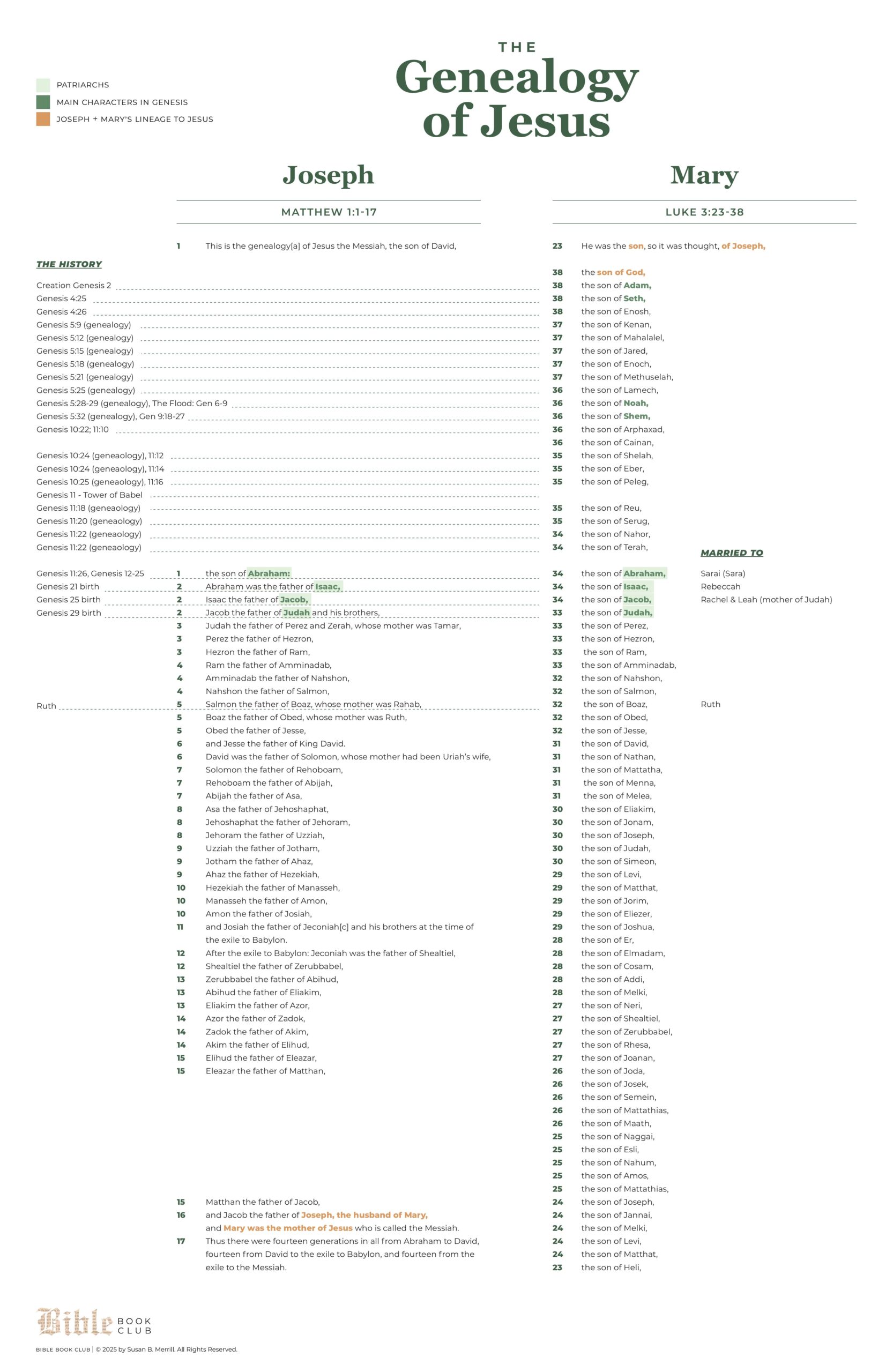
Have you noticed there are discrepancies in Jesus’s genealogy?
If you’ve ever compared Jesus’ genealogy listed in Matthew 1 and Luke 3, you’ve probably noticed something puzzling: they don’t match. Different names appear between David and Joseph, and the genealogies even run in opposite directions. So what’s going on? Are these contradictory accounts, or is there something deeper happening here?
Why are the two genealogies of Jesus different?
This isn’t an error, it’s actually a brilliant design. The Old Testament prophecies required the Messiah to be a descendant of King David. Matthew shows Jesus fulfills the prophecy in the legal sense, and Luke shows He fulfills it in the biological sense. By including both genealogies, the Gospel writers prove that Jesus fulfills this requirement in every possible way.
Matthew’s genealogy traces Jesus’ lineage through Joseph, his earthly father, showing Jesus has the legal right to David’s throne. It starts with Abraham and moves forward chronologically, ending with Joseph. This genealogy establishes Jesus’ legal right to David’s throne through the royal line.
Luke’s genealogy traces Jesus’ lineage through Mary, his mother, showing Jesus has the biological connection to David’s bloodline. It starts with Jesus and works backward all the way to Adam. What many people miss is that this genealogy is actually Mary’s line, not Joseph’s.
Before David, the two genealogies are essentially the same, tracing back through the patriarchs. But after David, they diverge—one showing Joseph’s line and the other showing Mary’s. But here’s where it gets really interesting…in Matthew’s account, Joseph’s father is listed as Jacob, but in Luke’s genealogy, Joseph’s father is listed as Heli. How can both be true?
The answer lies in understanding ancient Jewish customs around family lineage. Heli was actually Mary’s father, making Joseph his son-in-law. Joseph is referred to as “Heli’s son” because he married into Mary’s family. From that point backward, Luke is tracing Mary’s biological ancestry.
Why is Joseph’s genealogy even important?
In Jewish culture, legal inheritance and rights passed through the father’s line. So even though Jesus was conceived by the Holy Spirit, Joseph’s legal adoption of Jesus as his son gave Jesus the legal right to David’s throne. Meanwhile, Mary’s genealogy proves Jesus’ biological connection to David, fulfilling prophecy in the most literal sense possible.
God leaves no stone unturned
Jesus’ two genealogies demonstrate God’s attention to detail in fulfilling prophecy. He didn’t leave any loophole or any question unanswered. Both the legal requirement and the biological requirement are met. Both the royal claim and the blood claim are satisfied.
This is just one more example of how the Old and New Testaments work together to reveal the complete picture of who Jesus is. Every detail matters. Every genealogy tells part of the story. And when you put them together, you see the unmistakable fingerprints of divine design proving that Jesus is exactly who He claimed to be—the promised Messiah, the Son of David, and the Savior of the world.
