Subscribe to BBC on Apple, Spotify , or Amazon
As we open Nehemiah chapter 9, the returned exiles in Judah are coming to grips with the reality that they are no different than the Israelites who wandered around for 40 years in a spiritual wilderness. They were sent into exile for all the same reasons as their forefathers.
The realization is humbling. But it leads them to the right response to this conviction… repentance. Repentance is the act of turning away from sin to God, accepting that God forgives you, and then living free from sin’s power. None of this would have been possible for the Israelites if they hadn’t read the Law. That’s the power of sin without the Law.
Why is God’s Law required for repentance?
God’s Law defines or reveals sin, and without it we wouldn’t know what we did was wrong so we couldn’t repent! We’d be at risk of being just like the Israelites because without knowledge there is no conviction, repentance, or forgiveness of sin.
The apostle Paul explains it well in Romans 7:7: “I would not have known what sin was had it not been for the law. For I would not have known what coveting really was if the law had not said, ‘You shall not covet.'”
Breaking free from sin’s power
While a lack of knowledge certainly contributes to the power of sin, there is more to understanding its potential hold on us. Paul goes on to explain in Romans 7:14-25 that since the Fall in the Garden, we have been slaves to sin. We don’t do what we want to do, which is obey the Law, because we have “another law at work.” A sinful nature which continually pulls us in the wrong direction.
That is the power of sin. It’s a war that rages within us. One the Israelites just couldn’t win, and all the prophets and sacrifices of the Old Testament couldn’t save them. God is making a point in the Old Testament: humanity needs a Savior. And as Paul reminds us in this passage, we get one. “Thanks be to God, who delivers me through Jesus Christ!”
Does sin still have power over a Christian?
As Christians, we can break free from the power of sin by knowing the Word so we recognize right from wrong in God’s eyes. Then, if we sin, repentance is the right response to the conviction we feel.
The Israelites give us a beautiful example of this in Nehemiah chapter 9. They are just finishing up celebrating the seven-day Feast of Tabernacles, which they learned they should celebrate when they read the Book of the Law. In verses 1-3, it is the day after, and the people are assembling once again, but this time it is not a celebration. Instead, it’s a solemn day of reflection and repentance because they also learned they have sinned. They are publicly owning their sins by dressing in sackcloth.
What is the meaning of sackcloth in the Bible?
In the Bible, wearing sackcloth is an external expression of an internal condition of discomfort that’s related to either mourning or repenting. It tells the world you are as uncomfortable inside as out, because sackcloth is like burlap, coarse and very scratchy.
This visual reminder of the Israelite’s heart condition is awesome. While we might not want to wear sackcloth, hiding our sin or grief is not good for us. God doesn’t want us to be comfortable in our sin. If we’re comfortable, it means we are desensitized. By putting on sackcloth, they are saying to the world, “I may have been comfortable in my sin before, but I feel it now. I am uncomfortable, and I repent.”
So the Israelites put on sackcloth as a community. Then they stood there for a quarter of the day listening to the Word and another quarter of the day confessing and worshipping. They spent half a day listening, confessing, and worshipping all in the name of repentance. When is the last time we made ourselves uncomfortable for the Lord to remind ourselves of our sin? Ouch, that is convicting.
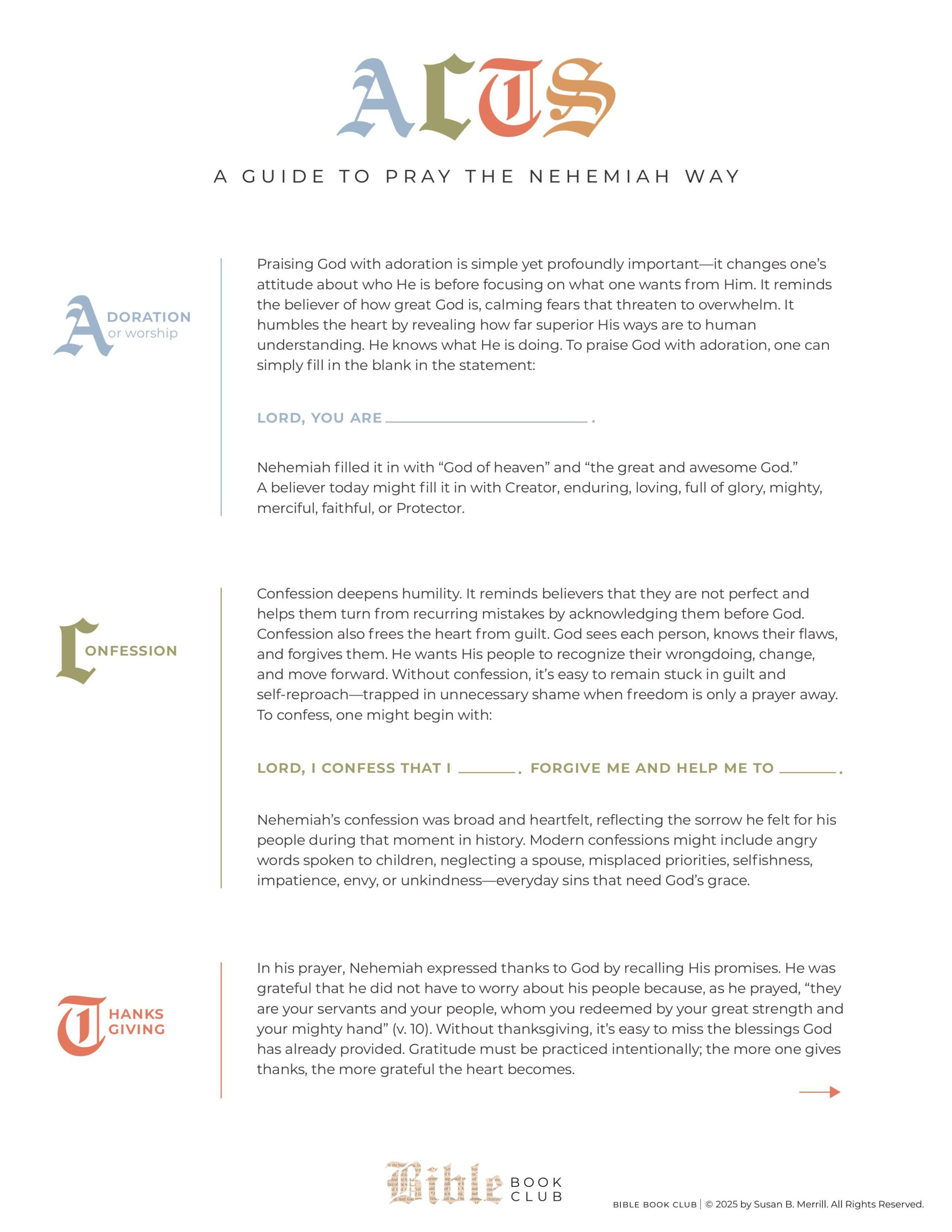
But the good news is we can give our hearts more time to be uncomfortable with what we’ve done (in other words, to grieve and ponder over it so we can turn from it and never do it again) by focusing more on the “C” in the ACTS model of prayer. As you may recall from when we first mentioned ACTS in Nehemiah 1, the “C” stands for confession. (Download and print the full ACTS prayer model here or in our show notes.)
How do the Levites use the ACTS model of prayer?
The Levite leaders loosely follow the ACTS model of prayer, beginning their corporate prayer of repentance with the “A” in ACTS which stands for adoration or worship.
Adoration
Adoration is praising God by remembering who He is. It’s as simple as filling in the blank to the statement: “God, You are [blank].” In Nehemiah 9:4-6 the Israelites fill in the blank by saying God made the heavens, stars, the Earth, and life. Next, in Nehemiah 9:7-8, they remember God’s Covenant. They are still in adoration mode here. They are worshipping God for what He has done for them.
The Levite leaders take the people back to their roots. They must remember that they are chosen and have a covenant with God. A covenant that started with Abraham and included land, land they lost control of due to their sin, but God brought them back to because He is faithful to the promise.
Then, in Nehemiah 9:9-12, the leaders turn to the exodus and remember God’s compassion and salvation. This is a walk down Miracle Lane. God saw them, sent signs and wonders, and saved them with plagues, a parted sea, and a pillar of fire. Who could forget that? The nations remember so why have they forgotten their God?
Next, in Nehemiah 9:13-15, they remember God’s plan and provision at Sinai. This is the beginning of the covenant. The marriage between God and the people when God provides His plan for their relationship in the laws, decrees, and commands.
Confession
God is good but they are not, and in Nehemiah 9:16-18 they move from “A” for Adoration to “C” for confession, remembering Israel’s rebellion. Starting at the Exodus, the Levites paint an unforgiving picture of the Israelites. They are arrogant, stiff-necked (a term used to describe a stubborn beast of burden), disobedient, forgetful of miracles, and rebellious.
But as unforgivable as the Israelites seem, God is forgiving, gracious, compassionate, slow to anger, and abounding in love. The people must remember that because of God’s goodness He responds with His plan, provision, and promise.
Point to Ponder
This day of repentance is just what God asks for in 2 Chronicles 7:14. The Israelites:
- Humbled themselves
- Sought God in His Word
- Turned from the sins of their past
Their hope is that God will hear and forgive them. This is such a great prayer for us too! We can have hope that if we, God’s people, follow this simple formula God promises He will hear and forgive us.
Thanksgiving
In verses 19-25, the main body of this prayer, they bounce back and forth between confession and thanks, which is the “T” in the ACTS model of prayer. From the time of Moses through Joshua the people rebelled, but despite their rebellion God continued with the plan. He sustained them in the wilderness, gave them victory over nations, caused their population to explode, gave them victory over Canaan, and prosperity in the Promised Land. He kept His promise!
Next, they remember, once again, Israel’s rebellion, and again recall God’s compassion in Nehemiah 9:26-27. As their disobedience progresses to blasphemy, God’s compassion progresses.
While God calls us to remember our sin, He also calls us to remember His Goodness. And that is what the Levites are pointing out. Again and again, the people were faithless, but God is always faithful. Still, this doesn’t mean there aren’t consequences. They are given over to their enemies, exiled, and enslaved. But then the Levite Leaders recall God’s compassion, and they add to it God’s mercy, despite their evil, in Nehemiah 9:28-31. They acknowledge they deserved to die but didn’t because of God’s mercy.
This prayer of remembrance is a confession of their failure, over and over, to keep the covenant. It’s also thanks for God’s righteousness, compassion, and mercy to love them despite their failure. It’s as if the Levite leaders have led the people in this prayer to the undeniable conclusion of this one question…who is God? The answer is: gracious and merciful. Period.
The Israelites deserve to be “unchosen,” wiped out, left to themselves in exile. The reason God does not destroy the Israelites has nothing to do with them. God does not destroy them because of who He is, gracious and merciful. Period.
God is the same yesterday, today, and tomorrow, and He has provided a way for us to be forgiven through His son, Jesus. He does not provide the Way to Salvation because of who we are but because of who He is. Gracious and merciful. Period!
However, there is an if. God is gracious and merciful if we confess our sins. As 1 John 1:9 says, confession and repentance lead to relational restoration. And relationship is exactly what God wants with the Israelites. It’s what He wants with us today. God wants a relationship, and for the Israelites that means covenant renewal.
Supplication
So, after remembering God’s faithfulness to His covenant of love and Israel’s unfaithfulness, the Levite leaders call the people to renew the covenant, moving the prayer into supplication, the “S” in the ACTS model of prayer.
Their request is that God enter into this covenant with them once again. In Nehemiah 9:32-37 they recognize they are at the beginning of their restoration to God. They are still slaves in a Persian province, and the fruit of their labor goes in taxes to a foreign king. These verses say the Persians rule over their bodies, which is a phrase used in other books of the Bible. It implies they are still oppressed and in a position of weakness.
The Feast of Tabernacles is a start to their relationship, but their repentance of sin is crucial. They are totally at God’s mercy to restore the Promised Land and nation. A renewal of the Covenant is the place to start.
In Nehemiah 9:38 the people acknowledge their sin in writing. By recounting this history in prayer, the Levites and the people are publicly announcing that they understand the Law, are aware and repent of their disobedience, and desire to take up the covenant and begin a relationship with God. They are claiming the promise God made to Solomon hundreds of years ago. And this national renewal of the covenant is a big deal.
Can a covenant be renewed?
Throughout Scripture we see God’s people return to Him through national covenant renewal six times, and if you’ve been with us since the beginning of our journey through the Bible, you’ve heard them all.
- Exodus 19: Moses at Mount Sinai
- Deuteronomy 29: Moses before entering the Promised Land 40 years after wandering
- Joshua 8: Joshua at Shechem, between Mount Ebal and Mount Gerizim
- Joshua 24: Joshua at Shechem, after the conquest of Canaan
- 2 Kings 23: Josiah, after finding the lost Book of the Law in the Temple
- Nehemiah 9: the sixth and last recorded formal covenant renewal.
Between the book of Nehemiah in 445 BC and Jesus, there is a 400-year silence. No prophets, priests, kings, or mentions of the covenant are recorded.
What does it mean that Jesus fulfilled the Old Covenant?
- Noahic Covenant: Gave the relationship permanence. God promised He would never wipe out humanity again. God was saying, “I’m staying committed to humanity.”
- Abrahamic Covenant: Narrowed the path through which humanity would be reconciled. God was saying, “Redemption from sin and reconciliation with Me is coming through Abraham.”
- Mosaic Covenant: Narrowed the path by adding the Law necessary to stay on the path for reconciliation. God was saying, “Through this nation, Israel, you will learn how to, and how not to, have a relationship with Me.”
- Davidic Covenant: Narrowed the path even further, identifying the one man, the Future King, through whom all could be saved. God was saying, “I am going to provide the One to save you from this separation, so that you can have a direct relationship with Me now and forever.”
- And then came Jesus. He is the fulfillment of all those covenants. Jesus is the King, from the nation, from Abraham’s family, the One that God promised. And on top of all that, He is the Son of God. And with Him came an entirely New Covenant. A covenant written not on stone but on human hearts.
Show notes: