
Subscribe to BBC on Apple, Spotify , or Amazon
Why is King Josiah important?
As Judah’s last righteous king, Josiah leads extraordinary spiritual reform, organizes the greatest Passover celebration in over 400 years, and shows obedience to God’s Word. His reign is a great source of hope and a model for the post-exilic community, but it ends too soon in 2 Chronicles 35.
The Power of Remembering Our Redemption: 2 Chronicles 35
As we begin our story in 2 Chronicles 35:1-9 Josiah is doing everything he learned from the Book of the Law to set the Israelites’ relationship with God right. In this diminished kingdom, his generosity is extraordinary as he provides a sacrifice for everyone who can’t afford one.
The precedence for the king’s provision of sacrifices was set in years of abundance, first in 1 Chronicles 29:2 by David and then in 2 Chronicles 30:24 by Hezekiah. Now, in 2 Chronicles 35:10-19, the Passover is of such a scale that it exceeds every Passover since the time of Samuel over 400 years before.
How long has it been since any Passover was celebrated? The only two kings known to have celebrated it were Hezekiah and Josiah. We can assume David and Solomon celebrated the Passover, but it’s not mentioned.
This is exactly why Moses dictated that every king must read the Book of the Law. To ensure they remember the Passover, the celebration of their redemption.
More than any other religious festival, the Passover draws the nation back to its roots. It’s because they were passed over on the night of the death of the first born in Egypt that they were given freedom and became a nation at Mount Sinai.
One Celebration to Honor Two Exoduses
The retelling of the Passover story would have been an important reminder for the returned exiles. The post-exilic people have just returned from the Babylonian captivity in what is called the “second exodus.”
The first exodus was the escape from slavery in Egypt. This second exodus is the release from slavery in Babylon.
Now Josiah has repaired the Temple and is holding an enormous Passover celebration. The Chronicler tells the story of the greatness of Josiah’s Passover to inspire the returning exiles to do the same.
They have rebuilt the Temple. Now they need to celebrate the Passover every year going forward as dictated by Moses in the Book of the Law so they remember both their first and now their second exodus.
How Did King Josiah Die?
The story in 2 Chronicles 35:20-21 requires a small review of world history. Israel, the Northern Kingdom, is currently under the control of Assyria, but Assyria’s power is weakening.
The new superpower is the Babylonian Empire, and they are attacking Assyria. Necho, the Pharaoh of Egypt, is trying to pass through Judah with a large army to support the Assyrian army against Babylon.
Josiah marches out to meet Necho, king of Egypt. Necho tells Josiah he’s not there to fight Judah and God will destroy Josiah if he opposes him.
Based on Israel’s history with Egypt, it’s no wonder Josiah doesn’t trust Necho. How is he supposed to know Necho of Egypt has indeed heard from the God of Israel? Seems a little far fetched.
Still, we can almost sense Josiah’s uncertainty about going into battle in 2 Chronicles 35:22-24 because he wears a disguised like Ahab did. Again, the disguise doesn’t work and, like Ahab, King Josiah is pierced by an arrow and dies in his chariot.
In our last chapter, the prophetess Huldah said Josiah would be buried in peace. In 2 Chronicles 35:25-27 he is. The country is not at war. Necho has moved on, and Josiah is honored with a burial and lament written by the great prophet Jeremiah.
God’s will is His will, and it will stand. We cannot alter it.
This is the second of three devastating foreign attacks on Judah. The first was Assyria under King Sennacherib. The second is this attack from Egypt, led by Pharoah Necho.
The third and final foreign attack will be Nebuchadnezzar from Babylon. And, even then, Babylon will invade Judah three times before the nation is no more.
What did Josiah do in the Bible?
During his reign, Josiah was tenaciously zealous in leading the country in obedience. He purged the Temple of idols and destroyed all the high places so the people were not tempted to sacrifice there. He was ruthless in his determination to set the nation on the right path and, to his credit, nowhere does it say he did not remove something he should have.
Josiah seems similar to Joshua because of his focus and relentless attention to detail. However, like David, Josiah was not perfect. His life could have ended differently had he listened.
The Brother Kings, Jehoahaz and Jehoiakim: 2 Chronicles 36
In 2 Chronicles 36:1-4, Jehoahaz and Jehoiakim are brothers from different mothers. Jehoahaz is 23 when his father Josiah dies and Jehoiakim is about 25. Even though Jehoiakim is older, the people choose Jehoahaz to be king.
Both brothers are plenty old enough to have learned about God from Josiah. However, despite having a father who modeled faith, they do evil in the eyes of the Lord.
After just three months as king, Jehoahaz is carried off to Egypt in chains and dies there. Jehoiakim becomes a puppet-king taxing the people to pay Pharaoh.
In the next three scenes, there will be three Babylon invasions of Judah. In the first invasion, Jehoiakim is king, and he is a vassal to Egypt and Pharaoh Necho.
Babylon’s First Strike
The Babylonian victory in 2 Chronicles 36:5-8 is the beginning of Judah’s march to captivity. In the book of Daniel 1:3-7 we will learn it was during this invasion that the best of the royal family and nobleman were taken with them including Daniel, Shadrach, Meshach, and Abednego.
Jehoiakim dies somewhere outside of Jerusalem, either on the way to captivity or already in captivity. We don’t know how he died, but Jeremiah was alive at the time and implies it was not glorious in Jeremiah 22:18-19. Jehoiakim’s son Jehoiachin succeeds him as king.
The house of Judah, the line of David, is dwindling. Two kings have already been carried into captivity. One brother was taken to Egypt, the country God redeemed Israel from and the other to Babylon, the country God condemned them to.
What is God’s message to Judah here? Perhaps He’s asking Judah how they could forget He saved them from slavery in Egypt. Maybe he’s begging them to remember their past in Egypt as they watch their king go to Egypt in chains.
Or maybe He’s asking Judah how they could forget the freedom they could have had in the Promised Land if only they’d loved Him. Is he telling them to picture their future as they watch their king go to Babylon in chains?
Surely God was trying to visibly wake the people up. How could they not see where they were headed?
We all experience lapses in faith when we are blind to our own sin. God calls to us…wake up, wake up! What are you doing? Look at where you are headed!
The Second Babylonian Invasion
In this second invasion, Jerusalem is totally ravaged. Nebuchadnezzar removes, carries away, exiles, takes, and deports:
- King Jehoiachin and his family.
- Treasures from the Temple and Palace.
- 10,000 people including all the officers, military men, skilled workers, and artisans.
Nothing is left except the poorest of the poor. In 2 Chronicles 36:9-10, Nebuchadnezzar leaves Jehoiachin’s uncle in charge as king and changes his name to Zedekiah.
We get more detail about these invasion in 2 Kings 23 and 2 Kings 24-25. Our Chronicler is less detailed because his only concern is the continuation of the line of David.
God provides for the protection of the line through Jehoiachin who is taken prisoner after this invasion. He is not the last king, but he is the only king to survive in captivity. This means the Davidic line will continue through him and not through Zedekiah, the king Nebuchadnezzar appointed.
If you fast forward to Matthew 1 when he’s listing the genealogy of Christ and the Davidic line, he leaves off before the exile with Jehoiachin (also called Jeconiah). After the exile to Babylon, he picks up the genealogy with Jehoiachin’s son Shealtiel.
Back to 2 Chronicles 36:11-14, Zedekiah rebels against Nebuchadnezzar. This is total insanity, because Judah is down to just the poorest of people. They don’t have a chance against Babylon unless the Lord is on their side.
But Zedekiah has done evil in the eyes of the Lord. The priests and people have followed him into unfaithfulness, even so far as to defile the Temple.
Still, God withholds divine discipline and instead sends warnings to Judah. But sometimes the leaders God gives a nation are part of His judgement on that nation. In this case, Zedekiah’s fall will mean the fall of Jerusalem.
The Third and Final Babylonian Invasion
By 2 Chronicles 36:15-19, the chance for repentance has passed. It is time for God’s plan of divine discipline, and God Himself brings the Babylonians against Judah. Zedekiah doesn’t stand a chance.
In 2 Kings 25, we get all the details about how Nebuchadnezzar marches his entire army to Jerusalem and surrounds the city. From the ninth year of Zedekiah’s reign to the eleventh year (an estimated year and a half) the Babylonians starve the city of Jerusalem.
Finally, knowing the people are too weak to resist, the Babylonians break in. The Israelite army flees through another gate, but King Zedekiah is captured and taken to Nebuchadnezzar.
They kill Zedekiah’s sons right in front of him, blind him, and take him to Babylon where he dies. This fulfills the prophecy written in Ezekiel 12:13-14.
The author is clear. In the end Jerusalem and Judah, like Samaria and Israel, disobeyed to the extent that the Lord would no longer tolerate their evil. So He removed the Israelites from the Promised Land through captivity and removed them from His presence through the destruction of the Temple.
By 2 Chronicles 36:20-21, the kingdom of Judah and the Temple of God are no more.
Writing from the Other Side
The Chronicler has been telling the exiles the story of their past so they can have hope for their future. In the upcoming verses, he ends the period of kings swiftly and oddly with a beginning. A miracle really.
It’s a hopeful ending considering the devastating story of exile he just finished, but the Chronicler has a different perspective. He is looking back, writing on the other side of the exile to the people who have returned.
Our Chronicler sees the exile as a fulfillment of the prophecy foretold in Jeremiah 29:1-14 that there would be a period of rest for the Promised Land. Now is the time for relational restoration after a long period of divine discipline.
This ending in Chronicles is a new beginning for Israel.
When Did Judah and Israel Reunite?
To fully understand how Judah and Israel reunite at the end of Chronicles, we need to know their captivity history.
- First, Assyria took the Northern Kingdom of Israel captive.
- Next Babylon conquered Assyria and took the Southern Kingdom of Judah captive.
- Then Persia conquered Babylon which contained all the Israelite captives.
Now, in 2 Chronicles 36:22, the Lord moves the heart of the Persian king, Cyrus, to release the Israelites. And he listens!
This is incredible, considering that during the first exodus the Pharaoh of Egypt would not listen to God. Then we had hundreds of years of kings in both Israel and Judah who would not listen to God. But now God uses a foreigner to save Israel, just as Isaiah 45:13 prophesied.
Certainly this miracle alone would have encouraged the exiles. In this second exodus there were no plagues. No chariot chases or fearful walks through the Red Sea. No wandering in the wilderness.
The Chronicler wants the returned exiles to remember their redemption from Persia is a gift from God, because the entire purpose of their divine discipline is to restore their relationship with the Lord.
From Chronicles to Christ
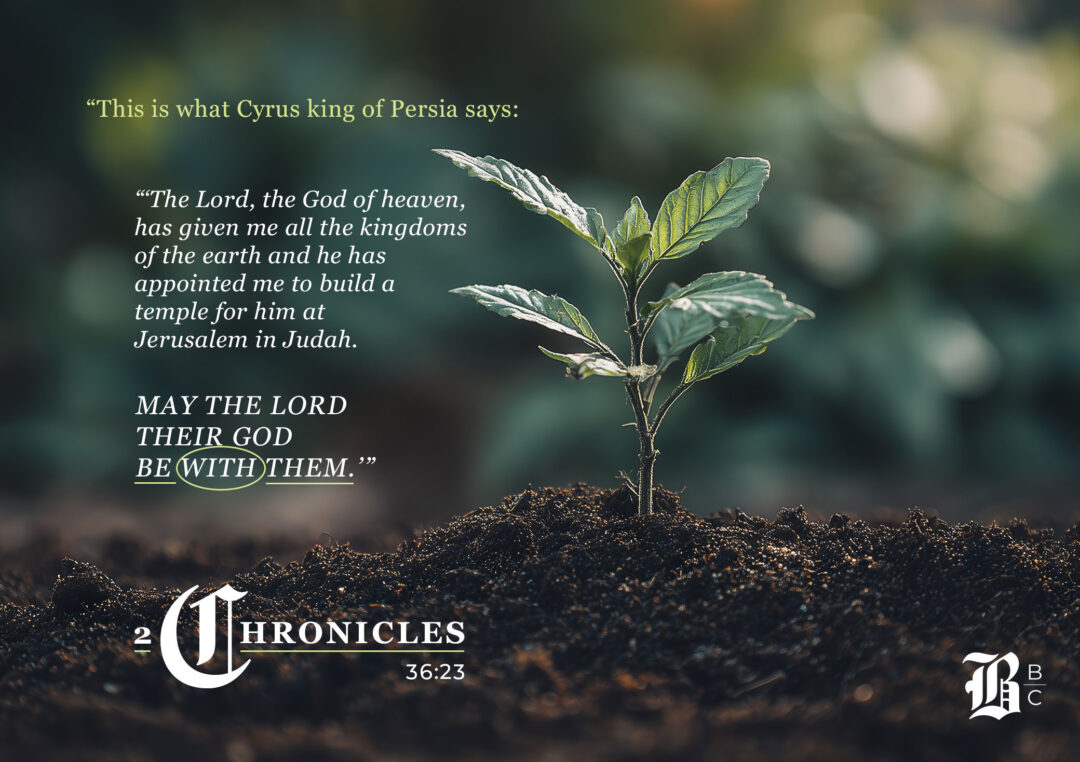
In 2 Chronicles 36:23, we come to the end of Chronicles, but not the end of the story. The people are given an invitation from the Lord, through Cyrus, to “go up” to Jerusalem.
It is an opportunity to climb out of the darkness of slavery and meet God on the Temple Mount. A chance to rebuild the Temple so they can dwell with Him through worship and rebuild their relationship.
Our Chronicler is writing to those who answered yes to this invitation. His purpose all along has been to give them hope for their future by retelling the story of their history, God’s covenant, the Temple, and the Davidic line.
These people are the very line that survived the exile and brought us great hope for our future. Hope that came through an invitation.
Our invitation did not come through a foreign king but from the Son of God, the King of Kings. It’s an invitation to receive Him as the only sacrifice for atonement we will ever need. An invitation to “go up.” To climb out of the darkness of slavery to sin. To reclaim our identity as God’s chosen people.
The hope the Chronicler gives to the Israelites is the same hope the Apostle Peter gives us in 1 Peter 2:9-10. Whether we are reading 1 and 2 Chronicles or 1 and 2 Peter, Old Testament or New, it was all written so we may know the love of God and His desire for a relationship with us. It’s our invitation to receive and respond with our yes!
The Chronicler leaves us with one more surprise twist. Ezra, the next book of the Bible we will explore, begins with the exact same verses the Chronicler ends with.
🎧 Ready to dive deeper? Listen to episodes of the Bible Book Club Podcast here.
Bible Book Club podcast episodes mentioned:
