
Subscribe to BBC on Apple, Spotify , or Amazon.
Who was Jehoshaphat?
Jehoshaphat was the sixth king of Judah in the Davidic line, known for his faithfulness to God. He sought to teach the people God’s laws, leading to blessings in Judah. However, his alliance with the corrupt King Ahab nearly jeopardized the Davidic line, reminding us even faithful people can make foolish choices. Still, God’s mercy is bigger than our missteps.
Was Jehoshaphat a good king?
The Chronicler’s goal in these chapters is to present the exiles with the story of a faithful but not perfect king. His hope is that the story will inspire them to be faithful too. We begin 2 Chronicles 17:1-6 with Jehoshaphat as king.
Like his father Asa, Jehoshaphat was one of the four good kings who followed David. His success is attributed to the fact that he sought God and followed His commands rather than the now idolatrous practices of Israel in the north.
Despite following David in his commitment to the Lord, Jehoshaphat made a foolish mistake that almost brought down the Davidic line through an alliance with Israel.
Revival by Scroll and Sword: 2 Chronicles 17
In 2 Chronicles 17:7-19, it’s clear Jehoshaphat has his priorities in order. The first thing he does is send his officials to teach the people the law.
Books were not a thing yet. The priests had scrolls, and the people were totally dependent on preaching.
Still, there were only three occurrences where the Bible noted the Levites went throughout the land to teach. It was their job, but in this case it says Jehoshaphat had to enforce it.
The result was that God blessed the land. The fear of the Lord fell on even the Philistines, and they paid tribute to Judah.
Judah grew strong and Jehoshaphat used that wealth to build up the nation with forts, supplies, and a larger military. It was a great start for King Jehoshaphat.
The Poisoned Apple of Compromise: 2 Chronicles 18
Judah and Israel have not been on good terms since Israel divided, and the Omri dynasty has most likely made Israel even more threatening. That’s why in 2 Chronicles 17:1 it says Jehoshaphat strengthened himself against Israel.
In his early years, Jehoshaphat did the right thing. He strengthened Judah against Israel. Yet here we are some years later in 2 Chronicles 18:1-2, and he chose instead to become allies with Ahab, a king known for his power and corruption.
Fear was most likely the primary motivation. Jehoshaphat’s fear drove the temptation to do something he knew was wrong. He could have trusted God for Judah’s security, but the alliance apple was so tempting he took it.
Then he gave it to his son Jehoram whose bite was spiritually fatal. Jehoram married Athalia, the daughter of Ahab and Jezebel, the Bible’s most wicked couple.
Athalia spread her idolatrous poison to her husband and throughout Judah, killing the covenant as she went. She also destroyed the spiritual good Jehoshaphat and his father Asa had done for Judah.
But that’s not all she did. Jehoshaphat’s failure to trust will prove to be deadly in our next chapters. Little did he know the apple contained the poison that would kill his great-grandchildren and wipe out the line of David all but for one small boy.
For more on Ahab and Jezebel’s story, listen to Season 11, Episode 12 or start reading in 1 Kings 16 with the beginning of the Omri dynasty.
For more on Jehoshaphat and Athalia’s story, listen to Season 12, Episodes 6, Episode 7, and Episode 8 or start reading in 2 Kings 9.
In-Laws and Influence
What was Jehoshaphat thinking encouraging such a marriage? The chances were slim an evil, idolatrous couple would raise a Godly daughter, but the ancient culture of alliances through marriage was a mistake so many kings made. Even the wisest king Solomon succumbed to the tradition.
Some years after the marriage, in 2 Chronicles 18:2-3, Jehoshaphat goes to visit Ahab. Maybe he wants to chat about their newly married kids or the birth of a grandchild. Who knows, but they are inlaws now.
The visit is another mistake.
Ahab rolls out the royal red feasting table, but not without reason. He has a motive, and he is persuasive. He wants Jehoshaphat to go into battle with him against Aram.
Judah is nowhere near Ramoth Gilead or Aram. While Judah’s traders would have passed through it on the road to Damascus, it really didn’t matter to them who they paid tolls to, Israel or Aram.
After much food and probably drink, Jehoshaphat succumbs to Ahab’s request and agrees to go into battle with him. He’s an easy yes.
Then, in 2 Chronicles 18:4-7, it’s as if Jehoshaphat suddenly remembers God and backtracks. He asks Ahab to first seek the counsel of the Lord.
The Worst Dinner Party
The whole scene is almost comedic. They serve a lot of food at this diplomatic dinner and no doubt a lot of wine, because it sounds as if these old kings are drunk or close to it.
Jehoshaphat agrees to the battle as if it were a picnic. He says they are family and of course he will join them in the war.
Then he switches gears. Oh, my bad, my God and I have a rule. I have to ask if I can go first. You got any prophets on hand?
Then bossy Ahab shouts to bring him a prophet, all the prophets. Now! And 400 prophets march in.
Jehoshaphat leans in and, with bleary eyes, studies the strange prophets. Then he asks, don’t you have any God prophets? Who knows exactly how he knew they weren’t.
Ahab responds like a child. Ya, ya we got one, but I hate him. He never says anything good about me.
Jehoshaphat tsks him like a mother would. You shouldn’t talk like that. We don’t say such things.
The whole conversation seems un-kingly. Like two old men arguing in their folding chairs on a street corner.
However the conversation went down, Jehoshaphat gets credit for three things. He asks for a prophet. Then he recognizes Ahab’s prophets are false prophets, and he doesn’t give in until Micaiah is called in 2 Chronicles 18:8-11.
A Bible Flash Mob of Prophets
If the last scene was a comedy, this scene is a circus. The two kings are royally decked out on thrones where everyone can see them near the gates to the capital, which was the common meeting place.
All 400 prophets are prophesying before them. Were they all talking at once? Are they dancing around? Was it choreographed or chaotic?
Then the circus master steps up, raises iron horns, and uses them as a visual to illustrate the victory they will have over the Arameans.
It’s not as loud or impressive as a military flyover, but it gets their attention. All the other prophets chime in…attack, attack, attack.
Micaiah Dropped the Mic
Ahab’s messenger sent to get the prophet Micaiah in 2 Chronicles 18:12-14 is not a fool. He wants to avoid the king’s anger and live to see another day, He tells Micaiah that all 400 prophets agree they need to attack Aram so, for once, just go along with it and agree.
Micaiah is not a fool, and he isn’t going to be forced to speak foolishness out of fear. Instead, he responds sarcastically to Ahab with exactly what Ahab wants to hear. Sure, go for it. Attack.
In 2 Chronicles 18:15, Ahab gets angry. He knows Micaiah is being condescending, and he wants the truth.
At that, the room must have frozen. The circus gets serious. Everyone surely grew quiet and the air became tight with tension. No one dared to breathe.
Imagine Micaiah leaning in, focusing his eyes on the king, and laying down the truth for whoever dares to pick it up in 2 Chronicles 18:16.
Ahab will die in this battle and his people, his sheep, will finally have peace. They have needed a shepherd, and he isn’t one. He is a cruel master.
God is done with Ahab and therefore Ahab is done. And Ahab’s response in 2 Chronicles 18:17 is foolish and childish. He turns to Jehoshaphat and basically says, see I told you he hates me.
How Ahab Died
Micaiah is still in the prophecy zone and continues in 2 Chronicles 18:18-22 with his vision of a conversation between God and his heavenly spiritual assistants. God asks them who can entice Ahab so he will be killed in battle, and God’s assistants throw out ideas.
God likes one. The spirit who says he will use Ahab’s very own false prophets.
It seems ironically fitting. Ahab insists on living by his own prophets, and now he will die by them.
The bottom line is, Ahab will perish because he refuses to believe in God. The purpose of this scene is more for Jehoshaphat. Can he see the truth? Will he act on it?
Ahab is not the only one who will perish because of foolish denial of God and the resulting delusions. In the New Testament Paul warns us in 2 Thessalonians 2:10-12 we all have the proof we need to believe and be saved. If we refuse, we will be led into believing the lie.
In 2 Chronicles 18:23-27, poor Micaiah gets assaulted and thrown in jail. Zedekiah, Ahab’s prophet, slaps him and sarcastically implies Micaiah spoke falsely.
Micaiah responds…we shall see. If the king walks out of the battle alive, Micaiah is not a prophet. If king Ahab dies, all 400 prophets will be wrong and will also most likely die.
Spoiler Alert, Ahab Dies
In 2 Chronicles 18:28-32, King Jehoshaphat is blindly foolish. Ahab is afraid of being killed as Micaiah prophesied so he tells Jehoshaphat to wear the royal robes while he will be in disguise. Then the enemy will think Jehoshaphat is Ahab and kill him instead.
Why would Jehoshaphat think Ahab’s idea was okay? It’s baffling.
In battle, Jehoshaphat has a close call and almost dies, but God steps in. Hopefully it’s a wake-up call for Jehoshaphat to see how ridiculously foolish it was to agree with Ahab.
Neither the disguise nor the armor can protect Ahab from God’s will. In 2 Chronicles 18:33-34, a random arrow hits him right between the sections of his armor.
Like Ahab, we have been forewarned in Proverbs 19:21 that no matter what our plans are, the Lord’s purpose will prevail.
Questioning Jehoshaphat: 2 Chronicles 19
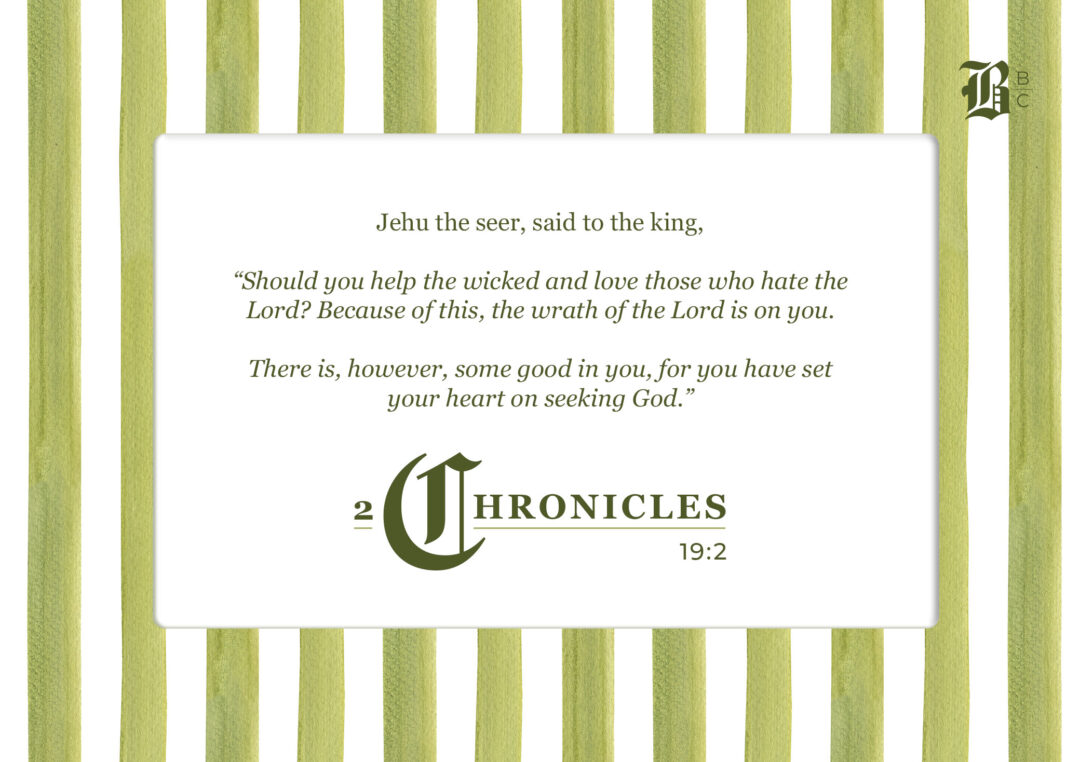
When Jehoshaphat gets home, the Lord sends the prophet Jehu to set him straight. Jehu is filled with accusatory questions. How could you help such a wicked king? You know better, you love the Lord, what were you thinking?
In 2 Chronicles 19:1-11 we see that, aside from Jehoshaphat’s foolish alliance with Ahab, he is faithful and seems to recover from that slip. He appoints judges throughout the kingdom and Levites, priests, and family leaders to administer the law.
The Ultimate Battle Strategy…Pray First, Panic Never: 2 Chronicles 20
The Chronicler comes to the end of Jehoshaphat’s story in 2 Chronicles 20:1-30 with a battle that contrasts with the impulsively foolish battle he fought with Ahab. In this battle, all is done according to God’s will. As a result, God does all the fighting.
This can make us stop and think.
In the daily battles of our life, do we pray to God first? Do we fully rely on Him for the outcome?
Or do we forge ahead in our own strength? Are we wasting energy on things that would have fallen into place without us even lifting a finger if we had only gone to God?
🎧 Ready to dive deeper? Listen to episodes of the Bible Book Club Podcast here.
