
Subscribe to BBC on Apple, Spotify , or Amazon.
David’s Final Chapter
As we arrive at 1 Chronicles 28 and 29, we’re at the end of our study of David. If you’ve been with the Bible Book Club for a while, this isn’t the first time you’ve read about David’s last days. But this will be the last time, and it’s different than before.
Our journey in Chronicles has been about the same King David as the book of Samuel. But, while it’s the same king, it’s a different story. Instead of focusing on David’s messy failures, the Chronicler highlights him as an ideal king who throws himself wholeheartedly into preparations for building God’s Temple and uniting the people in worship.
The message to the Chronicler’s post-exile readers is clear–this is your model. Do what David did. Prioritize God’s house and people, and you’ll see God’s blessings too.
David’s story as the ideal king ends as well as it began. David, the shepherd king, carries out a succession plan that isn’t just for Solomon. It’s for all David’s sheep.
David was many things.
- As the leader, he gives final instructions to his people.
- David, the father, instills final words in his son Solomon, the future king.
- As the faithful king, David gives a final gift to the Temple.
- David, the man who loved God with all his heart, pours out his heart to God in prayer.
The Legacy of a Shepherd King–1 Chronicles 28
In 1 Chronicles 28:1-7, there’s an emphasis on obedience. It’s crucial to the Chronicler that the returning exiles understand this in order to avoid another deportation. We see it again in Nehemiah 1:7 and 9:33.
Whether David was leading a motley army gathered in the wilderness as he ran from Saul or leading a discordant collection of tribes he united into a nation, he is a shepherd-king. Perhaps this is a clue as to why David is so successful as a leader.
He isn’t a distant dictator. Instead, he is a leader who walks among his sheep. He is with them.
David loves God and his people. He has a good life he loves, and he wants those who come after him to have a good life too. From experience, David knows this begins with the Israelites loving God and loving each other.
Therefore, in 1 Chronicles 28:8, David’s final words to the leaders are to obey God. He knows the words of 1 Samuel 15:22, to love God means to obey God. Obeying God is better than any sacrifice.
Then David mentions two very specific acts of obedience the leaders will need to make–to acknowledge God chose Solomon out of all David’s sons to be king and that God supports Solomon in building the temple.
David wants so badly for the leaders to obey God, and the secret to his own success with this begins with his love for God. His motives are pure and everything he attempts to do rests on love for God alone. John tells us to do the same in John 14:15.
The Lord Searches All Hearts
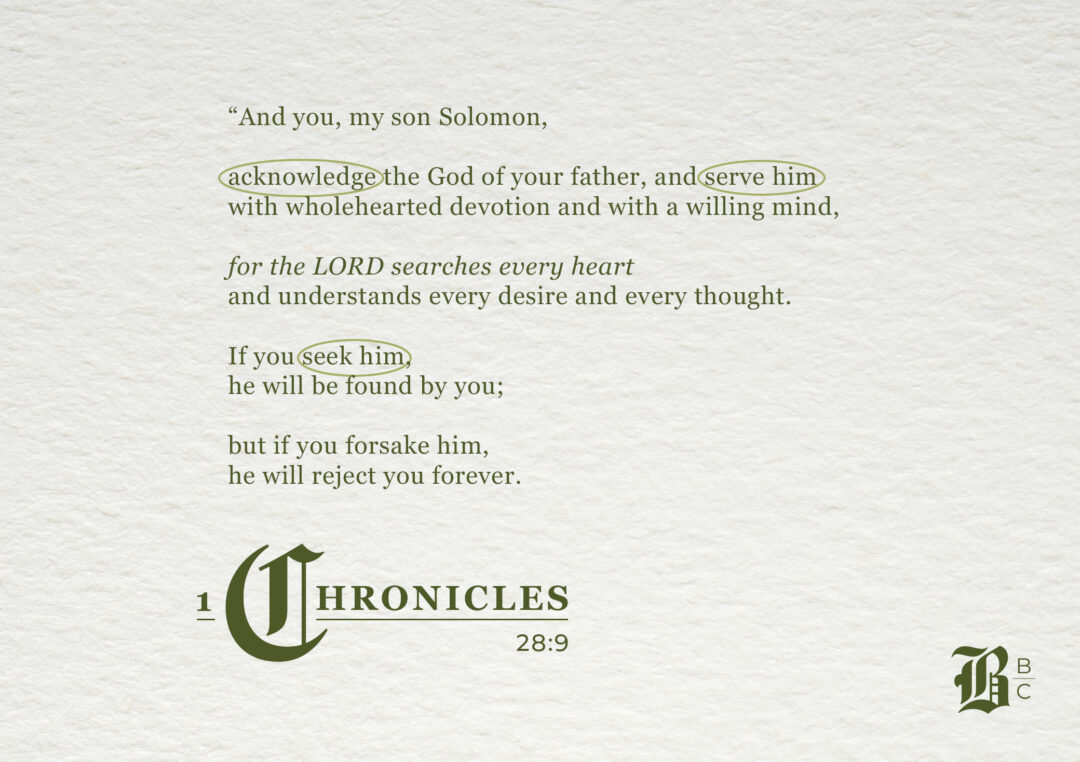
We typically link to the New International Version (NIV) of the Bible, but the way verse 9 is translated in the King James Version (KJV) is just so beautiful.
In 1 Chronicles 28:9-10, David turns as a father to his son Solomon, the future king, and implores him to serve God with a perfect heart and a willing mind. He tells Solomon that the Lord searches all hearts and understands all the imaginations of the thoughts. He wants Solomon to love God as he did and to serve him with a pure heart and a willing mind.
David is Solomon’s example and he’s ours too. When we receive our crown of righteousness in heaven, we want to have a shine like David’s–a light that reflects the glory of God and radiates from a pure heart. Not a perfect heart, but a pure heart that loves God.
Divine Details for Worship
David’s first words urged the people to love God. His second speech was to urge Solomon to love God and serve him with a pure heart. Now, in 1 Chronicles 28:11-19, David explains exactly how he wants Solomon to serve God.
David is meticulous down to the exact weight of gold they are to use in each temple dish. Why? It says these were the plans the Spirit gave him. Most of the instructions David lays out in these final chapters aren’t found anywhere else in the Bible.
Reflection Point
Is the Spirit giving you plans? Can you hear Him? Are you sitting still enough to listen? Or is the only time the Holy Spirit gets your silence in the middle of the night when you can’t sleep?
Maybe that’s when the plans come–people to reach out to, even if you don’t know why, or words you shouldn’t have said. Or maybe words people said that you didn’t take to heart. If we find more time to listen during the day, maybe we’ll get more sleep at night!
The truth is, we need to be present in life. If our minds are distracted by social media or entertainment, we’ll miss the plans the Holy Spirit wants to put on our hearts.
Do the Work
In 1 Chronicles 28:20-21 David is imploring Solomon to pour his love for the Lord into building His house. This is David’s passion project. The one he didn’t get to complete. It must be very hard to let go of his precious plan.
David knows firsthand any mission for the Lord will be fraught with trials so he urges Solomon again, as Moses did with Joshua, “Be strong and courageous, and do the work. Do not be afraid or discouraged, for the Lord God, my God, is with you. He will not fail you or forsake you…”
Where are you called?
Solomon is called to build the Temple. What work are we called to do? Do we see it in front of us or do we pass it by because the enemy has trained us to think, “I can’t do that.”
Years ago, we produced a podcast for Benjamin and Kirsten Watson called Why or Why Not. They chose this title because the husband was always asking, “Why are we doing this?” And the wife answered, “Why not?”
It’s important to ask both questions and be open to the answers God provides.
Why would I do that? It’s hard and uncomfortable.
Why? Well, is God asking you to? That is the question you must ask when you see an opportunity to do something and are pondering whether God is calling you.
Why not is the question you ask when fear, doubt, or an unwilling heart creep in. Why not puts the Lord on one side of the argument and every other excuse and fear on the other side. There is nothing on the other side that can outweigh God.
God is with you. He will not fail or forsake you.
A Faithful King’s Final Gift–1 Chronicles 29
So, to review, David’s words to the leaders are to love God and obey His commands. His words as a father urge Solomon to love God and serve Him with a pure heart. His speech to the people, his sheep, in 1 Chronicles 29:1-9 are to show devotion to God and give generously.
There’s another parallel here for us between David and Moses. In Exodus 35, Moses told the Israelite community to give an offering to the Lord for the Tabernacle and they did so with willing hearts. David follows Moses and the Temple follows the Tabernacle.
Worship Is the Way
David’s passion for the Temple isn’t just about a beautiful building. It is a place where God’s presence dwells. It’s what points the people of Israel to God. It serves as their center for relationship and covenant with God.
And their future depends on this covenant. It is the promise of life–security, provision, land, food, peace, and rest. A life of covenant obedience is a sign of genuine love for the Lord. Without God at their center, the people will become lost.
David knows their relationship with God–worship, His Word, prayer, music, and communion, along with loving each other–are the only things that can save them. In these last eight chapters, he does everything he can to prepare them.
Modern Times David
If David were alive today, his message to us would be the same.
- Love God.
- Obey God.
- Love people.
- Serve God by leading people to God.
- Love life and live well enjoying all the comfort and peace God offers–no matter your circumstances–when you live close to Him.
David’s Final Prayer
David’s third prayer is coming up. His first prayer in Chapter 17 was his humble response to God’s covenant promise that his descendants would rule forever. His second prayer in Chapter 21 was David’s confession after the census sin and a plea for mercy from the plague.
Now this third prayer is David’s farewell prayer of praise, gratitude, and surrender. David starts by praising God as ruler over all for eternity in 1 Chronicles 29:10-12. Then in 1 Chronicles 29:13-16 he thanks God for everything they have because of Him.
David follows it up in 1 Chronicles 29:17-19 by petitioning God for the hearts of the people so they will be loyal. He also prays Solomon will keep the commandments and build the Temple.
When he puts it like this, it’s so simple–love God, obey God, and do the work. In 1 Chronicles 29:20, the people respond to their faithful leader and follow him by praising God.
Solomon’s Succession Secured
The next day, in 1 Chronicles 29:21-25, Solomon is anointed king. He is the carrier of the promise in the Davidic covenant and the steward of the Temple he will build.
This passage mentions it’s the second anointing. This references the first time in 1 Kings 1 when Solomon was hastily anointed in order to stake his claim to the throne against his brother Adonijah.
The Death of David, a Man Who Loved Well
In 1 Chronicles 29:26-30, David dies. He is perhaps the most prominent Biblical example of leadership. He had the charismatic combination of intelligence, courage, and a winsome personality, all empowered by the Holy Spirit.
David was a man of vision. What he knew to be true gave him confidence to do hard things.
There is a common saying, “David died on the threshold of other people’s futures.” Isn’t this the ultimate goal as a leader? To empower the next generation.
David steps out as an example of a leader. If you lead with a pure heart, others will follow. You may be thinking, well, I’m not really leading anyone, but your life is an example to others. When you live in faith, you lead others in faith.
David didn’t get to build the temple or see the nation settle into Godly worship. But he did build a vital bridge to the future Temple and Godly worship. He did everything he could down to the last ounce of gold to make sure they would get there.
🎧 Ready to dive deeper? Listen to episodes of the Bible Book Club Podcast here.
Themes of this podcast:
Legacy leadership: living for the next generation. David’s final acts are less about finishing his own story and more about launching the future. His leadership shows that true greatness isn’t about what you personally accomplish. It’s about how well you prepare and position others to flourish and carry God’s work forward when you’re gone.
Worship as the center of life. David’s obsession with the Temple isn’t about architecture—it’s about anchoring the people’s identity and future in worship. For David, worship is more than music or rituals; it’s obedience, generosity, community, and a loving relationship with God and others. Worship is the way God’s people flourish.
True success isn’t found in achievement but in wholehearted devotion. David’s success as a shepherd-king stemmed from his pure heart that genuinely loved God. This allowed him to serve God with a willing mind because true obedience flows from love.
