
Subscribe to BBC on Apple, Spotify , or Amazon.
Satan’s Strategy: A Spiritual Battle in 1 Chronicles 21
Satan is only mentioned directly three times in the Old Testament and 1 Chronicles 21:1-3 is one of them. In Hebrew, satan means adversary, opponent, enemy.
His origin is a little blurry but we get a hint at his story in Isaiah 14:12-15. The Bible is clear Satan’s function is to oppose God.
The fact that Satan incited David to take a census doesn’t excuse David from fault. God allowed Satan to incite David. God is in control of all things, even the enemy.
But David is responsible for failing the test. Satan is the author of temptation and every temptation is a test.
It’s interesting the Chronicler notes Satan rose up against Israel. It was Israel that Satan was after. But David is the heart of Israel, and the enemy knows it. So he goes after David’s heart.
Why didn’t God protect David from this spiritual enemy as he had from so many earthly enemies? Neither 1 Chronicles nor 2 Samuel offers a reason.
But the point is, in Genesis 3 there was a fall and therefore we are all fallen. Like us, David was born with a nature prone to sin. Satan takes advantage of our condition by looking for just the right place to tempt us.
So far, David’s major weakness has been his desire for a woman. In this story, his calling as a warrior leads to pride. It’s so easy for success to go to our head. So David falls and orders Joab to take a census of his men fit for war.
What’s the big deal about a census?
A census was typically conducted for military or tax purposes. This census was a military count.
Many commentaries suggest the problem with this military count rested in David’s motive. He may have allowed pride to ignite his curiosity about his infamous army. Just how many men could he boast of?
Joab’s reaction supports this assumption. He begs David not to do it. If Joab knew it was wrong, it had to be a pretty blatant sin. Joab was ruthless and, as the leader of the army, he would have been exalted in the number too.
In fact, this was a role reversal. In several other stories, David is the one admonishing Joab to do what’s right. But this time Satan rose against David and sought out his weak spot…and he found it. And God, who had a perfect plan, allowed it to happen.
In 1 Chronicles 21:4-7 Joab obeyed David but stopped short. He didn’t count God’s holy men, the Levites, and he didn’t count the tribe of Benjamin. Maybe this is because their land included holy ground–Gibeon where the Tabernacle was and Jerusalem where the Ark was located.
Where there is sin, there are consequences. But this consequence has a redeeming twist.
From Sin to Surrender
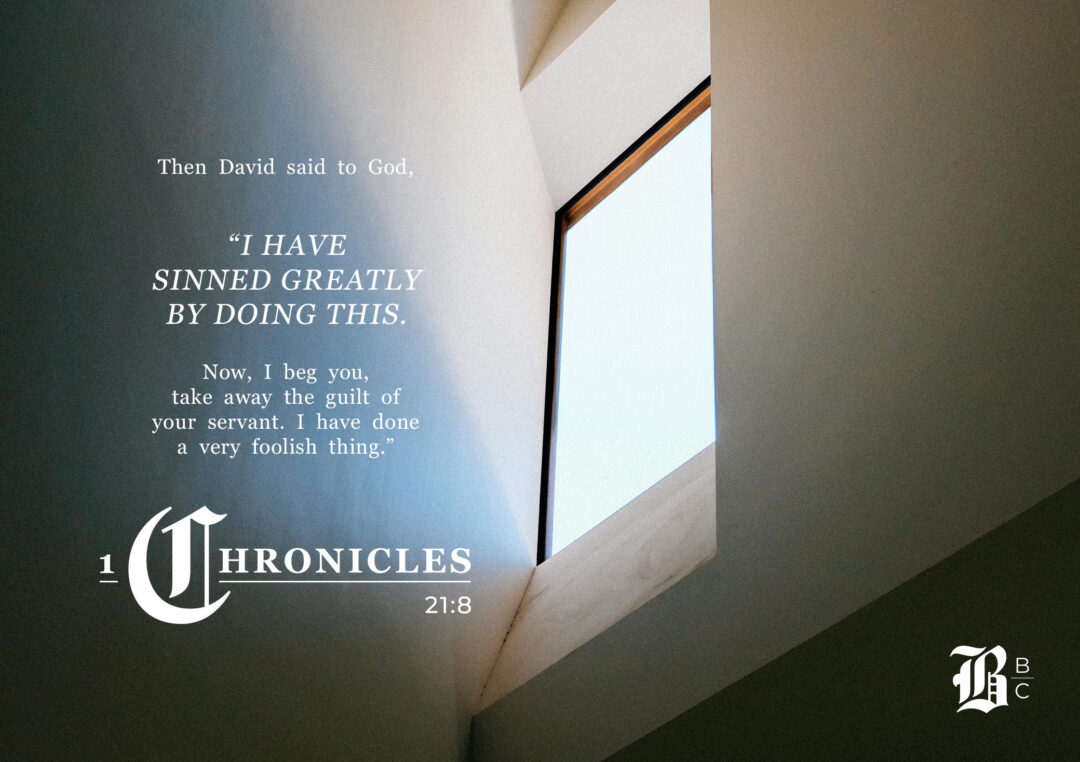
David sinned but he repented in 1 Chronicles 21:8-13. Note there are only two places where David says the words, “I have sinned.” It’s interesting that one confession is related to a family sin in 2 Samuel 12 with his affair with Bathsheba and the murder of Uriah. The second is a public or administrative sin.
God gave David a choice of consequences–three years of famine, three months of war, or three days of plague. David trusts in the Lord and wants God to make the choice. He doesn’t trust himself.
The Plague of Guilt
So God chooses. He sends a plague on Israel in 1 Chronicles 21:14-17. It must have been torture for David, who considered himself a shepherd, to watch 70,000 people–his sheep–die because of his pride.
As the angel reached David, the people with him fell facedown waiting for death, but the Angel of Death stopped. In 2 Samuel 21:17 David cried out, almost alarmed.
He told the angel not to spare him, because he was the guilty one. He pleads that his sheep are innocent and begs the angel to take him and his family instead–to take the line of David that God promised would be on the throne forever.
But God had other plans. God was faithful to:
- The Israelites who broke the covenant over and over again.
- Abraham who didn’t trust and lied.
- Moses who disobeyed in frustration.
- David whose heart was a strength and a weakness.
- Us, no matter how many times we fall.
We fall and God saves. God saved the line of David because He had a plan to save us through David.
The Threshing Floor
In 1 Chronicles 21:18-27, God tells David to go up and build an altar to the Lord on the threshing floor of Araunah the Jebusite. This threshing floor is on the very hilltop, also known as Mount Moriah, that we talked about in Season 1, Episode 21.
Mount Moriah has a story of redemption to tell. It’s the place Abraham almost sacrificed his son, Isaac, but after three days God provided a ram for the sacrifice at the last minute. In our story today, Mount Moriah is the location where David offered up his own family as a sacrifice for the people of Jerusalem. In both cases, an angel of the Lord saved them.
Coming up in 2 Chronicles 3, on this same threshing floor on Mount Moriah, Solomon will build the Temple–a place for worship and forgiveness. Many years later, after our Chronicler is long gone, just yards from that same threshing floor on Mount Moriah Jesus will die on the cross.
God Redeems Our Failures
In 1 Chronicles 21:28-30 and 1 Chronicles 22:1, God’s grace turned David’s sin into a gift of redemption. The House of the Lord–the Temple–would be on the very spot where David’s sin had almost destroyed Israel. Where God delivered His people once again.
It was a place of forgiveness where sin and all its consequences were removed.
Satan provoked the sin. God redeemed the sin…and the sinner. Then, now, and in the future. God is faithful.
Bible Bender
Threshing floors were often built on hilltops so when the grain was tossed into the air the wind would blow the chaff away, and the heavier kernels would fall to the ground to be collected.
Spiritually, it was divinely brilliant to build the Temple on a threshing floor. Threshing floors were a place of separation–the grain that makes bread is separated from the chaff. The good is separated from the bad.
In the Temple, God dealt with the separation of God and man that came when they were banned from Eden. That’s why the Temple had so many decorative features that referenced the Garden of Eden. To remind them this Temple was a place of atonement for the sin that separated them from God in the Garden.
The Temple was God’s threshing floor where He dealt with Israel’s sin–the chaff–the cause of separation from Him. Here He provided them with life, the grain that makes bread…the bread of life, Jesus in John 6:35.
Jesus is the seed promised at the Fall in Genesis 3:5 that became the bread that would end our separation from God. Like David, in John 10:11 Jesus saw himself as a Shepherd of the people.
David, the imperfect king with a heart for the Lord, was a foreshadowing of the perfect King. But David couldn’t save us. He wasn’t the seed. Only God’s son, the seed, could save.
What a picture of separation…
- Grain from the chaff
- Good from the bad
- God from man
It all came to an end and we now have the Bread of Life and a ticket into an eternity in the Kingdom of God. This sounds like an upgrade from the Garden of Eden!
A Divine Blueprint and a Promise Fulfilled
The people of Jerusalem and David’s family were saved on Mount Moriah when God halted the angel after a plague of three days. We were saved when Jesus died for our sins on Mount Moriah and rose again after three days.
This story is all one divinely brilliant plan where God…
- Chose one family–Abraham’s.
- Made that one family a nation–Israel.
- Chose a man from Israel to be king–David.
- Provided a Savior, the seed from David’s line, to save the world–Jesus.
David’s Legacy: Be Strong and Courageous–1 Chronicles 22
For the rest of 1 Chronicles, the authors’ main concern is worship and that means the Temple. This Temple theme jumps out at us nine times in the next 17 verses. Over and over we read the phrase, “Build a house for the Lord.”
This is a passion project for David, and his one concern is that Solomon will do it as he would have done it if the Lord would have allowed him to. This was the fulfillment of years of prophecy and David wanted it to be perfect.
David knows the builder–Solomon–and the location of the building–Mount Moriah. All that’s left is to provide the resources and the plan, and he’s on it in 1 Chronicles 22:2-5.
David gathers everything they’ll need to begin construction. He arranges the stonecutters, iron for nails, bronze, and cedar logs. It must have been huge piles because it was all provided in quantities too great to be counted.
And it was all stockpiled, awaiting David’s death, so Solomon could get started. With all the resources accumulated, David prepared Solomon to build the Temple in 1 Chronicles 22:6-13.
David says to Solomon what Moses said to Joshua when he was passing on the leadership baton in Deuteronomy 31:7-8. Be strong and courageous. Do not be afraid. Do not be discouraged.
What if we said this more to our…
- Children
- Grandchildren
- Friends
- Those suffering
- Ourselves!
How David Echoes Moses
The plans continue in 1 Chronicles 22:14-19. Many commentaries consider David as a type of Moses due to the numerous parallels in this story. For example, God gave Moses the plans for the Tabernacle, and God gave David the plans for the Temple.
There are so many other examples. Both Moses and David were literally shepherds before they were leaders. And both saw themselves as shepherds of the people after they became leaders.
They both had extended periods of exile and testing. Moses led the Israelites for 40 years in the wilderness. David led an army for about a decade hiding in the wilderness from Saul.
Both were flawed but forgiven. Moses disobeyed God at Meribah and was barred from the Promised Land. David had an affair and lost a child. Both repented, were forgiven, and continued to do great work for God.
Moses and David are both associated with a covenant. The Mosaic Covenant provided the laws for a relationship with God. The Davidic Covenant gave them hope for an eternal relationship.
And all covenants led to the one that counts–Jesus–the new covenant. Where our journey will end…the story continues.
🎧 Ready to dive deeper? Listen to episodes of the Bible Book Club Podcast here.
Themes of this podcast:
The battle between pride and humility. David’s sin in taking the census highlights how pride can subtly creep in even in moments of strength and success. Satan exploits David’s vulnerability, turning a military census into an act of self-glorification. Yet, through David’s story, we see how humility, confession, and trust in God’s judgment can redeem even our worst failures.
God’s sovereignty and redemption. While Satan incited David, it was ultimately under God’s allowance and control. And despite the grave consequences of David’s sin, God uses the very place of failure—Mount Moriah—to bring about a redemptive purpose. It’s the future site of the Temple and ultimately the place where Jesus secured eternal redemption for all humanity.
The threshing floor as a place of transformation. The imagery of the threshing floor—where chaff is separated from grain—emerges as a profound spiritual metaphor. It’s a reminder that God transforms our places of failure into holy ground, separating sin from us and providing the “Bread of Life” that ends our spiritual separation.
