
Subscribe to BBC on Apple, Spotify , or Amazon.
1 Chronicles 1: Tracing God’s Promises Through Generations
The author of 1 Chronicles doesn’t waste any time jumping in with an old-school DNA tracking of God’s people through a detailed geneaology. The story continues through 1 Chronicles 2 with an ongoing focus on showing the returning exiles where they came from and that God will keep His promises.
Of Abraham’s eight sons, the Chronicler chooses to focus on two who are particularly important–the firstborn of Hagar and the firstborn of Sarah. Hagar was Sarah’s maid, given to Abraham to produce a child, which she did. His name was Ishmael.
In Genesis 17, God told Abraham that Sarah would have a son as well. He was elated but asked God not to forget about his son Ishmael. God agreed to bless both Ishmael and Sarah’s son Isaac and make them into great nations.
A few years later, in Genesis 21:8-18 when Hagar and Ishmael are turned away from Abraham’s household, God does not forget his promise. As Abraham sent them on their way, worrying about his son, God comforted Abraham with a reminder Ishmael would survive and be made into a great nation.
God keeps his promise. Ishmael’s 12 sons become 12 tribes who live in Northern Arabia. (If your curious, the story continues in Genesis 25.)
Abraham’s Late-in-Life Legacy: The Sons of Keturah
Throughout Chronicles, you’ll quickly see the author often goes out of chronological order to make a point. We see it for the first time here as he focuses on Keturah, the wife Abraham married after Sarah’s death.
It’s shocking to think Abraham had even more children after Sarah died. He was 100 and Sarah was 90 when they had Isaac. Sarah was 127 when she died. So that means Abraham was over 137 when he married Keturah and had six more sons.
From these sons, God built the Midianite tribe. If that sounds familiar, Joseph’s brothers sold him to the Midianites. Moses married a Midianite woman named Zipporah, and her father was a Midianite priest who gave Moses leadership advice. Later, the Midianites become enemies of the Israelites.
Isaac’s Sons and the Power of Twelve: God’s Promise in Action
At last, we arrive at Isaac—the most important descendant of Abraham and the only son of Sarah. Isaac had just two sons, twins Esau and Jacob. Esau, the firstborn, famously sold his birthright for stew in Genesis. Jacob went on to have 12 sons who become the 12 tribes of Israel.
Esau, however, did not fade into obscurity. He had five sons whose descendants became the Edomites. (The names Esau and Edom are used interchangeably.) Over time, Esau’s lineage absorbed the people of Seir, the original inhabitants of the region where they lived. Recognizing this significant merger, the Chronicler includes the seven sons of Seir in Esau’s genealogy, effectively giving Esau 12 tribes of his own.
This is no coincidence. The Chronicler draws a deliberate parallel between Esau, Ishmael, and Jacob all having 12 sons who turn into tribes. This pattern reinforces God’s faithfulness. The Chronicler is highlighting the fact that God keeps his promises and this is the fulfillment of God’s promise to Abraham that he would be the father of many nations.
1 Chronicles 2 – From Jacob to Israel
Now the Chronicler is ready to narrow down the story to how it directly impacts Israel by starting with Jacob. You might remember the intriguing story in Genesis 32 when Jacob wrestles with God on the way to meet Esau for the first time after he stole Esau’s birthright.
Jacob is nervous because he’s heard of Esau’s national and military growth. God meets Jacob along the way, wrestles with him, and renames him Israel, which means he wrestled with God and with humans and has overcome. So the name Jacobe and Israel are interchangeable names for this one man.
As usual, the author of Chronicles isn’t worried about chronological order, so he doesn’t list Israel’s sons who become the tribes in order of their birth. Instead, he places specific emphasis on three tribes: Judah, Levi, and Benjamin. But the Chronicler gives the most attention to Judah because it’s from this line we get the Davidic Covenant that promises the Messiah will come from the line of David.
Judah’s Journey from Scandal to Spiritual Leader
Jacob’s son Judah had a rough start. First, he married a Canaanite woman. Then he raised wicked sons. Finally, he tried to trick his first son’s widow, Tamar, into waiting to marry his youngest son Shelah when he was older, without any intention of letting it happen.
Tamar turns around and tricks him right back. Pretending to be a prostitute, she sleeps with Judah and conceives twins Perez and Zerah. It’s a dramatic story you can listen to in Season 1, Episode 30 of the Bible Book Club Podcast.
Luckily, God does not require perfect people or a perfect past, and Judah’s rough start turns into a beautiful transformation. He starts by making things right with both Tamar and his brother Joseph. Judah’s powerful speech to Joseph reveals a heart transformed. You can listen to it in Season 1, Episode 33.
So a reformed Judah and his tribe rise to the top and become the largest population of the returning exiles. It’s no wonder the Chronicler, who is speaking to these exiles, wants to make a special point to detail their ancestry.
Perez and Zerah: A Tale of Two Sons and a Stark Reminder
Perez had two sons and Zerah had five. Zerah’s oldest son Zimri had a son named Karmi who had a son named Achar.
While the main focus of Chronicles is positive and uplifting, here the Chronicler (who may be the priest Ezra) gives the returning exiles a quick reminder through Achar that it’s a bad idea to be unfaithful. In Joshua 7 we get the full story of Achar’s idolatry and how it caused the Lord’s anger to burn.
The line continues with Perez’s oldest son Hezron who had three sons: Jerahmeel, Ram, and Caleb. All three sons get a lot of print.
Ram, Second Son of Hezron
There are a lot of familiar names in the list of Ram’s descendants because this is the lineage of David through his father, Jesse. It’s the fulfillment of the prophecy in Isaiah 11:1 that a shoot would come from the stump of Jesse.
Interestingly, in this portion of 1 Chronicles 2, David’s sister Zeruiah is mentioned. Her sons Abishai, Joah, and Asahel all served David throughout his conquests in the books of Samuel and Kings.
Caleb, Third Son of Hezron
The Chronicler goes into some interesting detail in the genealogy of Caleb to make a few connections. First, a mention of Bezalel, the architect and craftsman who designed and built the Tabernacle and its furniture for Moses back in Exodus 31 and Exodus 35. It says the Lord filled him with the Spirit of God, knowledge, and skills.
Then there is an aside about Caleb’s father Hezron. (Note: this is not Caleb who explored the Promised Land with Joshua.) At 60, Hezron married the daughter of Makir, the father of Giliad. Makir was Manasseh’s firstborn, which made him the grandson of Joseph. So this is a marriage alliance between the tribes of Judah and Manasseh.
Jerahmeel, First Son of Hezron
The Chronicler goes on to list the sons of Jerahmeel and most of the names are new to us, because there is no other Old Testament mention of this branch of Hezron’s family. So why did the Chronicler give Jerahmeel so much attention? He always has a reason.
Most commentaries speculate the final descendent in the list, Elishama, needed an established pedigree. When Sheshan had no sons, he gave his daughter to his Egyptian servant to continue his line. This Egyptian heritage came about in a similar way to Abraham’s son Ishmael, but this time the Egyptian servant is male, not female. The Chronicler is making a point that foreigners were absorbed into the family of Judah.
Back to Caleb
Once again, the Chronicler shows no concern for the chronological order of events. Instead, he takes us back to hear more about the sons of Caleb. In this section, we find a hidden gem, the birth of Bethlehem.
The Bible is God’s way of working, through men, to tell the story of His plan for our salvation. So while this bouncing around might feel scattered, nothing is random. God is always weaving together people, places, words, and stories. All of it points to the one King, His Son, who will complete the plan.
So the mention of Bethlehem is important here because God is establishing links. Proof of His hand at work throughout time.
Bethlehem: A Small Town with a Big Destiny
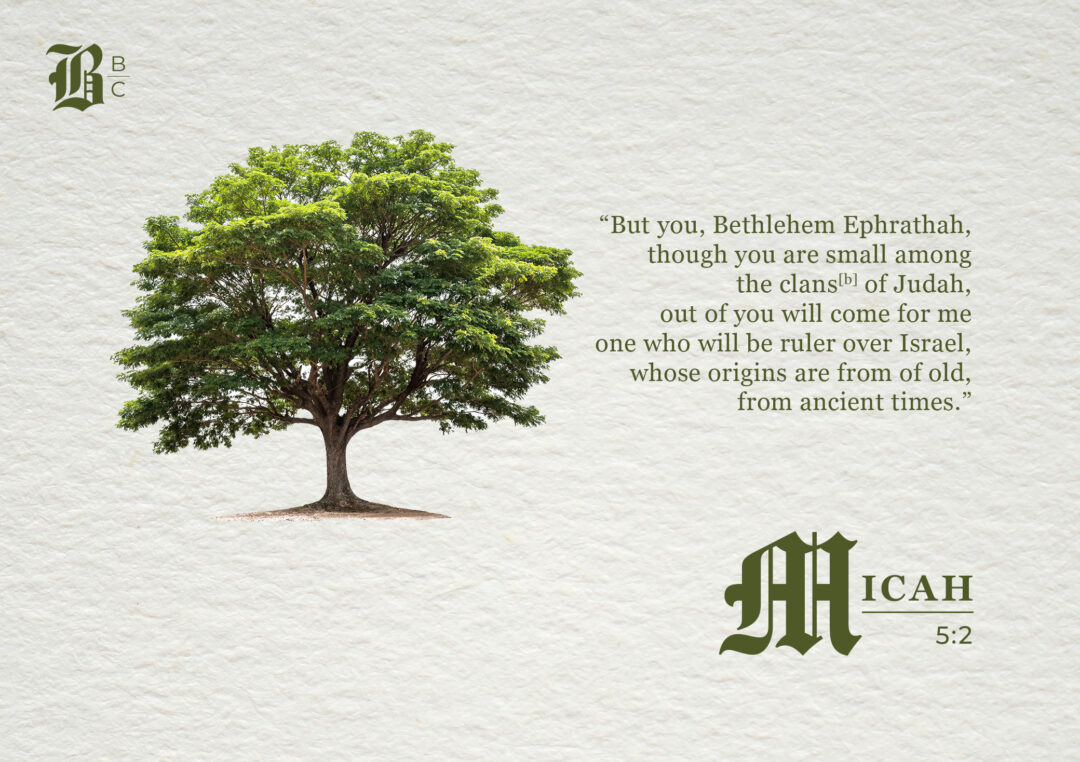
With God’s help, throughout the Bible the authors cast light on the small town of Bethlehem, which will have a life-changing impact on our world.
In Genesis, Jacob’s wife Rachel was buried in Bethlehem. She was not the mother of the tribe of Judah but of Benjamin, one of the remaining important tribes.
In 1 Chronicles we learn Bethlehem has been absorbed by the tribe of Judah.
In Ruth, we learn that David’s great-great-grandfather Boaz is from the small town of Bethlehem, which will lead to David’s birth in Bethlehem.
Bethlehem means bread and we all know David’s descendent Jesus–the Bread of Life–who was born in Bethlehem.
God transcends time. That means he can work the past, present, and future into his purpose as it states in Revelations 1:8.
Finding Your Name in God’s Story
The author of 1 Chronicles 1 and 1 Chronicles 2 wrote this genealogy for the post-exile Jews to remind them who they are and where they come from. They are sons, tribes, kings, the line of David. For a group of people who were in an identity crisis, returning from foreign exile, confused about where they fit in, this list must have meant everything.
Imagine their thrill at finding their family name in this list the Chronicler gave them–how close that must have made them feel to their ancestors. Perhaps it’s similar to the feeling we’d get if we found our family’s name on a memorial wall or in a history book.
Little did the Chronicler know he was writing this list not only for the exiled Jews but for us as well. When we see these names, we are seeing our own heritage as adopted daughters and sons of God. It is the lineage of our King Jesus who came from Bethlehem as it was prophesied.
🎧 Ready to dive deeper? Click here to listen to the Bible Book Club Podcast now!
Themes of this podcast:
God is faithful to His promises. In 1 Chronicles 1, the author highlights how God kept His covenant with Abraham that he would be the father of many nations. In fact, the 12 tribes of Ishmael, the 12 tribes of Esau, and the 12 tribes of Israel all serve as proof God’s Word does not fail.
The significance of lineage and identity. For the post-exile Jews, this genealogy was more than a historical record—it was a reminder of their identity as God’s chosen people. By tracing their lineage all the way back to Abraham, Isaac, and Jacob in 1 Chronicles 2, the author reassures the returning exiles that their heritage and covenant with God still stand, even after exile and hardship.
We can find our own heritage in this lineage. If we ever find ourselves in an identity crisis, wondering where we fit in, like the post-exile Jews, we can be confident this genealogy is ours too as adopted daughters and sons of the Lord, because it’s the lineage of our Eternal King…Jesus.
