
Subscribe to BBC on Apple, Spotify , or Amazon
When Influencers Fall
As we continue 2 Kings 9, Jehu is not done. The killing must continue because the mother-daughter duo who descended from Ahab must die.
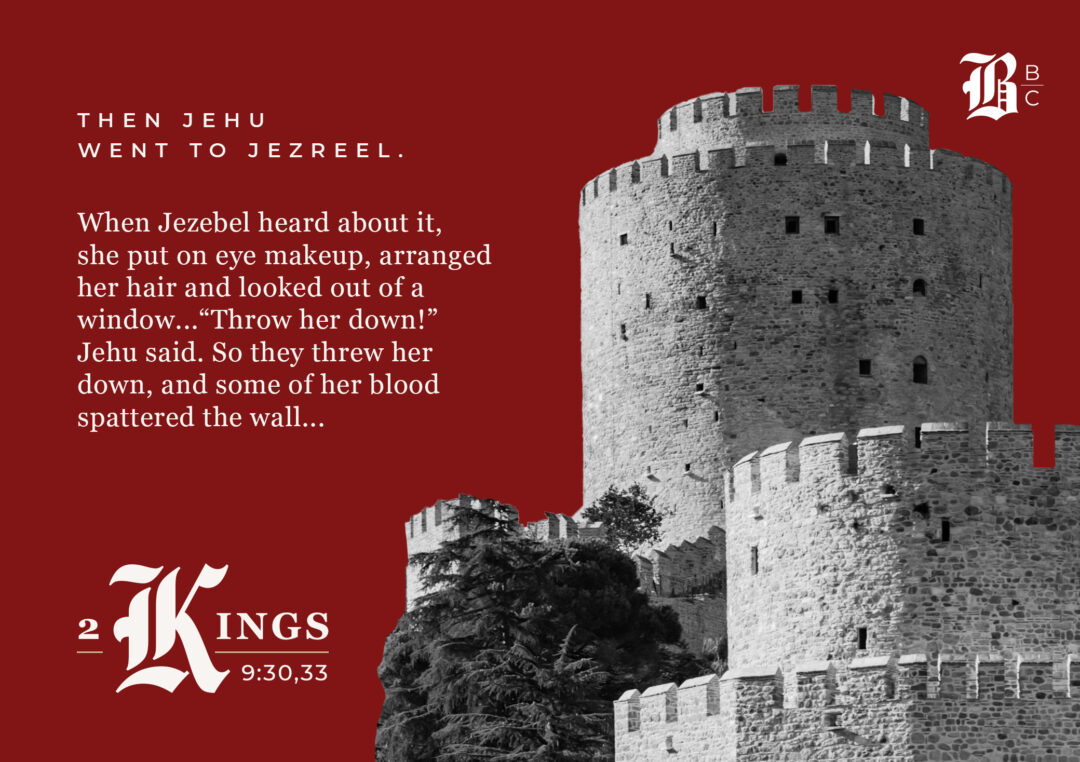
Jezebel’s death in 2 Kings 9:30-33 could be straight out of a movie script. She hears Jehu is on his way so she gets up, puts on her makeup, and styles her hair.
Some things never change. Jezebel was an influencer almost 3,000 years before influencers were a thing.
We discussed in 1 Kings, Episode 12 of the Bible Book Club Podcast how she influenced the entire nation of Israel into Baal worship. In fact, she gained such a large following that the people allowed her to get away with killing the prophets and priests of God.
Jehu is not a follower. He ignores her sarcastic question about whether he came in peace or not and speaks directly to her servants. He tells them to throw her down, and they obey.
Jezebel, the wicked queen of the north, is dead.
Jezebel’s Final Scene
People with influence have power. They can use that gift of influence for evil or for good. Jezebel used her influence and now Jehu uses his.
Both of them influenced people through intimidation and fear. Fear does not breed loyalty, so the servants quickly abandon Jezebel and follow Jehu.
If you are an influencer, think about where you are leading people. If you follow influencers, where are they leading you?
For Jezebel, the game of influencing is over, and she knows it. But if Jezebel is going to die she wants to look sensational. She will make a splash and, in this case, it is quite literally a bloody splash.
Her death was good news for Israel. She was the wickedest queen that ever was and the opening song of the musical Wicked says it best…no one mourns the wicked. Unlike Elphaba in Wicked, there is no backstory of redemption and transformation for Jezebel.
In 2 Kings 9:34-37, Jehu decides to honor Jezebel for being the daughter of a king. After all, she was a Phoenician princess and the daughter of the king of Sidon.
But the soldiers cannot find much of Jezebel to bury. This fulfills the prophecy about her death in 1 Kings 21:23 which says dogs will devour her by the wall of Jezreel.
That is exactly what happens. The death of this violent, wicked queen is the stuff of movies and no one mourns her.
God’s Instrument, Not God’s Servant
Jehu is not done with the wicked. He is going to continue his killing spree fulfilling God’s plan of judgment on the house of Omri and Ahab.
Naturally, knowing he is doing God’s work against evil, we want to champion him. But don’t be misled. Check our chart of kings printable in the show notes. Jehu is not listed as a good king.
But God can use anyone for his righteous cause. Jehu is an excellent example of this. He does not worship God, but God uses him anyway.
The Art of Annihilation
In 2 Kings 10:1-5, Jehu demands the leaders choose one son to be their king and prepare to defend themselves against him.
They are cornered and afraid, because they know Jehu’s military expertise. Perhaps they’ve even heard that Elisha, God’s representative, anointed Jehu as king. If so, it makes sense why they would readily surrender and fall in with Jehu.
In 2 Kings 10:6-8, Jehu is wickedly clever and kills all 70 of Ahab’s sons at once. That’s a lot of sons, but Ahab most likely had other wives than Jezebel, although it’s hard to imagine her tolerating that. Plus the 70 would have included sons of sons, so lots of grandsons.
They were all in Samaria, the capital. They probably fled there for safety when they heard Joram was dead.
Jehu is a military man whose strategy for a mass execution of the 70 is brilliant. He knows if he isn’t swift the sons will go into hiding, and he will have to spend years hunting them down one by one.
A Gruesome Delivery
Jehu writes a second letter to all of the leading men of the city and demands they cut off each son’s head and bring it to Jezreel, which may have been a country palace.
Every leader was so intimidated by Jehu they fell in and obeyed him, even putting the heads in baskets and delivering them like a gift for the city.
You have to wonder, how did this go down? Was there a procession? Did the grieving family and friends follow? Did anyone mourn? Was there wailing? Or were the families all too afraid to be killed themselves?
And how long did it take? Did they wait until the next day? It would have taken about five hours on horseback to get to Jezreel. A cart would take longer.
Who had the horrifying task of identifying and doing an inventory to make sure the head of every son of the wicked Ahab was accounted for?
The Master Manipulator
Next, Jehu rallies the people to his cause with a religious crusade and kills anyone associated with Ahab. Jehu begins his strategy to politically manipulate the people in 2 Kings 10:9-10, and he is a smooth operator. He confesses to killing Joram and says it’s all his fault.
Then he justifies his actions by pointing out all Israel’s leaders killed Ahab’s sons. The evidence of their collaboration is the 70 bloody heads piled up by the city gates for all to see.
So it looks like all the leaders support Jehu and every leader is in accord with him. The reality is they were forced.
The Jehu Dilemma
If you are conflicted about whether or not to like Jehu, you are not alone. There is tension in this story.
One struggle is finding peace with sin and violence as part of the judgement process. Jehu’s actions were part of God’s plan to bring judgement to the house of Ahab for their idolatry and wickedness, but the method was not.
God had specifically anointed Jehu through the prophet Elisha to carry out this mission. Jehu’s task was to eliminate Ahab’s descendants and end Baal worship in Israel, which he did.
However, Jehu’s methods were violent and deceptive. Jehu was used by God to achieve a specific purpose, but his methods and motives were not righteous. Jehu’s personal ambition and violence reveal the dark side of his character.
This can make us uneasy. It is disturbing. How can God allow such sin in conjunction with His plans?
One thing to note is that God uses evil people to bring about His plans. So we must focus on the plan without being reconciled to the process.
There will be sin, evil, corruption, and hurt until Christ returns. But Christ will return. As it says in Isaiah 65:17-19 and Revelations 21:1-4, when He does there will be a new heaven and earth. And that is our hope.
When we are burdened by the suffering around us, we must remember God has a plan. Even though we cannot always see Him moving behind the scenes, He has ultimate control.
Jehu’s Power Grab
Jehu has snuffed out the competition, manipulated the leaders, and won over the people. But he is not done.
He wants to add to God’s plan, so he continues to paint the town red with blood. First, with the blood of everyone associated with Ahab in Jezreel. Then, everyone in Samaria.
In 2 Kings 10:11-14, Jehu kills Ahab’s chief men, which probably included all those leaders who killed Ahab’s sons and promised to submit to Jehu, only to be killed themselves anyway.
The verses also say he killed Ahab’s close friends. How close is close? He also killed the priests, which we can assume would have all been Baal priests at least.
Jehu killed relatives of King Ahaziah of Judah and the 42 people who were with them. They were trying to visit the families of the king and queen mother, so they were assumed to be either friends or relatives of Queen Athaliah of Judah, the daughter of Ahab.
Has Jehu gone too far? Was he now killing just to ensure there was no opposition to himself as the new king? Yes and yes.
Jehu’s destruction of life exceeded what God had commanded. His zeal for carrying out God’s judgement was mixed with his personal ambition and desire for power.
This is a lesson for us to ponder. This story teaches us we must do God’s work, God’s way, and always with a pure heart. Like King David, we must be people after God’s own heart.
Jehu did it his way, not God’s way. Methods and motives matter!
The Jehonadab Exception
Jehu did not kill Jehonadab in 2 Kings 10:15-17 and there is little to no explanation why except that the house of Rechab belonged to the Kenites. The Kenites had traveled with the nomadic Israelites of Exodus and were on very friendly terms.
Moses’ wife and father-in-law Jethro were Kenites. Jael who killed the evil Sisera with a tent peg was also a Kenite.
Jehonadab was considered a strong leader of character. His rule of life was strict.
The Rechabites lived in tents, never entered cities, and abstained from wine. It’s possible they were metal workers, which were important in the crafting of chariots.
Surely Jehu who took Jehonadab up in his latest ride was interested in chariots. Jehu is always a man with a motive.
In 2 Kings 10:16, Jehu says to Jehonadab, “Come with me and see my zeal for the Lord.” This naturally makes us like him a little more.
However, while Jehu’s zeal is clearly against Baal, it is not for the Lord as he declared to Jehonadab. This is most likely another political move. Jehu must get rid of all those loyal to his predecessor Ahab.
Jehu’s Final Deception
Jehu starts his attack on Baal with another manipulative trick. He tells the people he is going to serve Baal with a great sacrifice in 2 Kings 10:18-28. Then he destroys Baal worship in Israel.
This is good news, and we want to cheer. But this is Jehu. His methods in this scene are similar to his methods in the mass killing of Ahab’s sons. He used deception and false pretenses for both.
For the leaders, he threatened and used them to kill all the sons at one time. Now he holds a fake ceremony for the Baal prophets and traps them all at once.
Should he kill in this way or not? That is the conundrum of Jehu. He is extra in his misplaced zeal.
Jehu is a talented man with a gift for saying what people want to hear. He is another influencer in the making, but 2 Kings 10:29-31 make it clear Jehu is not a godly man.
A Tale of Two Hearts
Jehu did wipe out Baal worship, but he didn’t worship God. Like Jeroboam, he went back to another Israel tradition, the worship of golden calves. Again!
He did God’s work and he led Israel, but he did it his way. Jehu’s lukewarm efforts get a lukewarm blessing. The house of Jehu will reign for only four generations. Not forever like David’s.
Note the wording in 2 Kings 10:31. “Yet Jehu was not careful to keep the law of the Lord, the God of Israel, with all his heart.” This reference is a comparison to King David, who made mistakes too, but all his heart was with God.
David was the standard of good to compare all kings to, and Jehu failed the standard because of his heart. Therefore, Jehu is compared to Jeroboam. King Jeroboam was the standard of evil.
The ultimate lesson is that motive matters. Jehu’s zeal is for Jehu and because of that he did what was right in his own eyes, which was evil. What happens next is expected.
Israel Begins to Lose the Promised Land
In 2 Kings 10:32-33, the Hebrew word that’s used for reduce is kah-tsah which means “to cut off.” Israel is being cut off from the Promised Land just as they were warned in Deuteronomy 28 and many other times.
Israel is being uprooted from the land they were promised because they did not follow the Lord. This is where the cutting off begins, as Elijah was told.
First, Hazael, the king of Aram, reduced the land and the people. He took the regions of three tribes: Gad, Reuben, and Manasseh. Now Jehu has carried out the next part of the prophecy.
Finally, in 2 Kings 10:34-36, Jehu rests with his ancestors. Thank goodness!
🎧 Ready to dive deeper? Listen to episodes of the Bible Book Club Podcast here.
Themes of this podcast:
Influence is powerful and dangerous without integrity. Jezebel and Jehu were both powerful influencers who weilded their power through fear, manipulation, and deception. It’s important to consider where we’re leading others and where we’re allowing ourselves to be led.
God uses flawed, even evil people to accomplish His righteous purposes. Jehu was simultaneously doing God’s work to fulfill God’s judgement while also being an ungodly man. His ambition and brutality exceeded what God commanded, which highlights tension between divine justice and human sin.
God cares more about the condition of our hearts than our outward accomplishments. Though Jehu eliminated Baal worship, like Jeroboam before him, he led with compromise because his heart wasn’t fully devoted to God. Jehu’s lukewarm heart led to lukewarm blessings despite his successful completion of God’s mission.
Show notes:

