
Subscribe to BBC on Apple, Spotify , or Amazon.
Miracles that Move Hearts (and Bears)
Miracles were often used as proof to the people so they’d believe in God. These supernatural acts defy the laws of nature and demonstrate God’s greatness, faithfulness, and presence in the lives of the people. In 2 Kings 3 and 4 we get to see a variety of miracles in action.
Miracles in the Bible often include:
- Healing: Such as Jesus healing the sick and raising the dead.
- Nature: Events like parting the Red Sea or Jesus calming the storm.
- Provision: Miraculous supply of food or resources like manna in the desert.
- Judgement: Acts of divine judgement such as plagues of Egypt.
Back in 2 Kings 2, Elisha performed his first three miracles. A nature miracle by parting the Jordan River, a nature/healing miracle with the purification of the water which healed the barrenness, and a judgement miracle with the bear mauling the scoffing mob.
Double the Spirit, Double the Miracles
Elisha’s miracles were documented for a reason. They were proof he did, in fact, received a double portion of Elijah’s spirit as was written in 2 Kings 2:9.
Most commentaries point out Elisha had twice the miracles of Elijah. However, some differ in the exact number. This is likely related to the fact that some miracles are a direct result of the prophet’s actions and others he only predicts will happen.
We see both examples clearly in the plagues of Exodus. In the first plague, Moses took action to initiate the miracle. He struck the Nile River with his staff and the water turned to blood. In the last plague of the the firstborn, Moses predicted the miracle and God struck down all the firstborn sons.
Whatever number you adhere to, Elisha did many more miracles in his ministry than Elijah because he received the double spirit he asked for. Most agree Elisha did anywhere from eight to twelve miracles and Elisha did anywhere from sixteen to thirty two miracles.
Joram’s Half-Hearted Reform
Back in 2 Kings 1, the first verse said Moab rebelled against Israel. Then it quickly moved on to Ahaziah falling through lattice.
Now, finally, we get the rest of the story. As the scene opens in 2 Kings 3:1-3, we are in the Northern Kingdom of Israel. Joram, the second son of Ahab, is king.
Joram does evil in the eyes of the Lord, but at least he isn’t as bad as his parents, Ahab and Jezebel. He gets rid of the sacred stone of Baal, a pillar for idol worship of Baal.
It’s uncertain why he removed it, but it might have been because he was trying to distance himself from his mother and father’s extreme Baal idolatry. This would have been a good move if he then turned to God, but he didn’t.
Instead, he chose to follow the ways of Jeroboam, the first king of Israel. He is the one who began the tradition of idolatry in the Northern Kingdom clear back in 1 Kings when the nation of Israel divided.
After the division, Jeroboam was worried people would go to Judah to worship at the Temple. So, in 1 Kings 12, he set up his own temples, one at Bethel and the other at Dan, and made golden calves for the people to worship.
We Keep Falling for the Golden Calf
All these years later, Joram chose to lead the people away from Baal and back to the golden calves. These golden calf idols just won’t go away.
The tradition dates all the way back to the beginning of the nation of Israel at Mount Sinai. Remember when Moses came down with the Ten Commandments and found the people in crazy calf worship?
It’s a trend, a temptation, a vintage vibe that keeps cycling back. It was also a sin and a break in the commandments.
We may never know why this particular idol was so popular. It seems so obvious and ridiculous today.
But isn’t it just like so many popular idols we have now? It’s easy, in hindsight, to see they are harmful. Yet we are blinded to the truth in the moment.
The greatest idols of our time include anything that is above our relationship with God. Money and materialism, success and career, technology and entertainment, self and personal image, relationships and sexual pleasures.
These idols can be super sneaky and can suck the very life out of us because they steal our time and draw our focus away from God.
Family Drama, Foreign Wars, and a Sheep Tax
Mesha, the king of Moab, was subject to King Ahab. This meant he was a vassal or subordinate ruler and had to pay tribute to Ahab. In 2 Kings 3:4-8, the tribute he paid was in sheep.
But now Ahab is dead. Moab wants his independence, and he’s willing to fight for it. So Joram prepares for battle and reactivates his father’s relationship with Jehoshaphat, king of Judah in the south, asking him to join them in battle.
Jehoshaphat really doesn’t have much choice in the matter, because he made the strategic mistake of marrying his son to Ahab’s daughter Athaliah. How can he refuse to support his daughter-in-law’s brother Joram?
Jehoshaphat is a good king in Judah but clearly lacks discernment when he aligns himself with such an evil family. Now he’s in an awkward, dangerous situation.
Elisha Enters the Battle…Sort Of
In 2 Kings 3:9-11, the armies are marching and run out of water. Jehoshaphat asks if there is a prophet of the Lord they can inquire of.
This is the second time he’s asked this same question. The first time was in the last episode of season 11 of the Bible Book Club Podcast when he asked Ahab for a real prophet to advise them. At that time, Ahab called Michiah.
Jehoshaphat gets an A+ for his devotion to consult God about these battles. Perhaps if he’d consulted God about marriages he wouldn’t have married his son into this wicked family, and he wouldn’t be in this war in the first place. The more we seek to do God’s will, the better our life will be.
So in 2 Kings 3:11-12, Joram does what Jehoshaphat asks and seeks a word from the prophet Elisha. Their rationale is amusing. If you are out of water, call the prophet who used to pour water for Elijah.
From Harp Strings to Battle Cries
At first, in 2 Kings 3:13-20, Elisha doesn’t want anything to do with these three kings. Eventually, because of his respect for Jehoshaphat the good king of Judah, he relents.
Elisha begins with a request for a harpist. Music is a wonderful form of worship.
It’s also a beautiful way to calm and redirect our thoughts to God, especially when we’re under pressure or gripped with fear. Elisha was under pressure and probably conflicted because, while he would like to honor Jehoshaphat, he has no respect for Joram.
The word Elisha receives is promising. God will do a miracle and provide water as He did so many times before for the Israelites in the book of Exodus when they were wandering in the wilderness. God will deliver Moab, and Israel and Judah will be victorious over them.
The defeat of the Moabites in 2 Kings 3:21-27 is interesting. Not only did God provide the water for the armies of Israel, Judah, and Edom, but he also turned the water into a trick by turning it red.
The Moabites interpreted the red water as blood from an internal battle between the three kings and thought they had an easy road to victory. But that was not the case. The Israelites and allies were ready and defeated the Moabites.
The king of Moab foolishly sacrificed his son to appease their angry god Chemosh. Human sacrifice was a known practice for the Moabites.
God Sees the Forgotten: 2 Kings 4
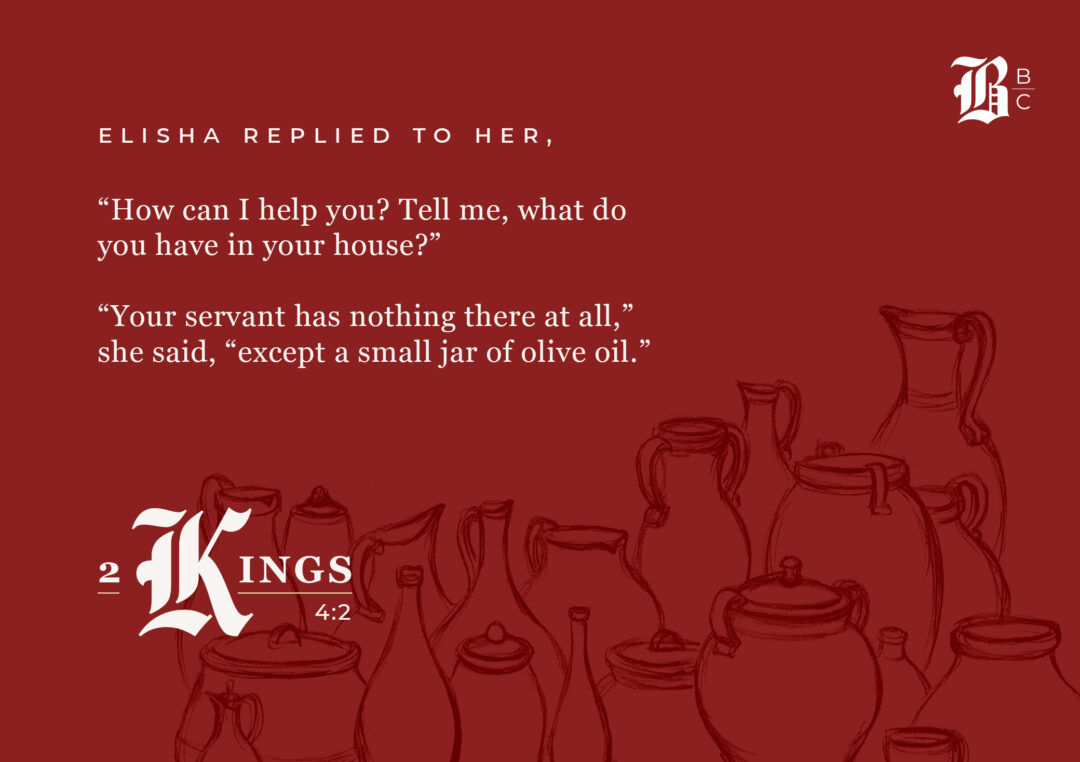
We switch gears a bit and in 2 Kings 4:1-7 the widow of a prophet is left destitute and cannot pay her bills. Her creditors are going to take her sons as slaves, which would make her totally destitute and alone.
This type of enforced slavery for defaulting debtors was common at the time, and it was especially risky for widows. Women relied on their husbands for provision, and widows relied on their sons.
This widow lost her husband and now may lose her sons. Her husband served as God’s prophet, and yet it seems God has abandoned her. She is frustrated.
Still, in her frustration, she does not abandon her faith. Instead, she cries out to Elisha, a lifeline to God.
Elisha’s reaction to the woman is very different from his reaction to Joram. He reads her heart and sees her devotion to God. He proves God cares for her by coming to her aid.
This is symbolic of the access we have to Christ. He sees our heart and our needs, and He cares.
Elisha frees this widow from debt by providing olive oil for her to sell. It’s a replica of Elijah’s miracle in 1 Kings 17 when Elijah helps the widow in Zarephath. These miracles are examples of God’s provision and care for the destitute.
Both women are widows and have sons who are at risk, one of starvation and the other of slavery. In both stories, the sons are saved with a miracle of provision. One of flour and oil for food. The other of oil to sell for money to pay debts.
This image is often replicated in the Bible. Someone has little and God uses what little they have to make more. The lesson for us is that God can take what little we have to offer and make it more.
The Woman Who Made Room for God
Think about the infertility stories we’ve heard in our journey so far.
- Sarah in Genesis 11
- Rebekah in Genesis 25
- Rachel in Genesis 29
- Samson’s mom in Judges 13
- Hannah in 1 Samuel 1
- And now the Shunammite woman in 2 Kings 4:8-17
This story is a little different than the others though, because in the other stories the child born has a very specific purpose. In this story, the focus is not on the child but on the woman.
We know nothing about the child, but we do have insight into the woman’s life. She lives in Shunam, a village in the territory of the Tribe of Issachar in northern Israel. She and her husband are wealthy and childless but not bitter.
This woman has the gift of hospitality and opens her doors to others. She also has the gift of spiritual discernment and recognizes Elisha is a holy man of God. Her love for God compels her to provide generously for Elisha with his very own guest suite.
Elisha is so overwhelmed with gratitude that he wants to give her something in return. But what do you give a woman who has everything? The child she never had.
The purpose of this gift is simple. It is a gift of love. A gift of Elisha’s gratitude to a woman who uses her gifts to help him.
The woman delighted Elisha with comfort from his work. He delighted her with a miracle from God to comfort her in her old age.
From Grief to Glory
When the woman’s son dies in 2 Kings 4:18-37, she does not hesitate. She knows exactly what to do. She places the boy on Elisha’s bed and goes to find him.
The woman may have lost her child, but she has not lost her faith. God gave her this boy through Elisha and God can give him back through Elisha.
Elisha’s servant Gehazi sees her first and asks if everything is okay. She replies all is well but the commentaries all think she said this to get to Elisha faster.
Perhaps she’s using her spiritual discernment and senses something about Gehazi she doesn’t trust. Spoiler alert, she’s right. There is something there.
Elijah wants to send Gehazi to conduct the miracle, but the woman will not relent. Her spiritual instincts are telling her she needs Elisha, and she refuses to leave without him. So he goes with her and performs almost the exact same miracle as Elijah in 1 Kings 17.
Just as Elijah saved the widow of Zarephath’s son, so Elisha saves the Shunammite’s son. Elisha is now among the powerful few who restored life in the Bible. The first of whom was Elijah.
God Saves the Soup
In 2 Kings 4:38-41, Elisha miraculously saves the soup. This miracle may seem insignificant. However, it would have been memorable to these prophets at the time.
You see, they are more than just a little hangry. There is famine in the region.
This means everyone is always hanging on the edge of hunger. As men of God, they may have been self-sacrificing more food than others for the good of the poor they served.
So, to have a steamy meal set before you, the savory aroma making your mouth water and your stomach rumble, then realizing the stew would be wasted, thrown out, taken without a replacement, was painful.
God moved Elijah to demonstrate his care for these hungry servants. He purified the stew.
It was a miracle of provision that encouraged them to believe God cared about them and could be trusted to provide. A miracle that offered a visual, experiential memory to build their faith.
Reflection Point
What has God done in your life to build your faith? Gather those memories. They are building blocks that form a foundation for the faith God knows you will need for whatever purpose he has in store for your time on earth. Without them, you may be on shaky ground.
Then ponder how you can use your stories of God’s work in your life to build the faith of others. As those prophets got older, they surely sat around with the younger prophets at their feet and told the story of how God saved the soup.
Faith in a Faithless Land
There is a Hebrew hint in the opening of 2 Kings 4:42-44 that magnifies this scene’s importance. The man was from Baal Shalishah, and the name of this town is telling. The town is in Israel but has the name Baal in it.
Normally, the first fruits of the harvest were to go to the priests. So, in bringing it to Elisha instead of the priests, the man is making a statement.
The priests are not worshiping God. Elijah is the one representative of God. Therefore, the first fruits go to him.
There is a message of hope in this story. The hope is that there is always a remnant of believers.
A man from a Baalish town still holds a candle for the one true God and acts on it by honoring his one true representative left in Israel. God takes this little offering and makes it into more.
This miracle of the feeding of the 100 is just a taste of what is to come in the New Testament, because anything man can do Jesus can do better. Elisha fed 100. Jesus will feed 5,000 in Matthew 14 and 4,000 in Matthew 15.
🎧 Ready to dive deeper? Listen to episodes of the Bible Book Club Podcast here.
Themes of this podcast:
Miracles are more than magic. They’re messages. Each miracle Elisha performs is more than just a display of supernatural power. These miracles reveal God’s character. His provision for the widow, justice in Bethel, and compassion for the Shunammite woman. They’re reminders God’s power is personal and purposeful.
Faithful obedience leaves a legacy. From the man who brought first fruits in a land named after Baal, to the Shunammite woman who made space for God, we see how small acts of obedience can ripple into miraculous impact. Even in a faithless land, God honors those who remain faithful.
God cares about the big and the small. Whether it’s a battle for survival in the desert or a pot of spoiled soup, God shows up. This episode reminds us that He sees our crises and our daily needs, and He moves to meet them both in love and power.
