
Subscribe to BBC on Apple, Spotify , or Amazon.
One Family, One Nation, One Promise
As we begin 2 Kings 1, we are right in the middle of the story of Israel’s kings. This is the beginning of the second part of the story.
But this story is really part of a much larger narrative. It is a story that began in Genesis with Abraham when God chose a family.
It continues in Exodus with Moses where God made Abraham’s family into a nation called Israel. The story goes on in Joshua where God gives the nation of Israel a Promised Land.
In a perfect world, that should have been a good thing. However, when the story continued in Judges 21: 25, Israel had no king and everyone did what was right in their own eyes.
So, in 1 and 2 Samuel God gave Israel two kings. Saul came first and was a bad example of a king. David followed and he was a good king with a heart for the Lord. David was from the tribe of Judah.
That catches us up to where we are now in 1 and 2 Kings with the history of all the kings who came after David. It’s been a walk through their failure to be faithful to God.
Ultimately, it will become obvious from the repetitive failings of the kings that no human king will ever suffice. Humanity needs a savior king, and that king must come from the family of Abraham, the nation of Israel, the tribe of Judah, and the kingly line of David.
We are way deep into the history of Israel now. Congratulations if you are hanging with us on this long and complicated journey. You will not regret it!
A Nations Slow Drift to Exile
The second book of Kings tells the story of all of Israel’s kings from David until the Israelites are carried into captivity due to their disobedience and idolatry. With each king, the question is answered, who will they be like…Saul or David? Disobedient or obedient? With a heart of pride or a heart for the Lord?
The story of these kings covers a 400 year period. The commentaries agree the books were written by someone in exile. This is someone who was pondering what happened, asking how they went from the prosperity of the Promised Land during Joshua’s era to exile. When and why did it go so wrong?
The author of Kings is looking back and wants the people to understand the reason for their exile is their stubborn persistence in breaking their covenant with God. The author wants to make sure they learn the lesson that rebellion and unfaithfulness lead to exile.
He wants the people to understand the covenant with God is about relationship with God. That’s what’s at the core of all the covenants. But Israel rejected the covenants and rebelled against God, which moved them further and further away from God until they landed in exile.
Fire Falls Again, a Harsh Reminder to Ahaziah
When we left Israel in 1 Kings, the evil Ahab, king of Israel and the Northern Kingdom had died. Ahab was the son of Omri, the man who began this evil dynasty.
Ahab was famous for creating Samaria as the new capital of Israel. They had economic prosperity, political power, and Baal worship, promoted by Jezebel, Ahab’s formidable wife.
It’s important to remember Baal worship suffered a major defeat when Elijah challenged them to a face-off. It was 450 Baal prophets versus one, Elijah. The 450 could not seem to wake up Baal and produce the necessary fire to burn the sacrifice they were offering.
Elijah doused his sacrifice with water and called on God. Fire fell with such heat it burned up the sacrifice, the water, wood, and even the stone. God won the face-off and Elijah proved his God was the one true God. The 450 Baal prophets were killed.
We don’t have exact dates for when this face-off occured. Ahab was king and witnessed the fire firsthand. Was his son Ahaziah in attendance? We don’t know for sure, but he must have heard the story.
In this chapter, Ahaziah is now king, but he is no better than his father. And, once again, fire will fall as a poignant reminder of who is God and who is not.
Ancient Battles, Modern Discoveries: 2 Kings 1
We begin 2 Kings 1:1 with a foreboding shadow cast on the near future with a mention of Moab’s rebellion. Moab had been subjected by David in 2 Samuel 8.
After the kingdom split, Omri again attacked Moab and oppressed them. The king of Moab probably heard of Ahab’s death in the battle against the Arameans in our last article in 1 Kings and seized his chance to rebel.
In a future chapter, Moab and Israel will face off in a battle. Interestingly, a record of this battle was found in 1868 on a black basalt stone called the Moabite stone or Mesha Stele. The inscription details King Mesha’s victory over Israel and gives their god Chemosh credit for the victory. How fascinating to have a non-Biblical record of their conflicts with Israel.
In 2 Kings 1:2, Ahaziah falls and must have internal injuries because he is suffering so much he fears he might die. With zero faith in the one true God, he turns to the god of the Ekron, named Baal-Zebub.
When the King of Israel Turns to the Gods of His Enemies
The Baal prefix is telling. Ahaziah has adopted his parent’s faith. The legacy of Ahab and Jezebel lives on.
Ekron is one of the five capital cities of the Philistines. The Philistines have been around since the book of Genesis and have been enemies of Israel since before Samson in the book of Judges.
Ekron was located in the territory given to the tribe of Judah in the book of Joshua 15. Judah fought and took the territory but never really rid the land of all the Philistines, so they became a thorn to Judah.
In 1 Samuel, the Philistines captured the Ark and it rotated through the Philistine capitals including Ekron. In 1 Samuel 17, after David killed the Philistine Goliath, the Israelites pursued the Philistines all the way to the gates of Ekron.
The Philistines are enemies, so why would the King of Israel ever go to the Philistines to consult their god? There is only one reason. Ahaziah doesn’t believe in the one true God.
He likes god options no matter where they come from. What better option than a god who may have been known for his healing qualities?
Reflection Point
Why would we go to anyone but God for anything? Do we or don’t we trust that He has the answers even when we can’t see the plan?
If we decide to do our own thing, because waiting on God means taking no action and that’s hard, are we not like every other Israelite who “did what was right in their own eyes?”
Elijah Stands Firm While Kings Fall
The theme that began in Judges which was “Israel had no king and everyone did what was right in their own eyes” has been modified. Now Israel has a king, and every king is doing what is right in their own eyes.
Israel’s faith has fallen further and further from God, with the kings they wanted so badly leading the way. And the Lord is angry. How long will Israel’s kings break the first commandment of the Covenant God clearly outlined in Exodus 20?
In fact, God is so angry he cuts Ahaziah’s messengers off before they even get to Ekron in 2 Kings 1:3-4. The angel of the Lord goes straight to Elijah who, once again, demonstrates his willing obedience and goes without question.
There seems to be a correlation between a willingness to obey and effectiveness for the Lord. The more we obey, the more useful we become in furthering God’s kingdom. Elijah’s willing obedience has made him a powerful voice for God.
The king’s messengers must have had an encounter with Elijah and returned too quickly because, in 2 Kings 1:5-8, Ahaziah wants to know why they’re back. Their simple description of the prophet’s attire is all Ahaziah needs to identify that the man who spoke to his messengers is none other than his parents’ arch nemesis, Elijah.
Two Prophets, Same Bold Spirit
Elijah is often compared to John the Baptist for several reasons. First, they have the same style, fur and leather. Matthew describes John the Baptist in Matthew 3.
Second, they both boldly confront the political and religious authorities of their time. Elijah challenges Ahab and the prophets of Baal. John the Baptist challenges Herod Antipas and the Pharisees and Sadducees.
The last reason they are often compared is because in Malachi 4:5 Malachi prophecies that Elijah will return. Then in Luke 1:11-17 an Angel of the Lord appeared to John the Baptist’s father Zechariah and identified John as the fulfillment of this prophecy saying John will go before the Lord “in the spirit and power of Elijah.
You Can’t Bully a Prophet
The Lord prevented King Ahaziah from seeking the counsel of Baal-Zebub, and now the king is mad because Elijah said he will die. Ahaziah must speak to Elijah, because he thinks Elijah has the power to reverse the prophecy.
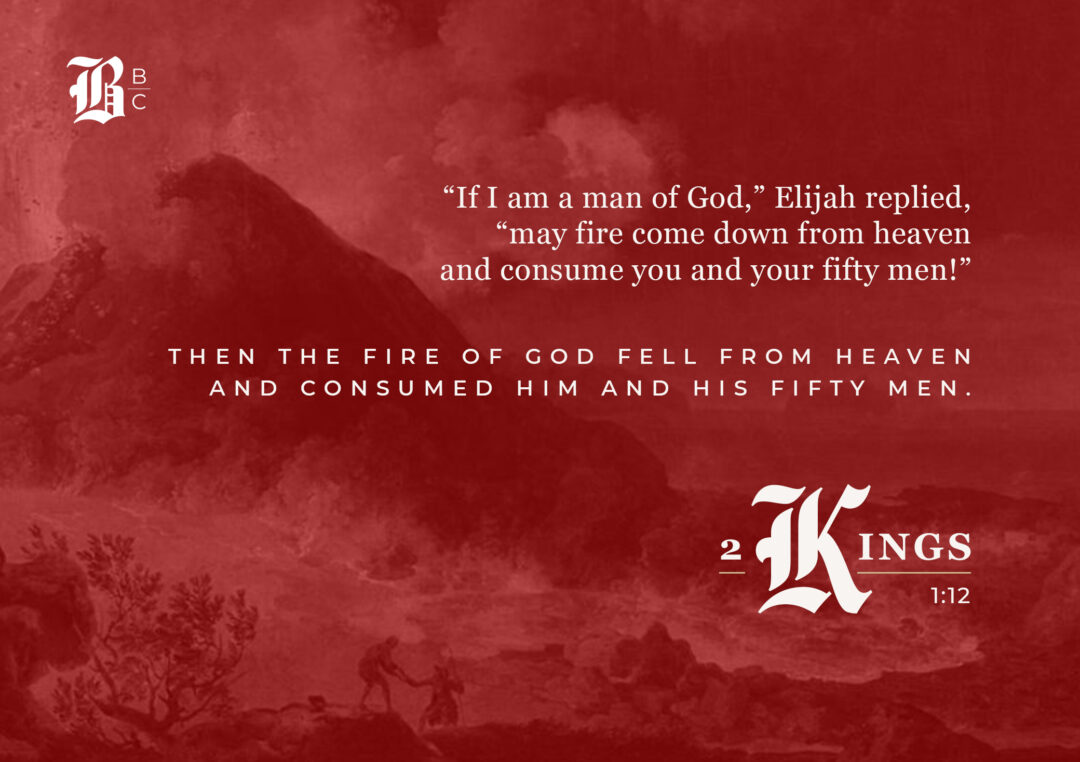
So in 2 Kings 1:9-12 the king sends two companies of 50 soldiers to capture Elijah and bring him back so the king can coerce him to change his prophecy. If Elijah doesn’t cooperate, the king will likely kill him. This isn’t too surprising when we remember Ahaziah’s mother is Jezebel, the killer queen.
However, both times Ahaziah sends these men to demand Elijah come with them, fire falls on their units killing them all before they can kill Elijah. The king had not sent these soldiers as an act of hospitality. It was an act of hostility, and that’s why God responded with fire.
When Warnings Go Up in Flames
This was Ahaziah’s chance to realize his mistake. He could have recognized Elijah’s interference with his messengers as the red flag it was and changed his ways, but he didn’t. God mercifully gave Ahaziah fiery roadblocks, but he ignored them.
Ahaziah’s father must have told him the story of the fire at Mount Carmel. It happened only a few years earlier and 450 Baal prophets were killed. It was legendary.
His mother, Jezebel, probably ranted about it for months. They were her prophets that died, and it was all because of this same prophet Elijah.
It was Elijah who called for fire at Mount Carmel to prove God was the one true God. And it is Elijah who calls for fire on the soldiers to prove he is a man of God and God’s word is true. So this fire God sent was a very obvious sign Ahaziah should have recognized.
God gave King Ahaziah every chance to make better choices, so he has no excuses. He should know God is the only true God, and now he should know God and His Word are true. That means he knows he is going to die.
Stubborn Hearts Miss God’s Mercy
Unfortunately, Ahaziah is blind to the truth. He is stubborn like Pharaoh from Exodus. The king ignores the burning signs and sends another 50 soldiers in 2 Kings 1:13-15.
The poor captain and 50 men must have been terrified to face the fire. And poor Elijah. This is not the first time he has had to fear for his life. He has been hiding from Jezebel for years.
Fortunately for the 50 men, they have a wise captain who chooses a posture of humility, and God listens. God is merciful and honors a right heart.
And lucky for Elijah he has a resident Angel of the Lord to tell him when to make a move. This time it was safe, and off to the king he goes. No questions.
When he gets to the king in 2 Kings 1:16-17, Elijah repeats exactly what he said to the first of the king’s messengers. Because the king tried to consult with Baal-Zebub, he will certainly die.
And he did. Just like that, King Ahaziah died.
Elijah’s Secret: Speak Less, Obey More
Elijah is so interesting. He never says too much. Remember how abrupt he was in Elisha’s call? He walked up to Elisha and didn’t say a word. He just threw his mantle on Elisha. Then he spoke eight words and walked away.
Maybe that is another key to Elijah’s success. He simply obeys and repeats God’s words. He speaks only what the Lord speaks to him.
Such a simple plan to follow…or is it? Every time he spoke, Elijah aroused anger. Nothing is simple when you are afraid, and Elijah expressed fear several times.
God sees our fears. He wants us to see His protection. God wants us to trust and obey just like Elijah.
Our willingness to obey God has to be stronger than our fear of man, because in our culture what we say may arouse anger. If we allow fear to have power over us, we will not take action for God.
The key for us is to obey and speak God’s Word. But to speak God’s Word we must know God’s Word. To know God’s Word, we must read it, or listen to our Bible Book Club Podcast and Heather will read it to you!
It’s Not About Ahaziah
In 2 Kings 1:17-18, the story moves on. Not much is said about Ahaziah’s short reign for a reason. This story is not really about Ahaziah, it’s about God. Ahaziah did not seek God in his suffering, because he didn’t believe in the one true God.
God mercifully gave Ahaziah every chance to see the truth. In the end, the one true God was true to His Word, but Ahaziah was no longer alive to see it.
Ahaziah was an evil king just like his father Ahab. He only reigned two years before he died. He was succeeded by his brother Joram who was the last king of the Omri dynasty.
🎧 Ready to dive deeper? Listen to episodes of the Bible Book Club Podcast here.
Themes of this podcast:
The promise of God’s covenant amid human failure. From Abraham to the kings of Israel, this story reveals how God’s unchanging covenant holds steady—even when human leaders repeatedly fail. No human king or leader could ever fully fulfill God’s promises. Only the Savior King, Jesus, could bring true faithfulness and hope.
The danger of doing “what is right in our own eyes.” Israel’s history shows the tragic results when people, even kings, reject God’s authority and live by their own rules. This ongoing rebellion leads to exile and broken relationship with God. It’s a stark warning for us today to seek God’s will rather than rely on our own understanding.
God’s mercy and faithfulness despite our stubbornness. Through Elijah’s fiery interventions and persistent obedience, we see God’s patience and power in action, even when kings like Ahaziah refuse to listen. God continually offers chances to turn back, but also honors His Word.
