Subscribe to BBC on Apple, Spotify , or Amazon
Who was Canaan in the Bible?
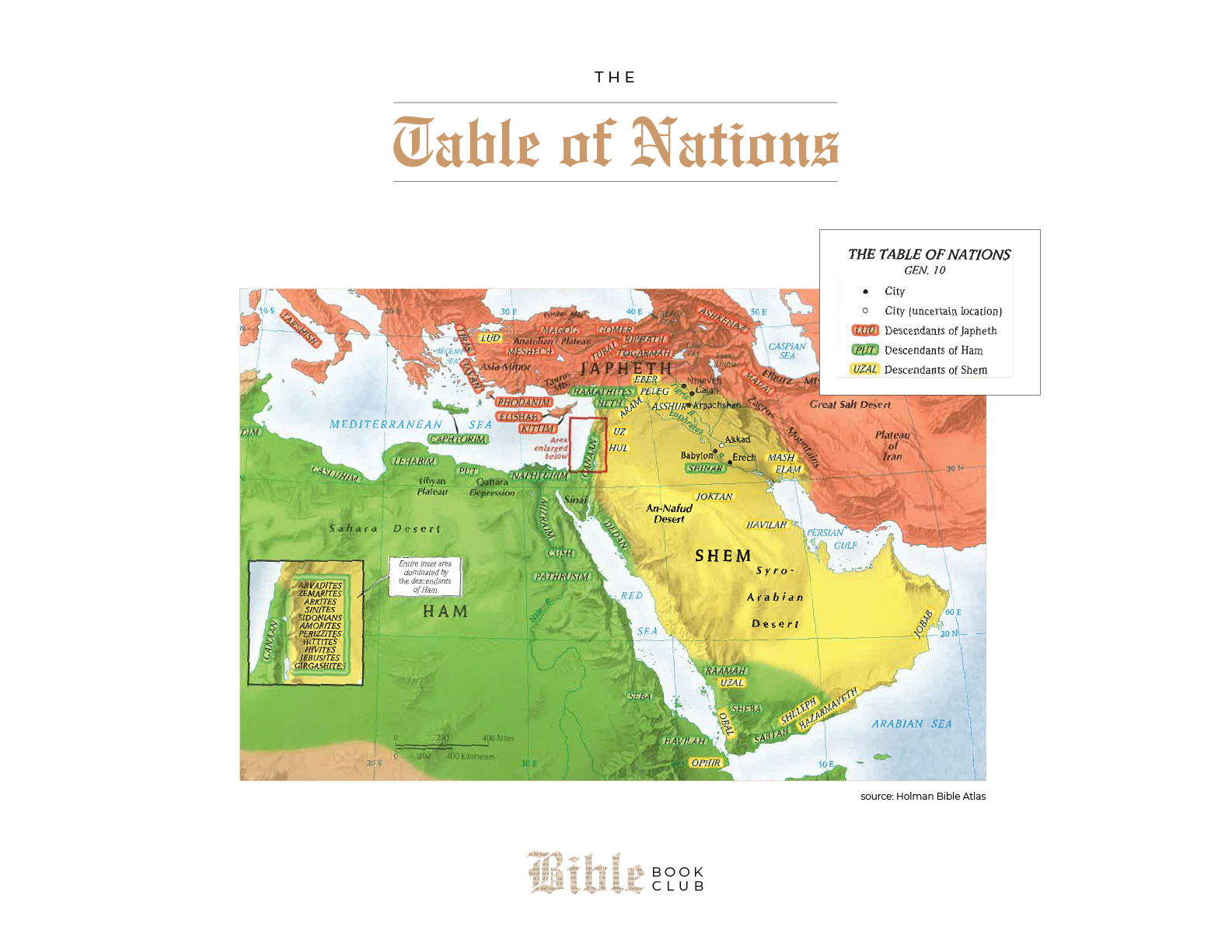
As we wrap up chapter 5 and head into Joshua chapter 6, the Israelites are about to conquer Jericho in the land of Canaan. The people of Canaan descended from Noah’s son Ham. He and his brother Japheth form the two Non-Semetic branches of Noah’s family. Noah’s son Shem forms the Semitic branch which carries the promised seed of Christ.
- Ham’s descendants (the Hamites) became 30 nations who had control of Canaan and spread south and east into Egypt and Africa with traces in southeast Arabia along the coast.
- Japheth’s descendants (the Japhethites) became 14 nations. They spread northwest of Canaan including Asia, Europe, and eventually America. Japheth’s line disappears in the Old Testament then reappears in the New Testament when Greece and Rome play a large role.
- Shem’s descendants (the Semites or Semitic line) became 26 nations. This line includes the Israelites who carry the promised seed that eventually leads to Christ, but it also includes many people who don’t. They spread into Persia, Mesopotamia (where Abraham came from), Northern Assyria, Palestine, Jordan, and Arabia.
We have met some of the people from Shem on our journey to the Promised Land because God forbids Israel to fight with them. This includes the Moabites (descendants from Lot), the Ecomites (descendants from Esau), and the Midianites (descendants from Abraham through his wife Ketura).
Today, people from the Semetic line include the Jews, Arabs, Assyrians, and Samaritans. You may have heard the term anti-Semetism.
The Conquest of Canaan Begins
In Joshua 5:13-15 Joshua has a conversation with a mysterious stranger. There is no background here, so it’s hard to guess the setting of this conversation. It says Joshua is outside Jericho but where exactly? Why isn’t anyone with him? He is the leader of a nation in enemy territory. Do they really let him walk around alone?
Joshua is wearing sandals and surely his tent doesn’t qualify as holy ground, so he must have be outside. He clearly doesn’t have a weapon with him or he would have instinctively drawn it in response, so he’s not outside the camp. The stranger must be very stealthy, because Joshua is a veteran warrior who wouldn’t startle easily.
Can’t you just imagine the wheels turning in Joshua’s head as he talks to this mysterious stranger? He’s got to be asking himself, “Who is the commander of the Lord’s army?” His mind must be searching every word in the Book of the Law that he was commanded to meditate on day and night. Then he must search every conversation with Moses for any mention of a heavenly commander, because surely Moses would have mentioned it.
Despite all this, he boldly steps forward, ready to take the stranger with his bare hands. He asks, “Who are you for?”
Identifying the Stranger Joshua Spoke to
Who is this stranger who seems combative with a drawn sword? There are similarities in this story to past mysterious visitations.
- Abraham’s visit from 3 strangers in Genesis 18, one of whom was the Lord
- Jacob’s wrestling with a stranger in Genesis 32, who most likely was the Lord
- Moses’ meeting in a burning bush in Exodus 3, which was the Lord
The stranger commands Joshua with the same words God spoke to Moses at the burning bush: “Take off your sandals, for the place where you are standing is holy ground.” The phrase “holy ground” always indicates God is present and a major event or miracle is about to unfold. For Moses, it was the plagues and the battle with Pharaoh. For Joshua, it will be the battle with the Canaanites.
While God is present, this stranger is not the Lord. He’s an angel. This isn’t our first encounter with a sword-bearing angel, and it won’t be our last.
How are angels described in the Bible?
- Numbers 22 mentions the angel of the Lord. The angel has a drawn sword in his hand and is blocking Balaam and the donkey’s path.
- 1 Chronicles 21 tells the story of David seeing an angel of the Lord with a drawn sword.
- Joshua 5:13-15 describes the angel as a man with a drawn sword in his hand.
The Angels’ Allegiance Is to God Alone
The stranger who speaks to Joshua identifies himself as the commander of the army of the Lord. His only allegiance is to God. In this instance, he will fight for Israel because Israel currently follows God. However, God warns in Deuteronomy that He will treat a disobedient Israel exactly like the Canaanites, removing them from the Land.
While Joshua meets with the Commander of the Lord’s Army, the city of Jericho senses the ominous presence of God and the impending doom. The city is silent. The people freeze, their hearts melting in fear, as everyone waits for the end to draw near.
Joshua 6 Summary
Can Joshua already see Jericho is theirs in Joshua 6:1-2? Remember, two layers of walls still surround the city, and lots of fighting men stand behind those walls. But the fact that God has a direct conversation with Joshua about this battle seems like all the assurance we need. The will have victory.
How many times did Joshua walk around Jericho?
Verses 3-5 in Joshua Chapter 6 give us the plan of sevens: seven priests, seven trumpets, and seven days. For six days they are to march around the city one time. On the seventh day, they are to march around the city seven times.
In Joshua Chapter 6 verses 6-14 Jericho watches from inside the walls as they begin to carry out this plan. How long would it take the entire army to make one loop around the city? It would be a pretty long line of men. They must not have walked too close, or the people of Jericho would have thrown stuff at them.
What are the people of Jericho thinking?
Seven trumpets doesn’t seem too loud or disturbing. When the Israelites leave after the first day, do the people of Jericho celebrate? Do they think the Israelites are giving up because the city is too fortified? What about on the second day? Or the third? Do they think the Israelites are trying to starve them out? The harvest has just ended, so that’s not a good strategy.
And surely merchants from other kingdoms try to approach Jericho during the seven days and, seeing that the city is under siege, leave and spread the news. By the seventh day the area has to be crawling with spies camped out at a distance watching in puzzled amazement. Late comer spies maybe ask others, “So how long have they been doing this? Are you sure it’s the same every day? They just march and go home?”
Perhaps this is God’s plan all along. By the time the walls fall, there will be many witnesses from all over Canaan and beyond with a front row seat to what the Lord’s army can do. Then they will have the opportunity to know and believe He is the One true God.
Why did Joshua walk around Jericho 7 times in Joshua 6:20?
Seven is the number of completeness throughout the Bible with dozens of uses from Genesis to Revelations. The most obvious example is the seven days of creation when God set aside the seventh day as a day of rest. Joshua chapter 6 verses 15-19 mention seven twelve times, which is a sign of completeness and perfection in God’s victory over Jericho. By Joshua 6:20 and 21 the Israelites’ are victorious.
Joshua Chapter 6 Explained
In the book of Joshua, the Jordan River floods and the walls of Jericho collapse. Now, thousands of years later, we are fascinating by the remains of Jericho and how these miracles could have happened. The answer, of course, is God who is the creator and master over creation. But there are theories on how God accomplished these two miracles using nature.
- The Jordan Valley is part of the Great Rift Valley, which is an unstable region with frequent earthquakes. On a number of occasions in recorded history, 1927 being the most recent, earthquakes have dammed the River Jordan in the area of Adam. This is located to the north of where the Israelites crossed the Jordan as we read about in the last chapters.
- Jericho’s ancient wall and defensive tower remain visible today. Evidence indicates an earthquake occurred at the time the city was destroyed, and it’s possible God may have also used seismic activity to dam the river for the Jordan River crossing.
Could it be that, as we read about in Psalm 114, the earth trembles and quakes at the presence of the Lord which dams the Jordan River and fells the walls of Jericho? Did God, the creator of the earth, use one tremor to dam the river and a second to bring down the walls? It is a plausible theory.
What does the term herem mean in Joshua 6:21?
Joshua 6:21 uses the Hebrew word herem which means “devoted” or “dedicated.” But this is another word that carries more meaning than its simple dictionary definition. Herem has different applications depending on the context.
- In herem warfare, everything and everyone in a specific area is “dedicated” for destruction.
- In its extreme form, like with Jericho, herem refers to the total destruction of a city, including its inhabitants, livestock, and possessions. This is typically carried out in cases where the city and its inhabitants are devoted to idolatry and a significant spiritual threat to the Israelites.
- In other instances, herem is a ban placed on certain types of spoils of war. This means that such items are either destroyed or devoted to God for use in the Tabernacle. These devoted things cannot be used personally, which unfortunately is a hard lesson for the Israelites in the next chapter. Why would anyone ever steal from God? He sees everything!
Herem, is a brutal practice, but it was a necessary evil during that period and served the very important purpose of eliminating the risk of Israel falling into the trap of worshipping false gods. Their very survival and possession of the Promised Land depends entirely on obedience to God. The herem ensures they will not fall out of His favor by worshipping Canaanite gods.
However, it’s important to note that the concept of herem is a practice of ancient Israel. Today, Jews are guided by a different set of principles and practices.
🎧 Ready to dive deeper? Listen to this episodes of the Bible Book Club Podcast here.
Next Episode:
Show Notes: